If none of that can be done, you might as well put a single agapanthus in a vase
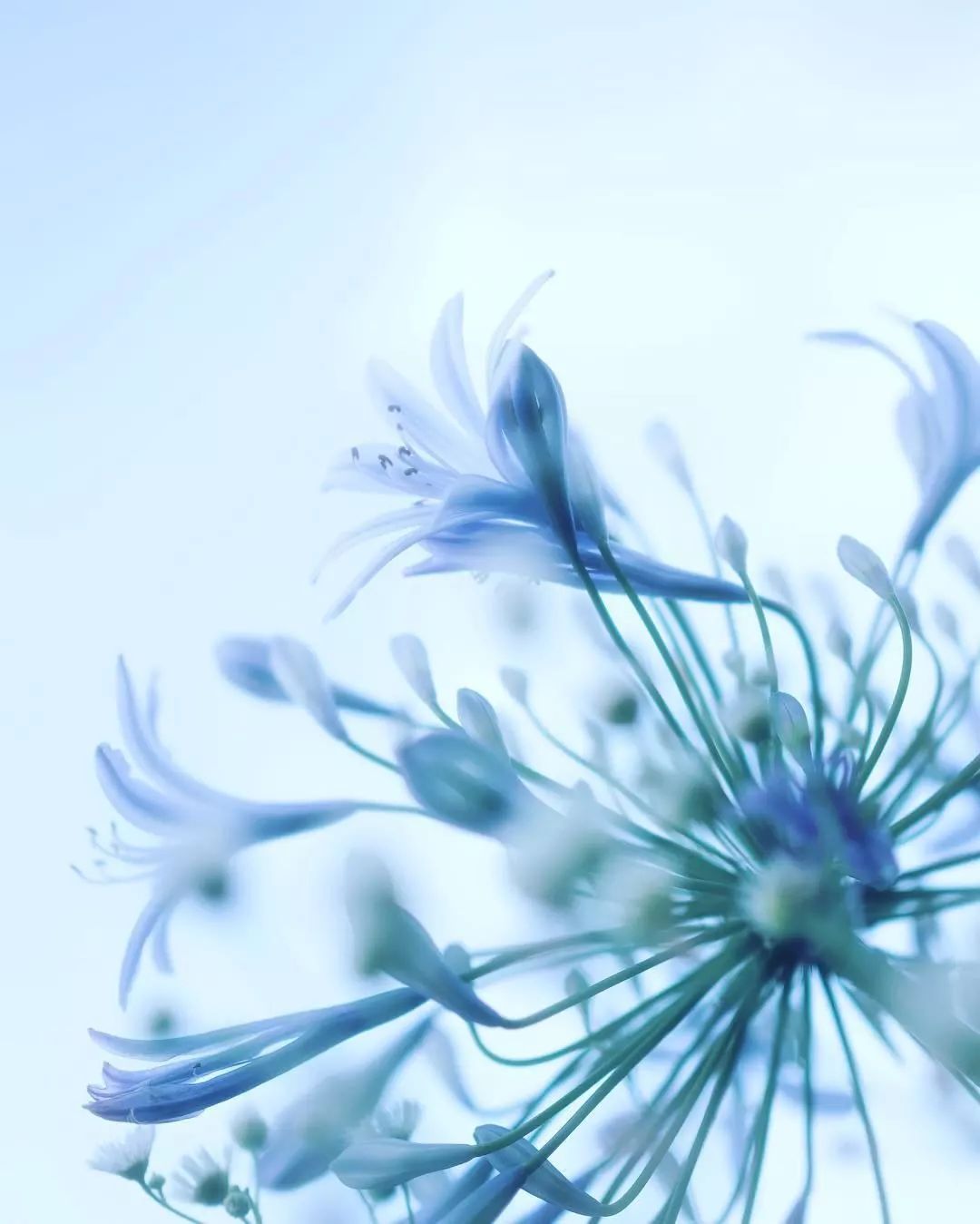
Today is the first day of the sanfu period, the hottest days of summer. Fu means the weather is too hot, so it's best to lie low rather than move around (a perfect excuse for my own laziness).
In this scorching weather, both eyes and body and mind need cooling down. To come up with little tricks for cooling off, Shaoyao has been racking her brains. Not long ago I introduced how to make flower and herb ice cubes, and today I thought of another plant with a cooling effect. Daiyu was the Crimson Pearl Fairy Grass, and this one is the "cooling fairy grass." One look and you feel cool - it's amazing!
This plant comes in the blue-purple range that Shaoyao loves so much, and it is also my favorite this summer. Its ice-cream-like cool hues instantly smooth away the restless heat in your heart, and once your heart is calm, you feel less hot too.
{ Shaoyao Girl Vol.811 }
x
A little coolness for you
"Beyond the mountains, beyond the sea, there lives a group of little blue elves~"
The flower I want to introduce today is the little blue elf of summer. Its name contains the character for lotus, but it has nothing whatsoever to do with water lilies or lotus flowers, and it does not live in water either.Its place of origin is warm South Africa, and it is also known as the African lily.
That's right, what Shaoyao is talking about is the agapanthus~
As soon as the weather turns hot, the agapanthus starts forming buds,
like little tufts tied on a small child's head.
You cannot imagine that inside this little tuft,
so many flowers can actually be hidden.
On the umbel-shaped inflorescence,
gather 10 to 50 flowers.
When a heavy rain comes,
the agapanthus, which looks so delicate, is not afraid,
and covered in water droplets, it actually looks even more enchanting.
Facing the blazing sun of July and August,
the "little trumpets" open completely.
The anthers start out yellow,
and gradually turn black.
Among the blue petals there is a dark vein,
as if soaked in ice water, instantly chilled through.
The agapanthus comes in many colors,
besides the common blue and purple, there is also white.
The white agapanthus is even more elegant,
and that delicate, fragile look makes anyone who sees it fall in love.
In fact, the agapanthus is not as delicate as it looks.It is a perennial herbaceous plant with a very good reblooming habit, and it is not at all fussy.
The agapanthus likes warm, humid environments with plenty of sunlight, because its hometown is around the Cape of Good Hope in South Africa. During the colonial period, the agapanthus was brought to Europe, and from then on it became one of the most common flowers in European gardens.
While taking a walk along the roadside,
you can see agapanthus stretching out their flower heads and peering around.
The low flower walls of agapanthus in the garden
form a blue-purple band, winding and flowing into the distance.
In English-style gardens,
the agapanthus is the most romantic touch.
A few clumps dotted nearby echo a stretch of blue-purple in the distance,
and this is where the soul of the garden lies.
Besides planting it in gardens, Europeans also like to plant it along the coast, where it combines with the sea and the blue sky to form an ocean paradise.
The agapanthus is also deeply loved by European artists. Monet's lifelong favorites were water lilies and agapanthus, and he once painted these two flowers together.
The water lilies sleep in the pond,
while the agapanthus sways quietly on the bank,
sketching out a dreamlike watery scene.
Europeans love the agapanthus so much not only because of its beauty. In their eyes,the agapanthus is a flower that represents love.The English name of the agapanthus is Agapanthus, and in Greek agape means love, so the agapanthus is also called the African love flower.
There are quite a few flowers that represent love, but few are as low-key and free of vulgarity as the agapanthus. Interestingly enough, the reason it is regarded as a flower of love has nothing to do with the flower itself - it is actually because it has so many seeds.
Many seeds mean many blessings, which sounds very "Chinese in character." Perhaps a happy love means having many, many children.
But Shaoyao would rather believe that her flower is also quietly waiting for love. With its light, understated color, neither vulgar nor fawning, it is like a young girl meeting someone for the first time, still innocent of the world's troubles, her eyes full of expectation, standing silently, waiting for love's favor.
It is precisely this fresh, desire-free blue that makes the agapanthus seem even more mysterious and elegant, and this beauty of hers naturally cannot escape the hunter-like eyes of floral designers.
The slender, graceful agapanthus,
with its straight stems and wonderfully beautiful lines,
is an excellent floral material in Chinese-style flower arranging.
The agapanthus that has not yet fully opened,
with its first-love face, has a DNA that goes with everything.
When paired with cool-toned flowers such as white and green,
it brings a rush of refreshing coolness.
When placed together with deep-toned colors such as pink and purple,
it is the most elegant touch of blue in the bouquet.
Shaoyao loves this kind of flower with a strong sense of line, because it is very suitable for lazy flower arranging. No need to agonize over what vase to use, what flowers or foliage to pair it with.
Just grab any bottle at random,
put in two stems and it already looks beautiful.
Or use a modular glass vase,
arrange a row, and you have a sense of coolness.
Placed in a white porcelain vase,
it immediately takes on a Japanese feel.
Even one left bare with only stems remaining
has a kind of wabi-sabi beauty.
The vase life of cut agapanthus is about 7-10 days. If you cut it directly from your own courtyard, be careful to put it in water immediately after cutting, otherwise exposure to air will easily dry it out and affect its water uptake.
Actually, Shaoyao strongly recommends that friends south of the Yangtze River grow agapanthus. In summer you only need to avoid direct strong light, and in winter give it plenty of sunlight and it will survive. However, in the northern regions of our country, overwintering is not so easy, and it needs to be moved indoors.
Plant a pot of agapanthus and let its blooming coolness dilute the steaming heat.
A summer with agapanthus is no longer an unbearable heat. A touch of light blue-purple arrives gracefully, airy and faint, carrying a hint of dreaminess, and all the misery of summer melts away.
In summer, I want endless ice cream,
I want to feel the breeze in the mountain streams.
If none of that can be done,
you might as well put a single agapanthus in a vase,
This is the most poetic way to cool summer down.
END