How to choose orchid potting medium? An in-depth analysis to help you grow orchids without worry
First: Principles for choosing orchid potting medium
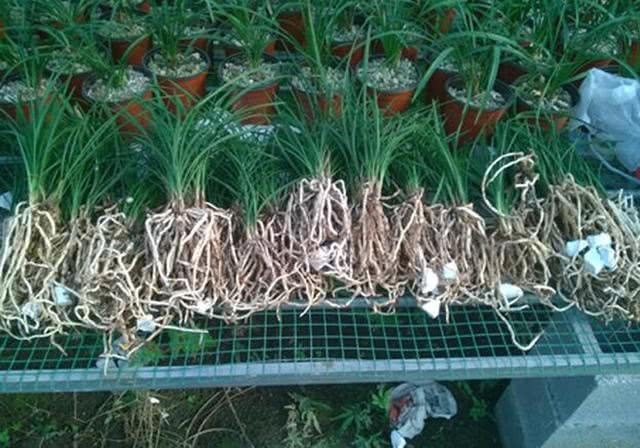
Choosing orchid potting medium is a key step in cultivating orchids and growing them well, because orchid roots differ somewhat in structure from the roots of other flowers and trees. They are fleshy aerial roots, thick and plump, and need to coexist with fungi to obtain nutrients. They need air permeability and must not accumulate water!
Let us first give a brief introduction to orchid roots:
The structure of orchid roots can be divided into the outer layer, middle layer and inner layer;
The outer layer is the root bark tissue surrounding the orchid root, mainly serving to protect the cortical tissue and absorb and retain water inside the cortex. Within the root bark tissue and around the rhizosphere, there usually live root fungi called orchid fungi, which belong to a type of true fungus. The mycelium of these orchid fungi invades the cortical tissue inside the orchid root, forming a symbiotic relationship;
The middle layer is the cortical tissue, with relatively developed cells, serving to store water and nutrients. This is the orchid fungus symbiont, with high water content. Its main function is to transform and digest fertilizer absorbed by the surface layer. The nutrients and water within the orchid root cortical tissue create the necessary living conditions for orchid fungi, enabling them to reproduce and develop. At the same time, the orchid root continuously decomposes and absorbs the mycelium of the orchid fungi as nutrients for orchid growth;
The inner layer is the central core of the orchid root, yellow-white, about 0.1 cm thick, not easily broken. Its main function is to strengthen the root and transport the water and nutrients needed for orchid growth. Fleshy orchid roots have a strong water-storage capacity, so orchids should not be watered too frequently, otherwise the roots rot easily.
Orchids are aerial-root plants. During their growth, a small part of the water they need comes from moisture in the air, while most of the water must be absorbed from the water contained in the growing medium. Orchid roots also need to absorb oxygen from the gaps in the medium in the pot for respiration. If the medium in the orchid pot drains poorly and has too high a water content, water will fill the medium's pores, causing water accumulation. When the medium's pores are filled with water and lack air, the roots suffocate from lack of oxygen, and over time root function gradually declines. At this point, because disease-causing fungi also invade and reproduce, the roots will rot as a result.
Now that we understand the characteristics of orchid roots, our principle for choosing potting medium is to choose an orchid potting medium with stable granular properties, good drainage and air permeability, moist but not waterlogged, dry but not parched, both draining and breathable, while also retaining moisture without waterlogging, and with a certain level of fertility. But note that the material used must be non-toxic, free of harmful fungi, free of pollution, and free of parasitic insect eggs, otherwise it will also harm orchid roots.
Second: Types of orchid potting medium
Orchid potting media are mainly divided into 2 types;
By degree of softness and hardness, they can be divided into: hard potting media and soft potting media. Hard potting media are also called hard media;
Or those that can degrade or degrade quickly are soft potting media, while those that cannot degrade or take a very long time to degrade are hard potting media;
By nutrient elements, they can be divided into organic potting media and inorganic potting media;
These 2 types mixed together become the 3rd type, mixed potting medium, that is, a combination of soft potting media and hard potting media. Next, let us talk about their characteristics!
1. Soft potting media
First, the drawbacks of soft potting media:
Soft potting media have relatively high requirements for environmental ventilation, especially in high-humidity environments. If ventilation is insufficient, new shoots are not easy to sprout, and even if new shoots emerge, the roots do not easily grow long quickly. If fertilizer is applied, root tips are very easily carbonized; at the same time, if the lower part of the pot remains wet and soggy for a long time, the crystal tips disappear, and the roots also turn black, become soaked and rot. Especially in summer, this process accelerates the rapid decomposition of the potting medium, further causing stuffy dampness in the pot.
Now the benefits of soft potting media:
A. Shoot buds are relatively easy to activate and grow, leading to high flowering and seedling production rates, especially suitable for reviving old back bulbs;
B. No need for frequent watering. If ventilation in the pot is handled well, the roots will be very good and easily fill the pot;
C. Nutrients are relatively balanced, no need to fertilize, and fertilizer damage can be effectively avoided;
D. The overall weight is relatively light, placing less load-bearing pressure on orchid shelves, and also convenient to move and carry!
Commonly used soft potting media include: pine bark, snake wood, peat, coconut husk, moss, tree bark, leaves, and so on
2. Hard potting media
First, the drawbacks of hard potting media:
Hard potting media do not easily retain water, and the inside of the pot dries out very easily, with strong dryness. They require frequent watering and are not suitable for lazy people, otherwise new shoots are not easy to sprout and hollow roots are very easily caused. Most hard potting media have little fertility, making nutrient deficiency likely, with stunted plants and yellowing leaves. During cultivation, fertilization is needed to solve the problem of insufficient fertility. A little carelessness can easily cause fertilizer damage. Flowering and seedling production rates are both lower than with soft potting media!
Now the advantages of hard potting media:
Hard potting media are not sticky or greasy, do not compact, are sterile and hygienic, have strong hydrophobicity, good air permeability, are easy to obtain, allow relatively casual watering, show little change in pH with long-term use, decompose slowly, do not easily rot, can be used repeatedly, and the orchids grown in them are not prone to disease and not easy to die. They are suitable for beginners!
Common hard potting media include: Kanuma soil, volcanic stone, perlite, crushed brick, crushed tile, weathered stone, ceramsite, and so on
Third, mixed potting medium
Mixed potting medium is made by mixing several kinds of hard potting media and soft potting media to create a new potting medium. Its greatest advantage is that during preparation we can increase or decrease the various media according to our own environment, pots and management methods, making up for shortcomings with strengths, so as to meet the needs of orchid growth and our own management. Generally speaking, in an open environment or a well-ventilated semi-enclosed environment, where breathable clay pots or sweating clay pots are usually used, more soft potting media can be used and less hard potting media; if it is a closed or semi-enclosed environment with relatively high air humidity, more hard potting media can be used and less soft potting media. Before preparation, sterilization and pest killing must be carried out with chemicals or high temperature. This type of potting medium contains a certain amount of nutrients, so usually little or no base fertilizer should be applied, and topdressing should be the main method, following the principle of "light fertilizer applied frequently."
Summary: Whether soft potting media or hard potting media, both can grow orchids well. There is actually nothing worth comparing between soft potting media and hard potting media. Whichever you find convenient, use that kind of potting medium. Some orchid growers say that orchids grown in soft potting media cannot be grown well in hard potting media, but this view is actually wrong; it is just that the first few months require re-adaptation. Some orchid growers also say that after using soft potting media, switching to hard potting media makes orchids prone to bacterial infection, and this view is also wrong. Could it be that orchids grown in soft potting media are all grown in a sterile environment? The key point is that most orchids grown in greenhouse environments use soft potting media, and that is the key. Greenhouse orchids are not easy to grow, absolutely not because of the potting medium, so when introducing plants everyone should determine whether the orchid is a diseased seedling and whether it came from a greenhouse. Naturally cultivated orchids, no matter where they go, no matter how the environment changes, will adapt if given some time, as long as you provide an environment the orchid can adapt to, there is no problem.
Finally, some suggestions for friends who like to use soil to grow orchids:
1. Use granular material as much as possible, sieve out the powdery material. Soil must not be too sticky. If it is too sticky, a small amount of coarse sand, wood shavings, tree bark, etc. can be mixed into the soil to improve its properties and texture.
2. For pots, choose breathable, open-mouthed clay pots or sweating clay pots. A drainage layer must be placed at the bottom of the pot to prevent soil from blocking the drainage holes and causing water accumulation.
3. In daily management, "dry cultivation" should be the main approach, that is, when watering we must grasp the principle of "do not water if not dry, focus on moistness; better dry than overly wet." However, we must also pay attention to preventing the phenomenon of drying from the bottom of the pot upward, that is, watering must be thorough.
4. Since the soil material we choose contains a large amount of humus, there is no need to add base fertilizer. Usually, topdressing can be chosen as the fertilization method. At the same time, pest killing and sterilization work must also be done well to prevent diseases and insect pests from attacking orchids.
5. The place where orchids are placed should be a well-ventilated site, such as an open or semi-enclosed place like a courtyard or balcony. Usually, orchid pots can be raised off the ground so that the pots are in an environment with ventilation on all sides, and the air humidity can be relatively lower. Author: Mei Fei, founder of the Orchid Bar forum, secretary of the Orchid Association of Jingshan City, Hubei Province, and an internet celebrity in the orchid industry on major self-media platforms! I publish orchid knowledge and pictures every day, taking you to understand orchids in depth and teaching you to grow orchids easily. If there is anything you do not understand about orchids, you can ask me at any time or leave a message below. If you like it, you can follow me or bookmark and forward it to help others!