No more agonizing over plant choices - master these 7 tips, and the second one alone can bring an exotic touch
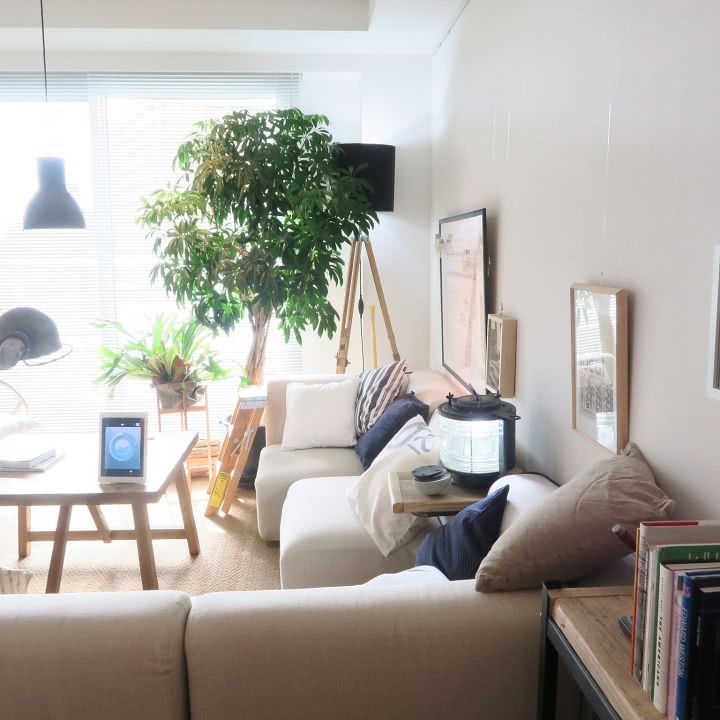
I believe everyone agonizes when choosing plants, with so many sizes and types that you just don't know how to choose. So today, I'd like to share my plant arrangement insights with you.
The living room in the photo above has throw pillows, wall art, lamps and decorations all in place, and it looks good, but somehow it still feels like something is missing. After adding a large potted plant, the plant became the visual focal point, and the spatial layers felt richer too.
Generally speaking, the larger the leaves of a plant, the stronger the "tropical feel" of the room, and the more wild and vibrant it feels. Although it grows in the tropics, it is actually a shade plant, so try not to place it in direct sunlight.
The equally popular fiddle-leaf fig (Ficus lyrata) is more adaptable to sunlight and can be placed anywhere at home, but be careful not to leave it in direct sunlight for long periods in summer.
Areca palm (Dypsis lutescens) leaves have many gaps, so they don't look so bulky, and even if they grow fast they won't look too "cramped." It's very suitable for placing next to the sofa, giving you the feeling of sitting in a tropical jungle, haha.
Tired of green, this time I also bought a variant of the Indian rubber tree (Ficus elastica), commonly called 'Black Prince'. Its leaves look somewhat black without light and aren't very eye-catching, but in sunlight they take on a purplish-red sheen, which is very beautiful. The shop owner said this kind of ficus grows easily, and indoors you shouldn't take too good care of it, otherwise the house will soon be too small for it. Unfortunately, the leaves of 'Black Prince' lose their luster and become dull in dry environments, so those in the north have no chance to grow it.
If you want the room to look more delicate, you can try small-leaved plants, and the regional feel won't be so strong. The color of umbrella tree (Schefflera arboricola) is very interesting: in good light the leaves are light green, and with poor light for a long time they turn deep green. It's also very easy to care for.
Orange jasmine (Murraya paniculata) has smaller leaves than umbrella tree, but its branch shape is very elegant, and it's also very suitable for indoor growing. From April to August it produces small white flowers with a fragrance. If you don't like flowers that are too fragrant, move it to a darker spot and the scent will be much fainter.
These are all choices for indoor plants - I hope there's one you like.