Plant this vegetable in mid-July, and you'll have a bountiful harvest by August
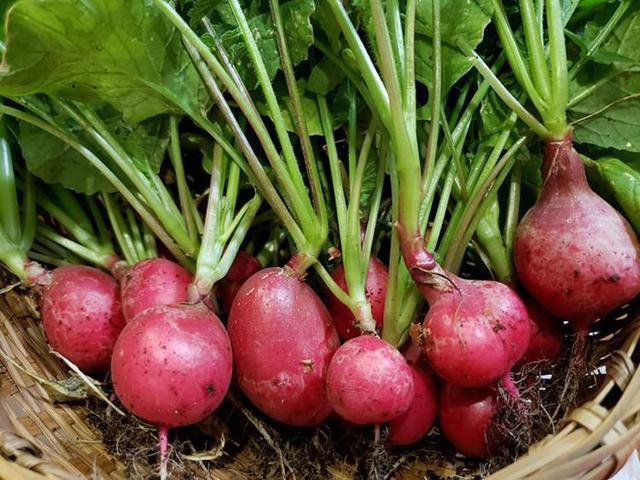
Radish is an annual or biennial herbaceous plant that can be grown in all four seasons. Its leaves are green, and some varieties have red or purple leaf stalks; the fleshy root shows white, pink, green or red parts above the soil, making it even more ornamental. As a food, radish is rich in vitamins and minerals, making it a highly nutritious vegetable.
If gardening friends want to eat safe radishes, they can choose to grow summer-autumn radishes in summer. Generally, they only need to be sown from early July to early August, and a bountiful harvest can be gathered from late August to mid-October.
When gardening friends choose to sow radish seeds, sow 3-4 seeds per hole or per pot at a depth of 2 cm, and seedlings will emerge 1 week after sowing. When the cotyledons are fully expanded, thin once, leaving 3 seedlings per hole or per pot; when 3 true leaves have grown, thin a second time, leaving 2 seedlings per hole or per pot; when 4-5 true leaves have grown, final thinning can be done, leaving just 1 strong seedling per hole or per pot.
For home cultivation, choose varieties whose fleshy stems are largely exposed above the soil and have brightly colored skin, such as 'Zhongqiu Hong', 'Dahongpao', 'Denglong Hong', 'Yanzhi Hong', as well as cherry radish varieties like 'Meiyingtao' and 'Xinchao'.
The container depth should be more than 40 cm; cherry radish has a shorter, smaller fleshy root, so a pot with a diameter of more than 12 cm is enough for growing it.
In addition, radish prefers a cool climate. When the temperature drops to 6°C, growth slows, but mature plants will not suffer leaf damage under short periods of low temperatures from minus 5°C to minus 4°C. However, radish is afraid of heat. When the temperature exceeds 25°C, nutrient accumulation decreases, plant growth weakens, and the root cannot thicken normally.
When caring for radish, give it as much sunlight as possible during the growing period. Control watering at the seedling stage to encourage the roots to grow downward. When the fleshy root swells to the thickness of a thumb and emerges above the ground, continue to control water to prevent excessive leaf growth and help the root swell. When 12-13 leaves have grown, the fleshy root enters its rapid swelling stage, and its water demand increases sharply, so watering should be increased to benefit fleshy root growth.
In addition, when caring for radish, do not apply too much nitrogen fertilizer at the seedling stage, to prevent excessive leaf growth that affects root growth and swelling. Only when the root has swollen to the size of a finger, apply a fruit-and-vegetable-specific organic liquid fertilizer once a week. After the plant grows 12-13 leaves, the amount of fertilizer needs to be increased, applying a fruit-and-vegetable-specific organic liquid fertilizer once every 5-7 days to promote root growth.
If gardening friends are interested in hydroponics, they can cut off part of the top of a radish and soak it in a dish with shallow water, keeping water in the dish afterward. Before long, leaves will gradually grow, and in spring it will also bloom with clusters of bright light purple flowers. After the flower stalk emerges, pinch off the growing tip, and multiple flower stalks will grow and produce even more small flowers.