How to solve sunburn spots on succulent leaves so the plant stays healthy and the leaves look even more beautiful
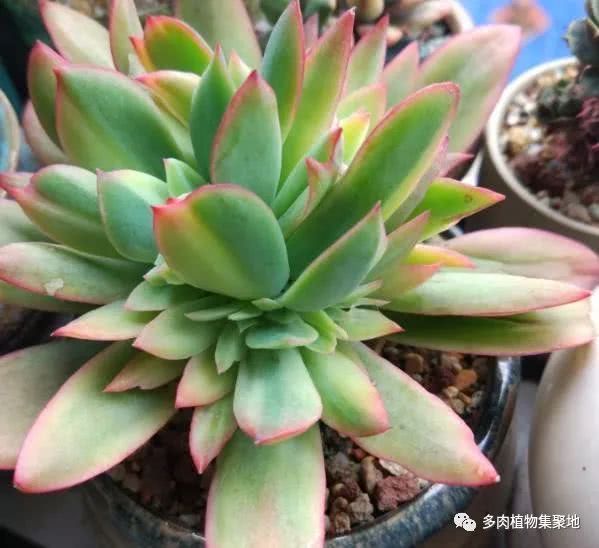
There are many reasons why spots and scars appear on succulent leaves. When watering succulents, we often pour water directly onto the leaves. If the water flow is too strong, it can cause some powdery succulents to lose their farina severely, or after watering, exposure to the sun can easily leave spots or minor burn scars. It is recommended to water along the edge of the pot or use a narrow-spout watering can to water the roots. Many succulent lovers, when treating pests and diseases on succulents, may cause slight damage to the leaves due to overly high solution concentration, with the pesticide residue remaining on the leaves and leaving spots and scars.
If "water-stain-type spots" appear on the leaves of a succulent, then you need to pay attention. This may be diseased foliage caused by water accumulation and stuffiness, and it should be removed cleanly in time, with more ventilation and observation of whether there is anything abnormal on the stem. As for soil: the soil that plants require is nothing more than loose, fertile and well aerated. Therefore, we can use peat soil mixed with vermiculite and coconut husk. After gradually figuring out the habits of different succulents, you can change the soil mix as needed. Of course, the most convenient way is to buy pre-mixed soil online. But if you want to become a master, you all have to learn to mix your own soil. It is better to learn it from the start than to learn it later.
If it is a succulent that has just been bought online, or one that has just been transplanted, do not water it immediately after planting. Wait until it has grown new roots before watering. The usual principle for watering is "water only after it has dried out completely, and water thoroughly when you do." Use less water in winter and less water on cloudy days. In summer, when temperatures are high, some succulents will go dormant, while in winter 5 degrees is a very important dividing line. When the temperature is below 5 degrees, you need to pay attention, because some succulents will freeze to death, so take care to protect them from the cold. Of course, there are also many cold-tolerant plants, and after some time you will be able to remember their habits. When spots and scars appear on succulents, there are many situations to distinguish. Some are not serious, but if they are diseased spots, they need to be removed in time to avoid spreading. Diseased spots on succulent leaves are mostly localized rot caused by moisture factors, commonly seen in thick fleshy areas such as leaves, leaf bases, stems and growth points.
Succulents can also develop sunburn spots, and there are many causes. The most common one is water droplets, either water droplets left on the leaves when watering or small water droplets remaining on the leaves in the early morning. After being exposed to sunlight on a clear day, they burn scars into the leaves. The principle is very simple, the same principle as a magnifying glass concentrating light to start a fire. This is especially common when placed outdoors under strong ultraviolet rays. Relatively speaking, succulents placed behind glass rarely have this happen. This is because glass blocks most of the ultraviolet rays, and the ultraviolet rays received by succulents behind glass are very mild. However, it has also been found that after improving the sunlight environment later, the newly grown leaves sometimes still have such scars. If sunburn spots are found, the most important thing is to place it in a ventilated, shaded place for care. In addition, if you water when the sun is shining directly at noon, the leaves will be burned due to the convex lens principle, so it is best to water in the cool evening. Generally, once new leaves grow out, they will naturally look nice. The oldest leaves at the very bottom will also gradually dry up and fall off, so there is no need to worry too much.
Sedum succulents are less cold-tolerant than Echeveria. In northern regions they are not suitable to be taken outdoors, while in southern regions there is no problem, but the prerequisite is that they must be grown plump. Once the root system is thick and strong, there is nothing to fear. In winter there is also no need to manage them at all, and no need to water them either, just leave them outdoors. For succulents, flowering depends not only on nutrients, but also on light, temperature differences, and even on whether the dormant period was spent well. Light is the most important. For most succulents, a full-sun or half-sun environment is needed for normal development. Insufficient sunlight plus lack of water causes the plant to grow slowly, and at best it only maintains its current condition. If there is insufficient sunlight plus continuous water supply, it will cause leggy growth or even rot. If it does not lose its shape and does not rot and die, that is already very good, so do not expect more about whether it blooms or not. In this situation, if it still blooms, after flowering the plant often grows deformed and ugly.
Leggy succulents are generally caused by too much water and too little light, and controlling leggy growth in succulents also requires effort in these areas. Preventing leggy growth in succulents generally means increasing light and controlling water, but in summer the ultraviolet rays are strong and the temperature is also high, so when receiving light you must be careful to avoid sunburn. Controlling humidity effectively prevents leggy growth in succulents, and generally this starts with the flower pot and the growing medium. Use flower pots with holes to make drainage easier, and if the material is breathable it can also further help remove excess water. Increase the proportion of granular soil in the growing medium so that drainage and aeration are better, and after each watering the excess water can quickly drain away and dry out. While controlling humidity, also be careful not to let it dry out too much, which can easily damage the roots.
This is a gathering place for succulent lovers, sharing succulent care tips. You are welcome to follow and exchange ideas.