Pokeweed comes in two types: the one with purple-red stems is toxic, while the green-stemmed pokeweed seedling is a high-quality wild forest vegetable
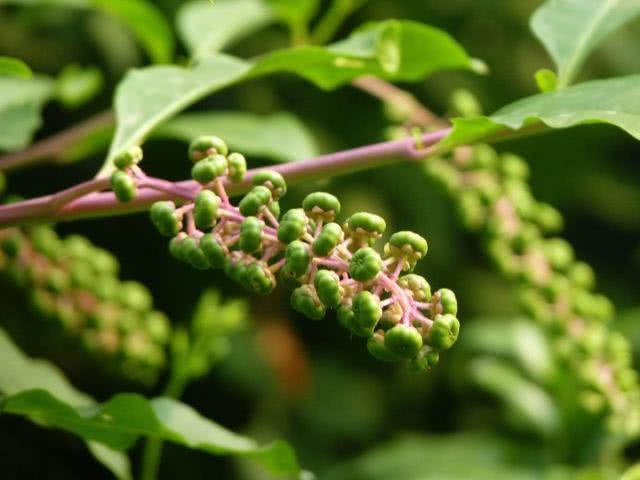
Pokeweed (Phytolacca genus, Phytolaccaceae family)
Pokeweed (Phytolacca acinosa Roxb.) is a perennial robust herbaceous plant in the Phytolaccaceae family and Phytolacca genus. It is widely distributed in the red soil low hilly areas south of the Yangtze River. Among the varieties currently distributed in China, the main ones are pokeweed (wild radish) and drooping pokeweed (American pokeweed, American pokeweed, ten-stamen pokeweed). In various places it is called large amaranth, mountain radish, flower pokeweed, rouge, etc. based on its morphology. Because its morphology closely resembles Talinum paniculatum of the Portulacaceae family (commonly known as soil ginseng or soil ginseng), it is mistakenly cultivated as soil ginseng in various places. The root is thick, fleshy, and conical. The leaves are ovate, with entire margins. It blooms in summer and autumn, with white flowers in racemes. There are eight carpels, free from each other. The berry is oblate-spherical, purple-black. The infructescence is upright.
The dried root of pokeweed used medicinally. It is excavated from autumn to the following spring, the fibrous roots and sand are removed, and it is cut into pieces or slices, then sun-dried or shade-dried.
The root is used as medicine, with the white and thick ones being preferred; the red root is highly toxic and is only for external use. It promotes bowel and bladder movement, expels water, and dissipates masses; it treats edema, distension and fullness, beriberi, and throat obstruction, and is applied externally to treat carbuncles, swelling, and sores. It can also be used as veterinary medicine and pesticide. The fruit contains tannins and can be used to extract tannin extract. The tender stems and leaves can be eaten as vegetables.
Pokeweed is mainly produced in Henan, Hubei, Shandong, Zhejiang, Jiangxi, etc.
Morphological characteristics
Perennial herb, 0.5-1.5 m tall, the whole plant hairless.
Root
The root is enlarged, fleshy, obconical, with the outer bark pale yellow or grayish brown and the inner surface yellow-white.
Stem
The stem is erect, cylindrical, with longitudinal grooves, fleshy, green or red-purple, and much branched.
Leaves
The leaf blades are thinly papery, elliptic, long elliptic, or lanceolate-elliptic, 10-30 cm long and 4.5-15 cm wide, with the apex acute or acuminate, the base cuneate and gradually narrowed, scattered with small white spots (raphides) on both surfaces, and the midvein raised on the back; the petiole is 1.5-3 cm long, stout, with a groove on the upper side, semicircular on the lower side, and slightly flattened and broadened at the base.
Flowers
The raceme is terminal or opposite to the leaves, cylindrical, upright, usually shorter than the leaves, densely many-flowered; the peduncle is 1-4 cm long; the bract at the base of the pedicel is linear, about 1.5 mm long, and the two upper bracteoles are linear-lanceolate, both membranous; the pedicel is slender, 6-10 (-13) mm long, thickened at the base; the flowers are bisexual, about 8 mm in diameter; the tepals are 5, white or yellow-green, elliptic, ovate, or oblong, with the apex rounded and obtuse, 3-4 mm long and about 2 mm wide, equal in size, often reflexed after flowering; the stamens are 8-10, nearly as long as the tepals, the filaments white, subulate, flattened at the base, persistent, the anthers elliptic, pink; the carpels are usually 8, sometimes as few as 5 or as many as 10, separate; the style is short, upright, curved downward at the apex, and the stigma is inconspicuous.
Fruit
The infructescence is upright; the berry is oblate-spherical, about 7 mm in diameter, black when ripe; the seeds are kidney-shaped, black, about 3 mm long, with 3 ridges.
Growth habits
Pokeweed has strong vitality and often grows wild at the foot of mountains, in forests, along roadsides, and around houses. It is distributed in plains, hills, and mountainous areas. It prefers warm and humid climatic conditions, is cold-tolerant but not waterlogging-tolerant, and the suitable growth temperature is 14-30°C; the aboveground part withers when leaves fall in autumn and winter, while the underground fleshy root can withstand a low temperature of -15°C. It has wide adaptability to soil; whether sandy soil or red loam, whether fertile or barren, it can grow with luxuriant branches and leaves,
Distribution
From southwestern to northeastern China, and also in Korea, Japan, and India.
Propagation methods
Pokeweed propagates easily; both roots and seeds can be used for propagation. Generally, two methods can be used: direct seeding and planting of fleshy roots. From August to September, select green-stemmed pokeweed mother plants, harvest when the fruit turns purple-black, rub off the outer skin in water, and dry for later use.
Seed propagation
It is fast, and can be directly sown or raised as seedlings for transplanting. For direct sowing, sow in late February. As a wall-protecting green manure, sow in shallow holes on terrace walls at a spacing of 1.0 m x 1.5 m, with 8-10 seeds per hole (the seed germination rate is 70%-80%). After sowing, cover with soil 1-2 cm deep; covering with burnt mud ash gives better results. Seedlings emerge 20-25 d after sowing. When the seedlings are 10-15 cm tall, thin them, leaving 1-2 plants per hole. For seedling raising and transplanting, first sow on a seedbed about 1 m wide, then cover with a thin layer of straw, and when the seedlings are more than 10 cm tall, transplant on a cloudy day or in the afternoon.
Fleshy root planting
From mid-November to mid-December, when the perennial roots have not yet sprouted, select fleshy roots with buds and plant them. Cut the part with buds, leaving 3-4 buds per piece, smear the cut with plant ash, and then sow at a spacing of 40 cm x 40 cm, cover with soil 3-4 cm deep, then apply high-quality farmyard manure and cover the pond to retain moisture. Water as appropriate to promote seedling emergence.
Cultivation techniques
Watering, loosening soil, and weeding
After final thinning and topdressing, or in cases of severe drought, water twice in a row. When soil moisture is suitable, loosen the soil and weed shallowly, keeping the soil surface loose, moist, and free of weeds.
Topdressing
After final thinning, spray the leaf surface with 0.5% urea solution, in small amounts many times, with the total amount not exceeding 225 kg/hm2. The following spring, before the plants emerge, open shallow furrows between the two rows and bury-apply about 1200 kg/hm2 of potassium sulfate high-concentration compound fertilizer. From July to August, spray about 1800 kg/hm2 of 1% potassium sulfate or 0.3% potassium dihydrogen phosphate, once every 15 d, for 3-4 consecutive sprays.
Overwintering
To help pokeweed overwinter safely and increase organic fertilizer in the field, in late autumn and early winter, spread 6000 kg/hm2 of chopped straw and chaff such as wheat and rice chaff in the fields planted that year.
Cutting flower stalks
Pokeweed blooms from June to August. Except for those kept for seed, cut off all flower stalks to reduce nutrient consumption.
Pest and disease control
Pokeweed has no diseases throughout its growth period. Because the stems and leaves are tender, the main pest is aphids, which can be controlled with 40% imidacloprid 600-fold solution or 25% pirimicarb 1000-fold solution, with maximum use frequencies of 3 times and 2 times respectively, and a safety interval of 7 days for both. Testing shows no pesticide residues. For a small number of aphids, pesticides may also be omitted; after picking, soak in a dilute saltwater solution for 10 seconds, then rinse once with clean water, which better meets environmental protection requirements.
Root rot
The pathogen of pokeweed root rot is a kind of fungus imperfecti among the fungi. The aboveground part of the affected plant withers in a green wilt state, the rhizome turns brown, and in severe cases the root rots.
Control measures: choose well-drained plots for planting; drain promptly during the rainy season; sterilize the soil with 70% quintozene at 15 kg/hm2.
Economic value
Green manure
As green manure for fertilizing fields, pokeweed has a very significant fertilizing effect. Fresh stems and leaves generally contain 2%-3% nitrogen, 0.3%-0.6% phosphorus, 2%-4% potassium, and 9%-31% other dry matter. Production practice in many places has proved that using pokeweed stems and leaves as green manure gives better fertilizing results than other green grasses and green leaves. Besides the fact that pokeweed itself contains relatively high nutrient components, its stems and leaves are tender and easy to decompose, and are readily absorbed and used by crops. Especially in the large areas of barren low-hill red soil in the south, because of high acidity, low fertility, heavy clay texture, and shallow soil layers, ordinary crops and trees are very difficult to grow, while fruit trees such as citrus, loquat, longan, and lychee require fertilizer application. If pokeweed is intercropped in orchards on red soil wasteland, it can not only resist drought and tolerate barrenness, but also has no pests or diseases, is easy to cultivate, and has high yield. Generally, 3500-4750 kg of fresh stems and leaves can be harvested per 667 m2, so it is called a pioneer green manure for red soil wasteland. According to reports, using pokeweed as a green manure raw material to fertilize citrus trees increased yield by about 3% compared with the control group.
As a manganese-accumulating plant
In today's society, with the enhancement of environmental awareness, people have gradually realized the major impact of soil heavy metal pollution on the environment and human health, and manganese pollution of soil and water bodies has also attracted attention. Manganese entering soil through various pathways continuously accumulates in the soil, and because it is non-degradable, remediation of soil manganese pollution becomes very difficult. Investigations and studies have proved that pokeweed has an obvious enrichment effect on manganese, with manganese content in leaves reaching as high as 19299 mg/kg. This discovery provides an economical and effective method for manganese pollution control.
Extraction to make biological pesticides
According to literature reports, in Awad in northern Ethiopia, people use dried American pokeweed berry powder suspended in water to kill schistosome-carrying Oncomelania snails, and its efficacy is not easily disturbed by the external environment, with low toxicity to mammals. Plant molluscicides cause little environmental pollution and have been encouraged by WHO since the 1980s. Studies have shown that total saponins of Chinese pokeweed have a strong molluscicidal effect; administration at a concentration of 125 mg/L for 24 h is equivalent to the effect of the classic chemical molluscicide sodium pentachlorophenate (10 mg/L).
There are two types of pokeweed: the one with purple-red stems is toxic and cannot be eaten, while the green-stemmed pokeweed seedling is a high-quality wild forest vegetable. The aboveground part of pokeweed generally withers and falls in autumn and winter, and sprouts tender buds in the spring of the second year, making it a superior wild vegetable variety. Because pokeweed is a perennial herbaceous plant, it can be harvested for many years after one planting, with a spring yield of more than 2 t per 667 m2.
But after Qingming Festival, once the stems and leaves become lignified, they are no longer edible. In many places, pokeweed is cultivated as a vegetable, becoming a good way for mountainous rural areas to become wealthy.
Pokeweed has a very good water- and soil-conserving effect, and is especially suitable for newly reclaimed red soil terraced orchards. In southern China, due to abundant rainfall, the heavy washing of rainwater in spring and summer often causes the terrace walls of newly reclaimed orchards to slide and collapse.
Because pokeweed is suitable for growing in red soil, has a developed root system, thick fleshy roots, and deep and wide distribution, and its branches and leaves grow quickly and luxuriantly, it has a good effect on water and soil fixation.
According to reports, pokeweed was introduced and planted on the terrace walls of citrus orchards in red soil hills as a wall-protecting plant. Before planting pokeweed, due to the washing of rainwater in the rainy season, the terrace walls often slid and collapsed; after planting pokeweed, all terrace walls remained intact without a single collapse, which not only saved repair work, but also conserved soil and water and increased green manure.
In seasons of severe drought, the citrus orchard was irrigated many times, yet the interplanted mung beans still died from drought; while the pokeweed planted on the terrace walls was not watered, yet still grew luxuriantly with dense green branches and leaves, and showed no wilting even at noon in high temperatures.