How to grow white-striped grass in water and care for it, and how to tell it apart from spider plant?
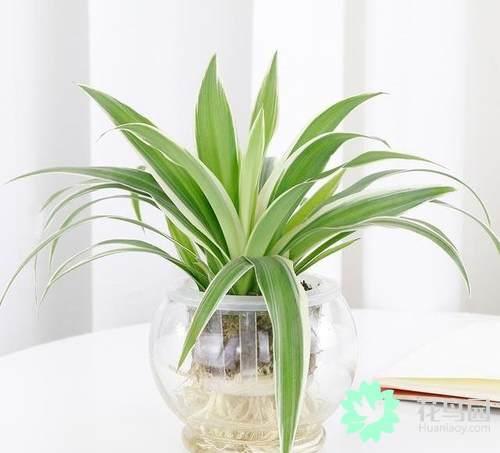
White-striped grass, also known as green bamboo or white-striped orchid. It is a perennial foliage plant with somewhat strong drought tolerance, suitable for small potted display. White-striped grass closely resembles variegated spider plant, but it has no runners. The leaves are delicate and soft, with white streaks on the green leaves.
1. Water cultivation method
(1) For water cultivation of white-striped grass, you can use the root-washing method: after washing soil-grown white-striped grass clean, cut off the overly dense tuberous roots, place them in a 0.05%-0.1% potassium permanganate solution and soak for 10 min, rinse them clean again, then plant them in a transparent watertight container, use expanded clay pebbles or shell sand, colored stones, etc. as the medium to fix the roots, then add water to about 1/2 of the plant's roots; do not submerge the entire root system, so as to avoid root rot.
(2) When the temperature is low in winter, the leaves tend to turn yellow and fall off. You can lower the water level, cut off the yellow leaves, and place it in a bright spot on an indoor windowsill; when the temperature warms up in spring, many new leaves and new shoots will sprout again. As shown in the picture, this is white-striped grass grown in water.
2. Care guide
(1) Temperature and light The temperature suitable for the growth of white-striped grass is 22-28°C. If the temperature is below 15°C, it will enter a dormant state, and the leaves will gradually turn yellow and wither. White-striped grass likes ample diffused light, and in summer it should avoid strong direct sunlight.
(2) Changing the water In the early stage of water cultivation, white-striped grass is prone to root rot, so the water needs to be changed every day and the rotten roots removed. When the roots adapt to the aquatic environment and no longer rot, change the water once every 2-3 days; after water roots have grown, changing the water once every 10-15 days is enough.
(3) Fertilizing Add nutrient solution when changing the water. When white-striped grass is growing relatively quickly, increase the nutrient solution to provide the nutrients needed for growth. When the weather is hot in summer, you can frequently spray water on the leaf surface to keep the air humid and the leaves clean.
(4) Pest and disease control White-striped grass is drought-tolerant and also moisture-tolerant; in water cultivation it almost never suffers from pests or diseases, making it a standard lazy-person plant. However, when the weather is cold in winter, cold damage can occur, and the indoor temperature needs to be kept above 15°C. If cold damage has already occurred, you can cut off the withered leaves and place the plant in a warm place.
How to distinguish white-striped grass from spider plant
Because white-striped grass and spider plant are very similar in color and plant form, white-striped grass is often mistaken for spider plant. However, if you observe carefully, you can still tell the two apart. Although the leaves of white-striped grass are similar to those of spider plant, spider plant will grow runners from the base, and small plantlets will also grow on the runners, while white-striped grass does not have this characteristic. And the thick, enlarged tuberous roots of white-striped grass are something spider plant does not have, which is also the best marker for distinguishing the two.