Peach Beauty routine care methods and things to watch out for
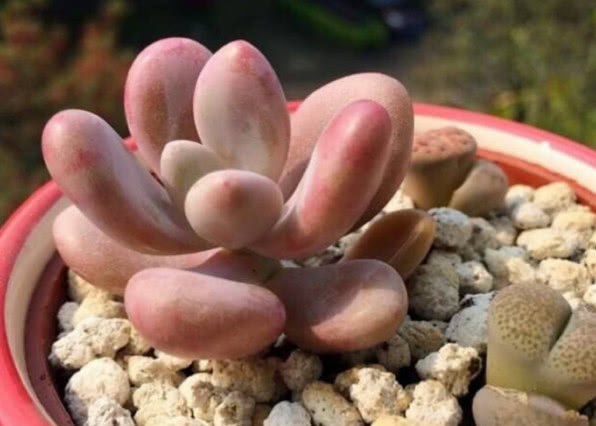
Peach Beauty (Pachyphytum 'Peach Beauty') is very beautiful, and its leaves have a kind of crystal-clear look, but if you do not grow it well, the leaves are not plump and become flat, and it will look much worse. On the surface of its leaves there is a thin layer of white powder, and set against its pink leaves it makes it look very pretty, pale pink, or pale purple, very eye-catching; on the back of the leaf it forms a round bump, but the surface of the leaf is rather flat. The tip looks like it has a pointed corner, but its shoulder does not look so obvious; if you care for it well, you can basically not see the leaf tip, and its leaves will become a very beautiful ovate shape.
Of course, many flower lovers say its appearance is somewhat similar to that of Pachyphytum 'Star Beauty'. In fact, the two differ greatly in colour, because Star Beauty, no matter what you do, is always white, or pale blue. But the Peach Beauty we are talking about today has leaves that are pale pink, or that kind of pale purple, so the two are still very easy to tell apart. Its plant looks rather short, arranged in strings, and it can also be pollinated by a single flower. Peach Beauties growing in clusters placed together are very attractive; its main propagation method is sowing, and it can also be divided, or simply beheaded, or leaf cuttings all work.
The method everyone uses most is probably leaf cuttings, because this method is very convenient, but when taking leaf cuttings you must remember that the cut leaves need to let the wound dry for a period, and then insert them into the flower pot, and you must remember not to water before they have rooted, because a large amount of water may cause the wound to rot. Its growing medium generally uses peat with perlite and coal cinders, and the three materials can be used in equal proportions. But there should be a certain gap between the plant and the medium; for better air flow, you can spread a thin layer of river sand, or pumice of course. It does not need to be very thick, only 3 to 5 mm is enough.
Be careful with watering, do not be too diligent, and be sure to wait until the soil is thoroughly dry before watering; it has no obvious dormant period and can enjoy sunlight all year round. In summer, pay attention to ventilation and shading, and remember to water it 3 to 4 times a month, roughly once a week. But only give a very small amount of water around the edge of the pot, just enough to keep its root system from drying out in the high-temperature soil. In winter, if the temperature is below 3°C, you can gradually reduce the watering frequency. Below zero, keep the soil dry, and try not to place it in an environment below minus 3°C. Only then can it get through the winter safely.
(The above images are all from the internet; if there is any infringement, please contact us to delete them)