Purple loosestrife is a wild plant used both as medicine and food; the whole plant is used medicinally and the young stems and leaves are edible.
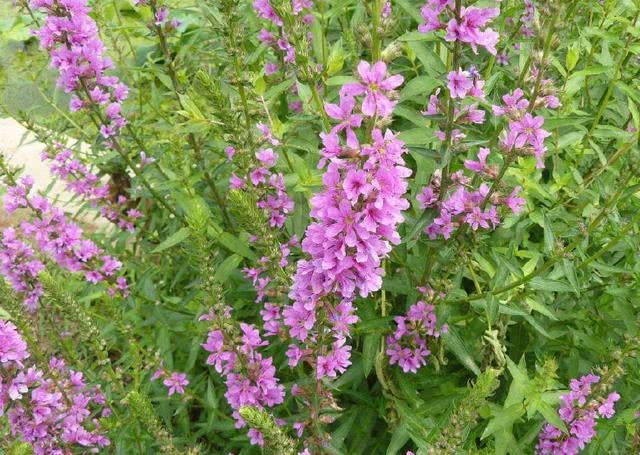
Purple loosestrife (plant)
Purple loosestrife, Latin scientific name: Lythrum salicaria L. A perennial herb of the family Lythraceae and genus Lythrum, with thick rhizomes lying horizontally underground; stems upright, much branched, the whole plant green, slightly covered with coarse hairs or densely covered with fine hairs, the branches usually 4-angled.
Leaves opposite or in whorls of three, lanceolate or broadly lanceolate, apex blunt or shortly pointed, base rounded or heart-shaped, sometimes slightly clasping the stem, entire, sessile.
Flowers arranged in small cymes, clustered; because the pedicels and the main stalk are extremely short, the whole flowering branch resembles a large spike; bracts broadly lanceolate to triangular-ovate, triangular; appendages needle-like, upright, red-purple or pale purple, oblanceolate-oblong, base wedge-shaped, borne on the upper part of the calyx tube, with a short claw, slightly wrinkled; extending beyond the calyx tube; ovary 2-locular, styles of varying length. Capsule flattened and round.
Morphological characteristics
Perennial herb, rhizomes lying horizontally underground, thick; stems upright, much branched, 30-100 cm tall, the whole plant green, slightly covered with coarse hairs or densely covered with fine hairs, branches usually 4-angled. Leaves opposite or in whorls of three, lanceolate or broadly lanceolate, 4-6(-10) cm long, 8-15 mm wide, apex blunt or shortly pointed, base rounded or heart-shaped, sometimes slightly clasping the stem, entire, sessile.
Flowers arranged in small cymes, clustered; because the pedicels and the main stalk are extremely short, the whole flowering branch resembles a large spike; bracts broadly lanceolate to triangular-ovate, 5-12 mm long; calyx tube 5-8 mm long, with 12 longitudinal ridges, slightly covered with coarse hairs, lobes 6, triangular; appendages needle-like, upright, 1.5-2 mm long; petals 6, red-purple or pale purple, oblanceolate-oblong, base wedge-shaped, 7-8 mm long, borne on the upper part of the calyx tube, with a short claw, slightly wrinkled; stamens 12, 6 long and 6 short, extending beyond the calyx tube; ovary 2-locular, styles of varying length. Capsule flattened and round.
Growth habits
Grows on riverbanks, lakesides, beside streams and ditches, and in moist grasslands. It likes strong light, is highly cold-tolerant, and likes water and moisture; it is not demanding about soil and grows better in deep soil rich in humus.
Geographical distribution
Produced throughout China, and also cultivated; distributed in Asia, Europe, Algeria in Africa, North America and southeastern Australia.
Propagation methods
Mainly by division, but also by sowing or cuttings. Divide in early spring or autumn; sow in spring and take softwood cuttings.
Sowing:
Seed propagation: sow in spring in March-April; before sowing, mix the seeds evenly with fine soil, then broadcast them on the bed, cover with 25px of soil, and finally cover with grass and water. Seedlings emerge 10-15 days after sowing; remove the grass immediately. Transplant when the seedlings are about 250px tall. Dig holes at a row spacing of 750px and a plant spacing of 500px, planting 3 plants per hole.
Cutting propagation: for cuttings in spring, select vigorous branches, cut them into lengths of about 300px, remove the leaves, insert them obliquely into the soil to a depth of 1/2 of the cutting, press firm, water to keep moist, and transplant after they have rooted and grown leaves. Division propagation: in spring, from April to May, dig up the root clumps, cut them into clumps each with several buds, and plant them in wet ground with sufficient base fertilizer.
Cultivation techniques
Cultivation points:
(1) It is not demanding about soil, is cold-tolerant, and likes light and moisture. Fertile soil is best for cultivation.
(2) It can be propagated by sowing, cuttings, division and other methods. Sowing must be done in wet ground; take cuttings in June-July by cutting off new branches and inserting them into muddy water, where they can root in one month; for division in spring, dig up the old plants, cut them into several parts, and plant them separately.
(3) It can be planted once and harvested for many years.
Field management: from planting until the rows close, cultivate and weed 3-4 times each year. Apply nitrogen fertilizer or compound fertilizer once each in spring and summer, and apply compost or barnyard manure once after autumn; keeping the soil moist at all times is the most critical measure for growing purple loosestrife well.
Main values
Medicinal
The whole plant is used medicinally, to treat enteritis, dysentery and bloody stool; externally for traumatic bleeding.
[Properties] Bitter, cold. Enters the large intestine meridian. Clears heat, cools the blood, astringes, and stops diarrhea.
[Applications] Treats dysentery, abnormal uterine bleeding, hematemesis, traumatic bleeding, festering sores, etc.
Treats diarrhea, dysentery, bloody stool and metrorrhagia. Decoct and take: 6-12 grams.
For traumatic bleeding, grind into powder and apply externally. This product contains salicarin, gallic acid tannins, choline, and various alkaloids such as lythrine, lythridine and lythramine. The flowers also contain vitexin, etc. The decoction can inhibit Staphylococcus, Salmonella typhi and others in vitro, and is especially sensitive to Shigella dysenteriae. It has an antispasmodic effect on isolated intestinal segments. The root decoction is used for chronic dysentery as an astringent or palliative.
Traditional Chinese medicine holds that the whole plant of purple loosestrife is bitter in taste and cold in nature. It has functions such as clearing heat and cooling the blood. It can treat dysentery, ulcers, metrorrhagia and other conditions. It has antibacterial and other functions.
Animal experiments have shown that purple loosestrife has a blood sugar-lowering effect. The extract can also reduce serum TG levels and raise FFA levels.
Pharmacological effects
1. Antibacterial effect: the decoction of the crude drug (whole plant) can inhibit the growth of Staphylococcus and the Escherichia-Shigella group; it is especially sensitive to Shigella dysenteriae.
2. Effect on blood pressure: vitexin 0.05-10.0 mg/kg intravenously can temporarily raise blood pressure in anesthetized rats, while more than 10 mg/kg intravenously produces lasting hypotension; the hypotensive mechanism is due to ganglion-blocking action.
3. Anti-inflammatory: vitexin 20 mg/kg intraperitoneally has an anti-inflammatory effect on carrageenan-induced inflammation in rats.
4. Antispasmodic: vitexin 10-30 ?g/ml can inhibit contractions of isolated guinea pig intestinal segments induced by acetylcholine and histamine. On isolated guinea pig intestinal segments, it initially has a strengthening effect, but later shows an antispasmodic effect, weakening the excitatory effects of acetylcholine and histamine on the intestinal segments.
5. Other effects: the hemostatic effect is due to the contained tannins. Its root decoction is used for purgation or as an astringent or palliative for chronic dysentery; this effect may be caused by the contained salicarin, Fe2O3·XH2O and tannins, and is harmless to the kidneys, stomach and circulatory system. Its extract Salicairine can prevent glycosuria caused by the ingestion of phlorizin in humans, but it does not itself produce hypoglycemia.
Macroscopic identification
The stem is square-columnar, grayish green to yellow-green, 1-2 mm in diameter, branched, hard and easily broken, the fracture edge fibrous, hollow. The leaves are grayish green, brittle, mostly shriveled and broken; intact leaves are opposite or in whorls of three, narrowly lanceolate, entire, sessile. The apex bears a spike; flowers bisexual, each 2-3 small flowers borne within leaf-like bracts, the calyx grayish green, tubular; petals purple. The capsule is elliptical, wholly enclosed within the persistent calyx. Slight odor, slightly bitter taste.
Chemical composition
The whole plant contains salicarin and tannins. In the ash, sodium is twice that of potassium, and it also contains a large amount of iron; choline 0.026%. The tannins are mainly gallic acid tannins, with contents of: root 8.5%, stem 10.5%, leaf 12%, flower 13.7%; the seeds also contain a large amount of tannins. The flowers contain flavonoids such as vitexin, orientin, malvin (Malvidin 3,5-diglucoside), cyanidin 3-monogalactoside, gallic acid, ellagic acid and a small amount of chlorogenic acid. They contain vitexin, orientin, isoorientin (homoorientin), chlorogenic acid, ellagic acid and gallic acid, and also contain choline, tannins and pigments. It has also been reported to contain a small amount of volatile oil, pectin, resin and alkaloids.
Landscaping
This species is a flowering plant; in North China and East China it is often cultivated at the water's edge or as a potted plant for ornamental purposes, and is also called water branch brocade, water zhi brocade or water willow.
The clumps are neat, upright and elegant, with abundant flowers, long inflorescences and a long flowering period, making it an excellent vertical-line material in waterscapes. It is best planted in clumps along shallow-water banks or planted in ponds. It can also be used as a flower border material and for cut flowers. Used for potted plants or bog gardens.
Edible
Purple loosestrife is a wild plant used both as medicine and food. Its whole plant is used medicinally; the young stems and leaves can be eaten as a wild vegetable, and this has a long history among the Chinese people.
Many ancient and modern documents, such as the "Jiu Huang Ben Cao", "Hunan Materia Medica", "Guizhou Folk Medicines" and "Illustrated Chinese Medicinal Plants", all contain records of its medicinal or edible use.
In ancient times, apart from famine years, when vegetables were scarce in spring people also commonly ate some wild vegetables to supplement vitamins and other nutrients and avoid illness.
Since the 1980s, purple loosestrife has been eaten again. Generally, people pick it in the wild between April and May, picking off the young stems and leaves of purple loosestrife at the point where they break easily, washing the fresh vegetable clean, blanching it briefly in boiling water, and then serving it cold dressed, stir-fried, or in soup. Some chop it and mix it into flour to steam; some use the fresh vegetable in noodles; others use it as a hot pot ingredient, etc.
In ancient times, people also made purple loosestrife into dried vegetables to keep for winter and spring. That is, first blanch the fresh vegetable briefly in boiling water, then dry it in the sun and store it. When eating, soak it in water, and it can be stir-fried or used in soup, also with a distinctive flavor.
This vegetable has the effect of clearing heat and cooling the blood, and is an excellent vegetable for the hot summer. This vegetable is also rich in iron and other components.
Cosmetics made by combining purple loosestrife with other ingredients have beauty benefits such as reducing congestion, preventing skin dryness and protecting against external irritation.