The temple where Tang Sanzang became a monk now actually grows flowers and vegetables and runs a teahouse
Many friends know that Shaoyao recently went to Chengdu for fun. Shaoyao's first stop in Chengdu was not to eat hot pot or skewers, nor to visit flower shops, but to head straight to a temple right after getting off the plane.
Speaking of temples, besides being able to think of the smoke-filled incense and the droning scriptures, you must also remember the Jizhao Nunnery that Shaoyao introduced to everyone before (Review | A nunnery that burns no incense and only grows flowers, one look and you want to become a monk!)
Everyone really loves Jizhao Temple to death, and what Shaoyao wants to talk about today is also a garden temple. That's right, Shaoyao is a little trickster, and today wants to trick you into becoming a monk again
{ Shaoyao Girl Vol.809 }
x
Garden Temple
On Chunxi Road in Chengdu, you can find the harmonious coexistence of fast pace and slow life.
The rising and falling sounds of mahjong and the roar of cars each bustle on their own; the businessmen in the cafe and the men and women slumped in the teahouse, neither looks down on the other, and when mealtime comes they eat skewers together in a hole-in-the-wall restaurant.
Right next to the bustling Taikoo Li district, there are not office buildings and luxury residences, but a temple.
This thousand-year-old ancient temple is not hidden in the mountains and forests,
it proudly "sits amid the city's prosperity."
This is Daci Temple, also called Ancient Great Sage Compassionate Temple,
just hearing the name gives the meaning of "my Buddha is compassionate."
Thin, small bamboo grows sparsely in a ring outside the wall, the trees inside the courtyard stretch out beyond the high wall, and it guards a quiet spot within the busy market. Shaoyao is rather Buddhist (lazy), and does not know which gate she entered through, but as soon as she stepped in she was attracted by the datura flowers in the courtyard.
"What kind of flower is this?"
"A trumpet flower growing on a tree~"
Datura flowers hang on the tree like trumpets,
but many people do not recognize them and mistake them for morning glories,
and so the above conversation full of Sichuan flavor came about.
Pink datura is more favored,
while yellow is more ordinary,
like an upside-down pumpkin flower.
Datura is originally a transliteration from Sanskrit. The Lotus Sutra says, "When the Buddha preached the Dharma, the heavens rained datura flowers." In Buddhist scriptures, the datura flower means comfort, that is, everyone who sees it will feel joy.
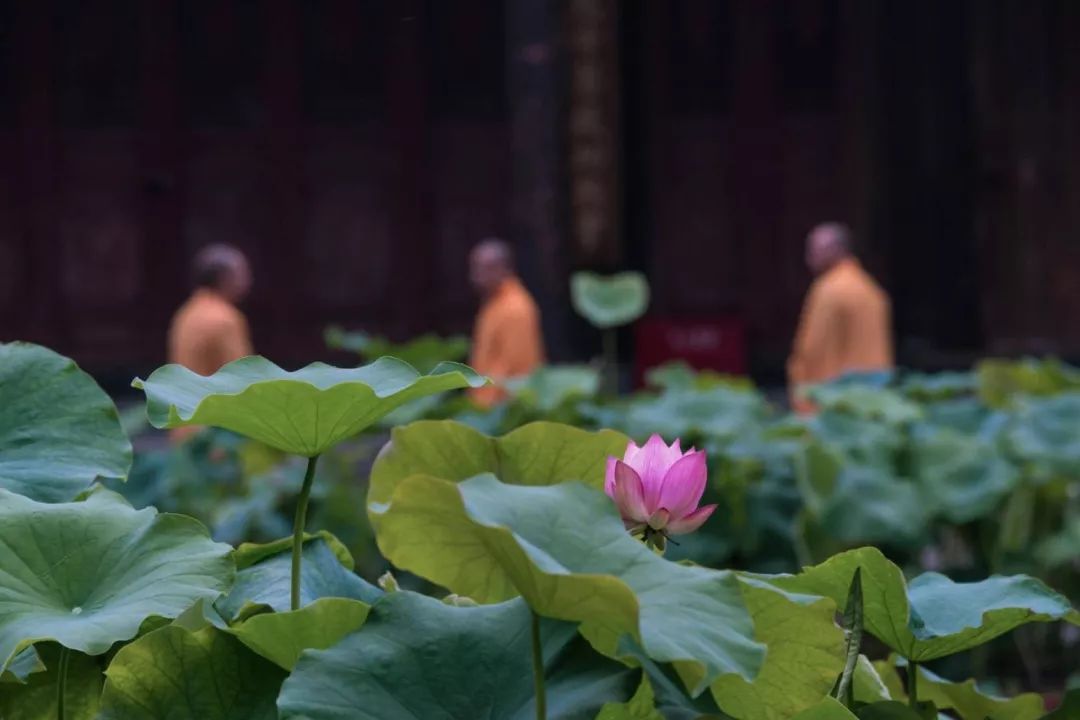
Turning around, there is a pond of lotus leaves.
Kalimeris pours out from the pots,
spilling pink-purple all over the ground.
There is no heavy smell of incense here. Stepping into the courtyard, it is full of flowers, plants and a small vegetable garden, as if one had wandered by mistake into a private courtyard.
Daci Temple after the rain just cleared,
everything became fresh and bright.
The little mushrooms under the leaves are the Buddha's gift.
The green little tomatoes are dotted with water droplets
At this time of year at Daci Temple, lotuses play the leading role, and almost every hall has a pond of lotuses in front of it. The lotuses at Daci Temple grow tall, and you need to stand on tiptoe to see them; only dragonflies can stand elegantly on the pointed petals.
Some have not yet fully opened,
some have already grown lotus seed pods.
Parrot's feather and lotuses grow together in the pond,
the thread-like tender green needles make people feel especially cool.
Watching red lotuses and green water reflect each other,
walking further in, one smells the faint fragrance of lotus.
Devout believers, silent monks, Buddha statues,
under the reflection of a pond full of green leaves, the Zen mood is deep and distant.
When admiring the lotuses in front of the courtyard, close to the hall door,
dazedly listening to a passage of scripture,
one only feels the Buddhist chanting lingering around the beams, only feels the ears become quiet.
The crape myrtle tree grows close against the wall,
its purple flowers reaching upward all the way to the eaves,
keeping company with the stone-carved Buddha statues.
Outside the red wall is the bustling world of flowers,
inside the red wall the crape myrtle blooms quietly.
If you came two months earlier,
you could also see hydrangeas all over the courtyard.
Daci Temple calls hydrangeas "Zen hydrangeas,"
blue-purple hydrangeas within the ancient temple,
giving off a quiet and indifferent temperament.
A temple silent for a thousand years,
because of hydrangeas it radiates new vitality.
Not only does it grow flowers, Daci Temple also grows quite a few vegetables, which gives this seemingly aloof temple a rich earthy warmth.
The plant with small white flowers outside the fence,
is the chili pepper that all Chengdu people love.
Inside the fence are several different vegetables and corn
The small purple flowers grow into eggplants.
These vegetables each have different owners, all planted by volunteers recruited by Daci Temple. In this way, Daci Temple wants to let people living in the city experience the hardship of farming and cherish food.
The master of Daci Temple also went to Jizhao Nunnery at the beginning of this year for study and exchange. Compared with the garden-style temple of Jizhao Nunnery, Daci Temple is more like a garden with deep heritage.
This garden already has a history of more than 1600 years, built between the 3rd century and 4th century AD, and is known as "the first monastery of Cathay."
In 618 AD, Xuanzang went from Chang'an to Chengdu and studied Buddhist scriptures at Daci Temple. Four years later he was ordained here and practiced the summer retreat and studied the vinaya (monks stay in place for the three summer months, sitting in meditation and cultivating quietly, called the summer retreat). But Daci Temple had a troubled fate and was destroyed many times by war and fire. What we see at Daci Temple today is mostly the halls rebuilt in the Qing Dynasty.
For thousands of years, the morning bells and evening drums, rise and fall, partings and reunions have not been able to shake the foundation of Daci Temple, nor has it ever faded from people's view. Instead, because of the flowers and plants all over the courtyard and its youthful style, it has attracted more young people to come and listen to the Buddhist chanting.
Many young people who are tired from shopping in Taikoo Li,
choose to come to Daci Temple for a stroll.
As soon as they enter the gate, the bustling mortal world is shut outside,
the whole world slows down, and one can only see the wind blow and the flowers move.
Many people who come in laughing and playing,
within a few minutes are attracted by the flowers and plants everywhere,
and quietly smell the fragrance of the flowers.
The charming little monk,
is the mascot of Daci Temple.
It sits on the ground, tilting its head in an adorable way,
as if thinking about the scripture the master just taught.
It also has more than a dozen cute little brothers,
some spacing out, some acting cute, some giggling foolishly.
Many temples use incense money to support faith, but Daci Temple uses flowers, plants, vegetables and mascots to calm people's hearts.When I am here, my heart is calmer than ever before.
The Buddha bathing ceremony organized by Daci Temple
There is no smoke-filled incense,
fruit and fresh flowers are the protagonists of the Dharma.
A flower-viewing tea gathering prepared for volunteers,
flower arranging, drinking tea, eating snacks,
returning to peace of mind in the simplest way.
If you are tired from walking around, there is also an old Chengdu teahouse in Daci Temple, where you can sit on a bamboo chair to rest and drink a bowl of tea. The teahouse is full of people, all looking leisurely and content, very different from the style of the heavily decorated teahouses by West Lake.
Sitting down in the teahouse, with a 20 yuan tea fee and two plates of snacks, you can leisurely while away an afternoon with a clear conscience. The people drinking tea here include both outsiders and locals.
The local old tea drinkers are calm and composed,
either leaning sideways with eyes closed to rest,
or gathered around a table playing cards.
ps: Photography is not allowed inside the teahouse, so I secretly took pictures outside the door
Young people from out of town like to sit in the open-air teahouse,
reading a book, chatting, enjoying half a day of fleeting life.
Shaoyao is an ordinary person bound so tightly by the dusty world that she cannot move, busy with work, troubled by feelings, but after spending an afternoon wandering around Daci Temple, the thoughts placed on worldly matters and worldly people were slowly pulled back.
Drinking a bowl of tea in the teahouse, letting time flow inch by inch, every plant and tree forever quiet and wordless, in a daze one gets the feeling that "the days and months in the mountains are long."
When getting up to leave,the tea has gone cold, but I have already tasted the warmth of life.
Studying Buddhism and worshiping Buddha does not necessarily require eating vegetarian food and chanting scriptures,
having a quiet heart undisturbed by turmoil is the pure land.
Knowing how to be grateful and enjoy the present,
is the meaning of a temple to the mortal world.
END
Some images in the text are from Weibo @Chengdu Daci Temple, copyright belongs to them