Succulent etiolation is not entirely a bad thing; in fact, it can be an opportunity to become a major succulent grower
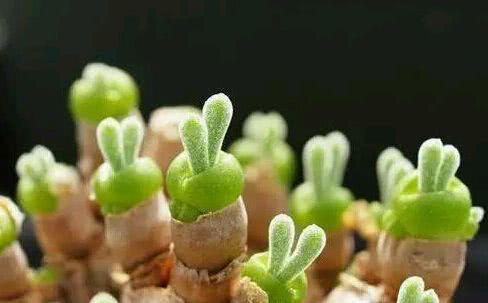
The petite appearance of succulents is very appealing, but under the influence of certain factors, succulents may grow in a purely elongated way, and this kind of growth is what we commonly call etiolation. After etiolation, succulents no longer have their uniquely charming and adorable form, and even the color of the leaves will change, losing their ornamental value.
Causes of succulent etiolation:
1. Insufficient light. Succulent care requires sufficient light. If there is not enough light, succulents can easily obtain more light through etiolation as a way of self-rescue. Succulent etiolation causes the spacing between leaves to become larger. On one hand, this is due to phototropism; on the other hand, it expands the contact area between the succulent leaves and light.
2. Overwatering. If succulents are watered too much, the excess water cannot be fully absorbed by the plant itself. The water is stored in the leaves and stems, causing them to expand and grow rapidly. In this way, the water used is easily all directed toward building stem cells, and succulents will develop etiolation.
3. Overfertilizing. Succulents are more suited to organic fertilizer. If a large amount of compound fertilizer is used, especially compound fertilizer mainly based on nitrogen fertilizer, it can easily cause succulent etiolation. Nitrogen fertilizer itself can promote the growth of plant roots, stems, and leaves, which speeds up plant cell division and can easily lead to succulent etiolation.
The native environment of succulents is already harsh. In poor soil environments, they do not have high nutrient requirements, so there is usually no need to rush to fertilize succulents to make them grow quickly. It is best to let nature take its course.
Solutions for succulent etiolation:
Beheading: Cut off the etiolated part of the succulent from the top, keeping just a few leaves on the remaining plant. Then place the cut-off part in a cool place to let the wound heal, after which it can be re-cuttaged or rooted in water. Once new roots grow, it can be transplanted into a flowerpot.
Leaf removal: Besides beheading, there is an even simpler and more direct method, which is to remove the leaves from the etiolated part of the succulent. Do not throw away the removed leaves either; just insert them into the potting soil, and in this way we can obtain several pots of succulent plants.