Clivia not growing? Add one thing to the bottom of the pot, and the leaves will grow like crazy with extra-large blooms
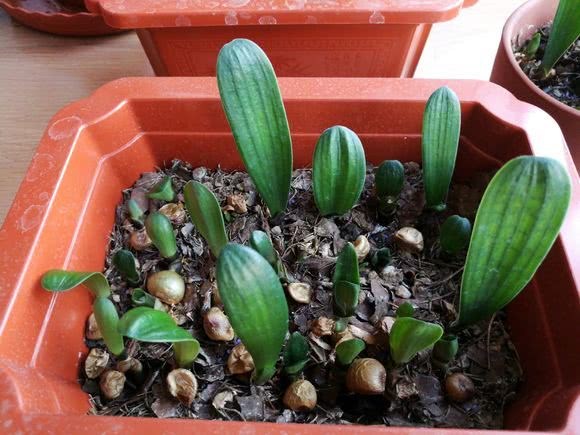
There are now many gardeners growing Clivia. The main reason is that this flower has large, brightly colored blooms when in flower, and when not in bloom, its leaves are glossy green, wide and thick, full of vitality. In addition, Clivia has since ancient times carried fine meanings such as "the demeanor of a gentleman, nobility, and grandeur," so more and more people grow it. In fact, growing Clivia well is not difficult, as long as you master a few little tricks.
In the daily care of Clivia, many gardeners have summed up quite a lot of experience. For example, watering Clivia with beer can prevent "clip arrows" (blooms stuck between the leaves), and watering Clivia with rice-washing water can make the root system more developed, and so on. Next, let us share a few more little tips for Clivia.
Clivia generally grows rather slowly, and it really takes two to three years of effort to grow large leaves!
Although Clivia grows slowly, that does not mean there are no tricks. To speed up Clivia's growth, besides daily watering and light, the most important thing is fertilizing. Only the supply of fertilizer efficiency will let Clivia grow freely. At this point many gardeners may wonder: how should Clivia be fertilized? What fertilizer is best? Of course, fertilizing must follow the principle of "light fertilizer, applied frequently," and the fertilizer is best as organic fertilizer fermented from barnyard manure, chicken manure, and the like.
Using the organic fertilizer described above is good, but the problem is that "the smell is too strong"! In response to this situation, many gardeners have surely also found an alternative method. That is to bury a little "well-rotted soybeans, soybean residue" and the like in the potting soil of the Clivia.
Rotted soybeans themselves are a very good organic fertilizer, and they are rich in amino acids and nitrogen, which is exactly the fertilizer efficiency that Clivia needs for growth. In previously shared flower knowledge, rotted soybeans can be used to grow most orchid-family plants, such as cymbidium orchids, Christmas cacti, spider plants, and so on. Clivia is naturally no exception.
How to make rotted soybeans:
First, wash the soybeans clean, then soak them in water for two hours. After that, begin steaming or boiling. The purpose of soaking is so they cook easily. Next, put the cooked soybeans into a mineral water bottle in the way shown in the picture below, fill it with water, and place it in a cool, shady spot for more than half a month. In this way, fermentation can proceed. To avoid a strong fermentation smell, you can toss in a little orange peel.
Take out the soybeans rotted after half a month and set them aside for use. At the edge of the Clivia's flowerpot, or at a spot a little farther from the Clivia's root system, use a small trowel or a twig to dig a small hole 5-8 cm deep, then put in just 3 rotted soybeans. Remember to stop watering two days before applying the soybean fertilizer to the Clivia, and do not water immediately on the day after fertilizing either; you can wait 5 hours before watering, or wait until the next day.
Using rotted soybeans to grow Clivia, fertilizing once every two months is enough. In this way, after three to five months, you will find that the Clivia's leaves clearly begin to grow like crazy, and the leaves will be glossier than before. That is all for the sharing on growing Clivia. Of course, in the process of caring for Clivia there are still many little tricks, and more than anything you need a pair of eyes good at discovering things. Go and discover flower-growing techniques.
Finally, thank you for reading!
Remember to like and share~