This flower blooms in cascading strings like a waterfall, easy to grow and quick to fill a pot, an excellent choice for container growing
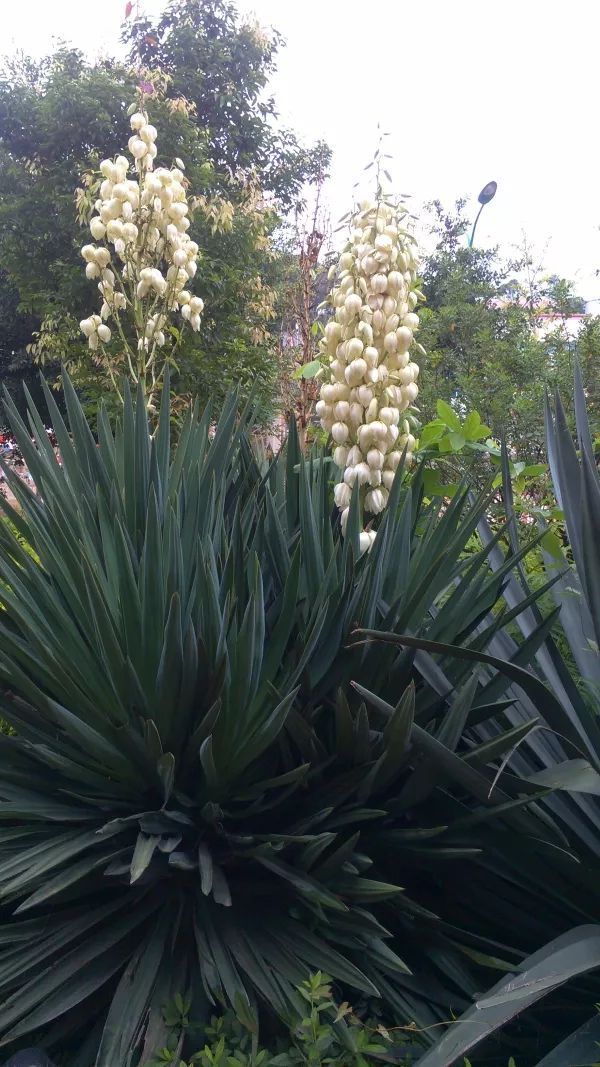
Yucca gloriosa, also known as Spanish dagger, has leaves that stay deep green all year round. When it blooms, the flower stalks rise tall and upright, with abundant white flowers hanging down like bells. The flowers are pure white and elegant, the form is graceful, the blooming period is long-lasting, and the fragrance is pleasant. It is a common ornamental garden flower with a unique tree-like form. Several plants grown in a clump are often planted in the center of flower beds, and its ornamental value is very high.
“
Blooms in strings"
-Yucca gloriosa and sisal-
Yucca gloriosa, also known as Spanish dagger, is also called sisal in many places. Actually, there are still some differences between Yucca gloriosa and sisal. Yucca gloriosa is the national flower of Seychelles. Both are flowers of the Agavaceae family, and their leaves are very similar, but the flower forms differ greatly.
Sisal leaves are straight, about 1.5m long, growing in a rosette arrangement, and can produce 200-250 leaves. The flower stalk grows from the base, reaching 6m tall, bearing yellow-green flowers with a strong scent. Sisal cultivation is mainly concentrated in Guangdong, Guangxi, Fujian and Hainan, and other places. Its leaves are relatively soft and tend to droop.
The stems of sisal and Yucca gloriosa also differ considerably.
Yucca gloriosa leaves grow upward from the stem in a spiral arrangement, about 40-70cm long. The inflorescence is short, about 1m, the flowers are creamy white and conical, and the flower quantity is large, with 200-400 flowers possible. Yucca gloriosa leaves are relatively hard and will not droop if they do not lose water. Under open-field conditions, Yucca gloriosa can overwinter naturally north of the Yellow River; sisal can only grow in the open field south of the southern subtropical region.
Yucca gloriosa blooms from June to October. The blooming period is relatively long, the flower quantity is also very large, and it is very beautiful.
-Soil for Yucca gloriosa care-
Yucca gloriosa has strong adaptability, grows vigorously, and tolerates poor soil. Except for saline-alkali land, it can adapt to general soil, with well-drained sandy loam being best.
-Watering for Yucca gloriosa care-
Yucca gloriosa is very drought-tolerant and also fairly tolerant of waterlogging. Generally, just water thoroughly when the soil is dry. For Yucca gloriosa planted in the ground, pay attention to appropriately supplementing water in summer. In other seasons, if there is abundant rain, it is basically enough for the growth of Yucca gloriosa. For potted plants, you can follow the principle of not watering until dry, and watering thoroughly when you do. After entering winter, control water and stop fertilizing, which helps Yucca gloriosa get through the winter.
-Fertilizing for Yucca gloriosa care-
Yucca gloriosa has strong adaptability and does not demand much fertilizer. Generally, apply nitrogen-phosphorus-potassium compound fertilizer 1-2 times each in spring and autumn. Do not fertilize in winter or summer.
-Temperature for Yucca gloriosa care-
Yucca gloriosa likes a warm growing environment. The suitable growing temperature is around 25°C. It is also fairly tolerant of severe cold, and can be planted in the open field in the middle and lower reaches of the Yellow River and areas to the south. In winter, potted plants can be placed in a sunny spot, or moved indoors for care.
-Light for Yucca gloriosa care-
Yucca gloriosa likes light and is also fairly shade-tolerant. It is best to keep it in a sunny environment for care. Full-sun conditions are best, and there is no need to shade it in summer.
-Propagation methods for Yucca gloriosa-
Yucca gloriosa can be propagated by sowing, cuttings, and division, with division being the most convenient. The stems of Yucca gloriosa easily produce adventitious buds and readily grow suckers. In spring, around February to March, the root sucker buds exposed above the ground can be separated and planted. When separating and planting, it is best if each bud carries some fleshy roots. Some of the lower leaves can be removed, the wounds dried, and the separated sucker buds placed into the potting soil. Be careful not to bury them too deep, water thoroughly, and they will soon take root.
What do you call Yucca gloriosa where you are?
It is so beautiful when in bloom
Show it to flower lovers who need it!