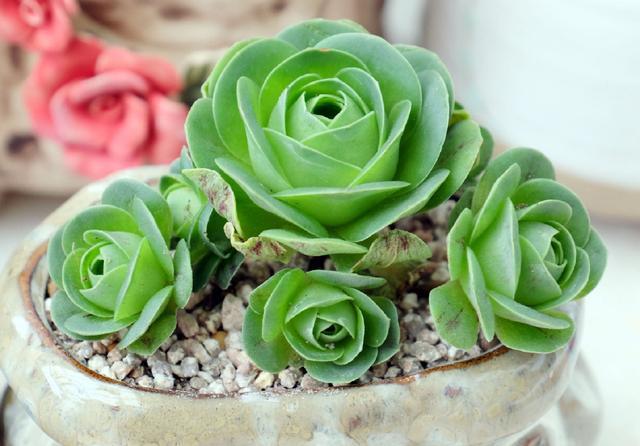
The mountain rose has a plant shape that closely resembles a rose bud, making it a green rose that never withers.
Mountain Rose (plant)
Mountain Rose is the collective name for succulents formerly in the Crassulaceae family, genus Greenovia (Latin: Greenovia Webb & Berthel), now classified under the genus Aeonium. It is characterized by leaves that open during the growing season (winter and spring) and close during the dormancy period (summer).
The fleshy leaves are arranged in a rosette. The plant width varies greatly among different species; the small species Aeonium aizoon is only 2 to 4 cm, while the large species A. diplocyclum can reach 30-40 cm or more in width.
Leaf color varies from grayish-green and blue-green to emerald green depending on the species and growing environment. After exposure to intense sun, the leaves may develop reddish-brown markings.
Some species have leaves with a slight coating of farina and fine hairs, or glandular hairs along the leaf margins. The flowering period is from late spring to early summer, with racemose inflorescences and yellow flowers. After flowering, as the seeds mature, the mother plant gradually withers, but offspring can be continued through side shoots at the base of the plant.
Morphological Characteristics
The fleshy leaves of Mountain Rose are alternate and arranged in a rosette. The plant width varies greatly depending on the variety, ranging from 2 cm to 40 cm. Leaf colors include grayish-green, blue-green,
or emerald green. The flowering period is from late spring to early summer, with racemose inflorescences and yellow flowers. After flowering, as the seeds mature, the mother plant gradually withers, but small shoots emerge from its base.
During its dormancy period, to avoid strong light, intense heat and other unfavorable conditions, the outer leaves age and wither while the central leaves tightly wrap together, giving the plant a shape that closely resembles rose buds about to bloom. It is precisely this characteristic that drives most plant enthusiasts crazy.
Distribution Range
It is distributed in the Canary Islands and nearby islands including Gran Canaria, Tenerife, El Hierro, La Gomera and La Palma, in rock crevices of north-facing slopes at elevations of 1000-1900 m in coniferous forest areas. On the southern highlands of Tenerife, in remote areas of north-facing slopes at 950 m elevation, and in open areas of coniferous forests at around 650 m elevation on the north sides of La Palma, El Hierro and La Gomera.
Growing Environment
Mountain Rose grows in ravines, rock crevices in mountainous areas, and coniferous forest land. The dormancy period is from July to August. During dormancy, the outer leaves wither and the central leaves tighten into a rose shape. In summer, with ventilation, little water and 50% shading, it can maintain its "soul-stirring" state.
Mountain Rose prefers a cool, dry environment with plenty of sunlight. It is drought-tolerant and tolerant of partial shade, but afraid of waterlogging and muggy, humid conditions. It has the habit of going dormant in high temperatures and growing in cool seasons. The growing season is from autumn to late spring, when it should be given ample sunlight. If light is insufficient, the plant will become leggy, resulting in a loose plant shape and thinner leaves.
The growing season runs from mid-September to June of the following year. Moving it indoors in winter allows normal growth; be sure to ventilate frequently. Once the growing season begins, the previously "soul-stirring" rose shape rapidly opens within a few weeks, and at this point its form is very close to other varieties in the genus Aeonium. This may be the reason it was merged into the genus Aeonium.
Propagation Methods
Seasonal Requirements
The growing season of Mountain Rose is from autumn to late spring.
Light Requirements
It should be given ample sunlight while keeping the potting soil slightly moist at all times. Avoid intense sun exposure and especially avoid rain, to prevent the plant from rotting due to muggy, humid conditions. Apart from appropriate shading during the summer dormancy period, it should receive ample sunlight at all other times, consistent with most Crassulaceae plants.
Fertilization Requirements
It has no strict requirements regarding fertilization. Generally, placing some granular slow-release fertilizer in the soil is enough to meet its growth needs.
Precautions
1. Although the plant will not die at around 0°C in winter, growth often stops, so it is best to maintain a minimum temperature of around 5°C with a day-night temperature difference of around 10°C.
2. In summer, most Mountain Roses should enter dormancy. Avoid intense sun exposure and especially avoid rain, to prevent the plant from rotting due to muggy, humid conditions.
3. Repotting Mountain Rose is best done in autumn. The potting soil should be loose, breathable and somewhat granular. Generally, a small amount of grass peat or peat moss mixed with vermiculite, perlite or other granular materials is used for planting.
Cultivation Techniques
Substrate
Indoor enclosed balconies have poor ventilation, so the non-granular portion of the substrate is used in very small amounts, with only about 1/6 being rice husk and peat; the remaining 5/6 is entirely various granules, including honeycomb coal cinders, orchid stone, pumice, ceramsite, perlite, small stones, etc. Additionally, 2 mm diameter maifan stone and small stones are used for top dressing. The granules at the bottom of the pot can be larger, but the granule size in the middle is best kept at 3 mm or less, because Mountain Rose has relatively fine roots, and overly large granules will hinder root growth. Personally, I do not put insecticides in the substrate and rarely use fungicides other than potassium permanganate. All substrate is soaked in water and then microwaved on high for 20 minutes before use, trading some beneficial microbial flora for the peace of mind of avoiding pesticide residue toxicity.
Watering
Nanjing has relatively high air humidity, more rain, and insufficient light intensity, so I generally water only once every 4 weeks, which helps control the plant shape. I personally prefer the soak-watering method, with the water level at about 2/3 the height of the pot. Soak for a few seconds and then take it out, keeping the substrate surface dry year-round, which helps avoid root crown rot as much as possible. Another advantage of soak-watering is that it allows free control of the amount of water given. For example, in late spring, to be safe, many growers gradually reduce water and then transition to no water throughout the summer. However, I have never cut off water for my Mountain Roses in summer. At most, I briefly dip them shallowly in water and take them out quickly, keeping some moisture at the bottom of the pot. Facts have proven there is no problem, especially for seedlings. In summer, there is basically no need to cut off water; at most, slightly restrict watering.
Ventilation
Strong ventilation is essential for Mountain Rose to get through summer. For example, place it at an open window during the day. At night, most people turn on the air conditioning. If you do not turn on the air conditioning, then place it at an open window all day. If you are really worried, you can even hang a gentle breeze fan nearby. As long as ventilation is good and the plant's root system is healthy, they can get through summer safely. But it is best not to put it here in the morning and there at night, constantly moving it every day; such excessive pampering is actually detrimental to normal plant growth. To grow plants well, the key is not what you want to give them, but rather making the effort to figure out what they want.
Light
A south-facing window is ideal. Of course, an even more ideal state is outdoor cultivation, but unfortunately for most balcony growers this is just a dream. So apart from enthusiasts in blessed places like Kunming, most Crassulaceae enthusiasts rarely get to see Mountain Rose turn red from sun exposure. What a captivating purplish-red color with a grayish-white base that is!
Cultivation Points
This overall plant state resembling a rose bud only appears during the summer dormancy season. During dormancy, the lower leaves of the entire plant wither, and the root system darkens in color, like dead wood. In the other three seasons, its leaves open normally in a rosette, just like other Aeonium plants. If you observe carefully, you will notice that the flower bud formed by all the leaves curling toward the center during dormancy is very similar to the leaf center appearance of many Aeonium plants in summer. Also, a reminder: in actual cultivation, please try to avoid water accumulating in the center of the leaves, otherwise root crown rot is very likely, especially in indoor environments with poor ventilation. If water accidentally accumulates in the leaf center, use a cotton swab to absorb it and then provide as much ventilation as possible.
Cultivation Points
Mountain Rose prefers a cool, dry environment with ample sunlight. It is drought-tolerant and tolerant of partial shade, but afraid of waterlogging and muggy, humid conditions. It has the habit of going dormant in high temperatures and growing in cool seasons. The growing season runs from mid-September in autumn to late spring of the following year in June, when the plant should be given ample sunlight. If light is insufficient, the plant will become leggy, resulting in a loose plant shape and thinner leaves. Moving it indoors in winter allows normal growth; be sure to ventilate frequently. It should be given ample sunlight while keeping the potting soil slightly moist at all times. The dormancy period is from July to August.
Although the plant will not die at around 0°C in winter, the summer dormancy period requires good ventilation and controlled watering, so that the plant can get through the hot summer in a ventilated, dry and cool environment. Avoid intense sun exposure and especially avoid rain, to prevent the plant from rotting due to muggy, humid conditions. Repotting Mountain Rose is best done in autumn. The potting soil should be loose, breathable, somewhat granular, and contain a small amount of organic matter. Generally, a small amount of grass peat or peat moss mixed with vermiculite, perlite or other granular materials is used for planting.
During the growing season, the potting soil should always be kept slightly moist. Waterlogged soil and excessive drought are both detrimental to plant growth. In particular, avoid water accumulating in the center of the leaf rosette, otherwise root crown rot is very likely. There are no strict requirements regarding fertilization. Generally, placing some granular slow-release fertilizer in the soil is enough to meet growth needs.
Related Species
Green Jade Cup
Scientific name: Aeonium aizoon (Bolle) Mes
Relatively rare. The leaves are dark green, covered with a very thin layer of fine hairs. Compared to other Aeonium plants, it is smaller, generally 2 to 4 cm in diameter under natural growing conditions. In spring, many side shoots grow from the base. The flowering period is from February to April, the inflorescence can reach 12 cm, and the flower color is golden yellow. After flowering, the mother plant withers and the side shoots continue to grow.
Golden Mountain Rose
Scientific name: Aeonium aureum (C.Smith ex Hornemann) Mes
Distributed in Gran Canaria, Tenerife, El Hierro, La Gomera and La Palma. The open leaf diameter is 20-25 cm. The leaf color is light blue, with a layer of farina on the surface. The flowering period is from May to July, the flower color is cream yellow, and after flowering there are large numbers of seeds. It can also grow many side shoots.
Egg Mountain Rose
Scientific name: Aeonium diplocyclum (Webb ex Bolle) Mes
Distributed in La Gomera, La Palma and El Hierro of the Canary Islands. In its native habitat it often grows mixed with Golden Mountain Rose. The diameter is 10-20 cm, and the plant shape is also difficult to distinguish from Golden Mountain Rose. It may have slightly smaller floral leaf arrangement, but the flowers are larger. The leaves are green with a slight yellow tinge, covered with a layer of farina. In summer the leaves close into a cup shape, wrapped by dried leaves.
Emerald Ball
Scientific name: Aeonium dodrantale (Willdenow) Mes
Distributed in the eastern and western parts of Tenerife, growing at elevations of 150-1200 m. In remote eastern and western areas. Due to tourism development, wild plants are increasingly dwindling. The diameter is 10 cm. It very easily grows side shoots, and the inflorescence height is 20 cm.
Mountain Rose can be propagated by sowing during the growing season, with autumn being the best time. Scatter the seeds evenly on the soil surface without covering with soil. Place in a location without direct sunlight and use the "soak-watering" method to avoid the tiny seeds being washed away by water.
Sprouting occurs 5 to 10 days after sowing. During the seedling stage, keep the soil moist and provide ample, soft light. When the seedlings become too crowded, separate them promptly to avoid affecting growth. You can also snap off side shoots during the growing season and let them dry for 3 to 5 days. Once the wound is dry, plant them directly in pots; they will survive with or without roots.
In summer, most Mountain Roses should have entered dormancy, so summer care for Mountain Rose should include good ventilation and controlled watering, so that the plant can get through the hot summer in a ventilated, dry and cool environment. Avoid intense sun exposure and especially avoid rain, to prevent the plant from rotting due to muggy, humid conditions.
Mountain Rose Flower Meaning
The green rose that never withers.
Mountain Rose refers to the plants of the genus Greenovia. In fact, after 2003 this small genus Greenovia no longer exists, because in 2003 it was merged by taxonomists into the genus Aeonium. However, for convenience of description, it is still referred to as Greenovia below.
The reason the Mountain Rose series is so popular is mostly because they look so adorable when dormant.
The so-called "green rose that never withers" is the charming Mountain Rose series in the Crassulaceae family. The flower meaning of the rose is love and beauty. So does the green rose that never withers represent even more enduring love and beauty?