Kuxueqie (Khasianum nightshade) dispels wind and relieves pain, clears heat and detoxifies; the fresh fruit is pounded and applied to the painful tooth to treat toothache
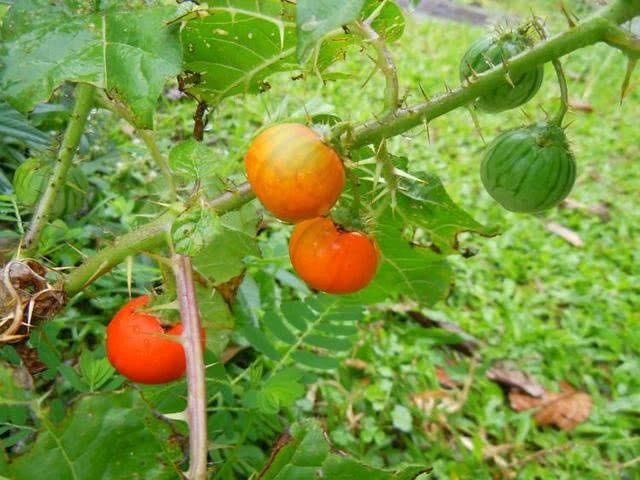
Kuxueqie
Kuxueqie, a traditional Chinese medicine name. It is the fruit of the Solanaceae plant Solanum khasianum C.B.Clarke. It is distributed in Yunnan and other places. It has the effects of dispelling wind and relieving pain, clearing heat and detoxifying. It is often used for rheumatic arthralgia, headache, toothache, acute mastitis, mumps, and traumatic pain.
Aliases
Kudianqie, Huangjiaoci, Citianqie, Ciqiezi, Tianqiezi, Guquedan, Tianpaozi, Tianqianguo, Gouqiezi, Guojiaoqie, Dakuge, Jindanzi.
Medicinal part
The fruit.
Nature and flavour
Slightly bitter in taste, cold in nature, mildly toxic.
Meridian entry
Enters the Heart, Liver and Stomach meridians.
Effects
Dispels wind and relieves pain, clears heat and detoxifies.
Indications
Rheumatic arthralgia, headache, toothache, acute mastitis, mumps, traumatic pain.
Related combinations
1. To treat sores and toxic swellings that are about to come to a head: dry the leaves and fruits of Citianqie in the sun and grind them into powder, add Chonglou powder, mix well with honey and apply externally. (Kunming Folk Commonly Used Herbal Medicines)
2. To treat toothache: pound the fresh fruit of Citianqie and place it on the painful tooth. (Yunnan Chinese Herbal Medicines)
Usage and dosage
Internal use: decoct in water, 3-6g. External use: appropriate amount, pound and apply or grind into powder and mix for application.
Collection and processing
Harvest in autumn, use fresh or dry in the sun.
Morphological characteristics
Erect herb to subshrub, 1-2 m tall, up to 3 m at most; stems, branches, leaves and flower stalks mostly bear a mixture of yellow-white long bristles with nodes, short bristles, glandular hairs and pale yellow straight prickles that are broad and flattened at the base; prickles 2-15 mm long, 1-5 mm wide, dark yellow at the base.
Leaves broadly ovate, 6-12 cm long, width about equal to length, apex acuminate, base hastate, 5-7 deeply lobed, the lobe margins irregularly toothed and shallowly lobed; upper surface dark green, indumentum denser along the veins;
lower surface pale green, besides bearing the same indumentum as the upper surface, also bearing sparse scattered stellate hairs; lateral veins equal in number to the lobes, flat on the upper surface, slightly protruding on the lower surface, with scattered straight prickles that are broad and flattened at the base, prickles about 5-15 mm long; petiole stout, about half as long as the leaf blade.
Scorpioid inflorescences extra-axillary, short and few-flowered, solitary or 2-4 flowers, pedicels about 1 cm long; calyx campanulate, green, about 1 cm in diameter, about 7 mm long, 5-lobed, lobes oblong-lanceolate, about 5 mm long, about 1.5 mm wide, outside with fine straight prickles and cilia, the marginal cilia longer and denser;
corolla tube pale yellow, concealed within the calyx, about 1.5 mm long; limb white, 5-lobed, lobes lanceolate, about 14 mm long, about 4 mm wide, veined, apex reflexed when open;
filaments about 1.5 mm long, anthers prolonged at the apex, about 7 mm long, apical pores directed upward; ovary globose, covered with fine down, style slender, about 8 mm long, smooth, stigma truncate.
Berry globose, about 2-2.5 cm in diameter, initially green-white with green markings, pale yellow when mature, the persistent calyx bearing cilia and fine straight prickles, which gradually fall off later; seeds pale yellow, nearly obovate, flat, about 2.5 mm in diameter.
Flowering in spring and summer, fruit ripening in winter.
Growing environment
It prefers to grow under mountain forests and by wasteland ditches. It is distributed in Yunnan and other places.
Related discussions
Kunming Folk Commonly Used Herbal Medicines: "Reduces inflammation and detoxifies, calms and relieves pain. Treats rheumatic traumatic pain, nervous headache, stomach pain, toothache, mastitis, parotitis."