Choosing the right pot diameter for succulents this way promotes growth and propagation while preventing waterlogging and root rot
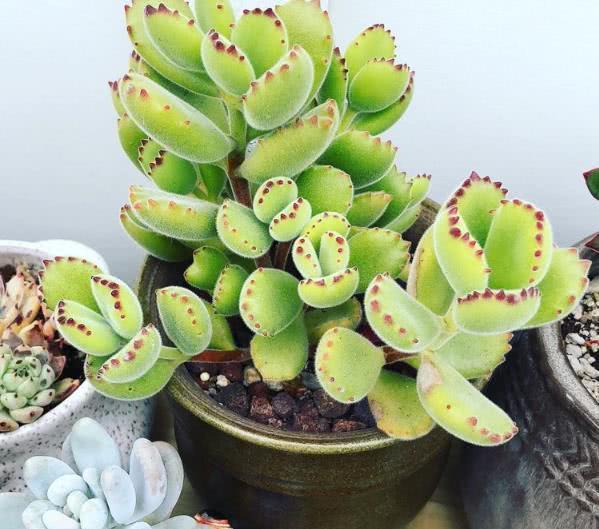
Succulent pots must have drainage holes, and the planting medium for succulents must also be sterile. Pots with holes do not easily become waterlogged, effectively preventing succulent root rot. A larger pot diameter is good for ventilation. Although pots with a narrowed opening look nice, they are not so suitable for succulents getting through the summer. Observe the plants' growth state regularly. Once you find a plant looking abnormal, dig it out promptly, and choose to take it out of the pot to get through the summer.
Whether a succulent container is breathable is the most important criterion when choosing a pot for succulents. An ordinary plain pottery pot is the most breathable and the "home" succulents like best. There are many painted pottery pots on the market that look cute but are less breathable. However, offsetting the overly breathable nature of plain pottery pots, they actually become a good choice. It is just that if you want to buy painted pottery pots, you must choose ones with drainage holes in the bottom. If you are really fascinated by those beautiful holeless containers, you can first put a layer of well-draining pumice or even coal cinders, foam and the like at the bottom of the holeless container, and just pour out the excess water each time after watering thoroughly.
Red clay pots are about as breathable as tile pots. Their common drawback is that once the pot is small, being too breathable means they do not hold water well and dry out very easily. Although porcelain pots are pretty, they are not very breathable, so attention must be paid to solving the breathability problem. The center of the pot can be left empty (for example, when multiple plants are mixed together), and it is best to use a straight-through ventilation tube. But making a straight-through ventilation tube is rather troublesome, and it generally suits large porcelain pots, while what we stack on office desks are mostly small and medium porcelain pots. In summer, do not give succulents too much water. If you are afraid the succulents' roots will dry out from lack of water, you can place the succulents next to a water trough with water in it, or find a foam box, fill it with water and place it next to the succulents. The succulents' water-deficient state will improve noticeably.
Generally speaking, the root system of succulents is not very developed, and excess water in the soil cannot evaporate and transpire away all at once, which easily leads to rot. So when choosing a pot, follow the principle of "rather small than large, rather shallow than deep." For medium and large globular cacti, choose a pot whose diameter is basically equal to the globular diameter, or a pot diameter one or two cm slightly larger than the globular diameter. For small globes, it is best to plant several together. The depth of the growing soil should be at most twice the globular diameter. That is, if the globular diameter is 5 cm, a soil depth of ten cm is quite enough, and for large globes it can be even shallower. The larger the globe, the less water and nutrients it consumes. Too much potting soil is not only useless but also easily leads to rot. If the pot is too deep, be careful to add more non-soil filler at the bottom.
Actually, pot materials are really quite varied: red clay pots, porcelain pots, coarse pottery pots, wooden pots, wrought iron pots, plastic pots, and even little pots made from eggshells. Pots of different materials differ only in shape, because each has its pros and cons. When the medium is dry, it is easier to remove the plant from the pot, so try to repot when the medium is dry. For repotting seedlings, or when the roots are relatively new and not aged, you can move them directly into a larger pot without pruning the roots. If the roots have already aged, it is recommended to prune the roots, remove at least two-thirds of the original soil, and then pot them up.
Do not use a large pot for small seedlings, and do not use a small pot for large plants. It is best for the distance between the outermost edge of the plant and the pot rim to be at least one cm. Whichever kind of pot it is, the choice is made according to your own interests and preferences. Retro or modern, it is always a kind of life enjoyment. For all plants to survive, thrive and look spirited, root breathability is indispensable. Besides the pot not being too large, the soil being loose, and placing them in a ventilated environment, you must also pay special attention to the size of the drainage holes at the bottom of the pot. Whether it is a cartoon pot, plastic pot, pottery pot, purple clay pot or porcelain pot, the ventilation holes at the bottom are generally too small or too few. You should without hesitation use an electric drill, an ordinary drill bit or a glass drill bit, etc., to enlarge the bottom holes as much as possible or drill as many extra holes as possible.
This is a gathering place for succulent lovers, sharing succulent care tips. Welcome to follow and exchange ideas.