Tips for growing Hoya at home: more blooms, rich fragrance, long flowering period
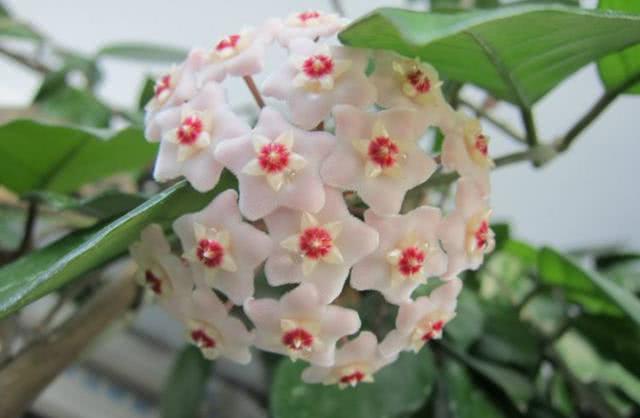
Hoya, a high-appeal internet-famous plant. Its original living environment is in tropical and subtropical regions, growing epiphytically on tree trunks or rocks, with aerial roots growing at the stem nodes and strong climbing ability, and its stems and vines can extend more than 2 m. When it blooms, 3 to 4 inflorescence peduncles grow from the leaf axils, in umbel-shaped inflorescences, and each cluster can bloom continuously for more than 10 days with a rich fragrance. After fading, the flowers and flower stalks fall off on their own, leaving the inflorescence and main peduncle, and after a period of time they will continue to produce flowers, with the flowering period from May to October.
For home cultivation, the most suitable growing environment is a spot with light by a window on an indoor balcony or under a tree in the yard where it can climb, but Hoya is afraid of cold, so in winter it must be moved indoors in time to prevent frost damage. Hoya likes warmth, tolerates drought, and prefers high temperature and high humidity and a semi-shaded environment, but it also likes light, and giving it 3 to 4 hours of sufficient light every day is the prerequisite for Hoya to bloom. Long-term shade will cause it to grow only leaves without flowering, and in midsummer it should be properly shaded, otherwise the leaves will turn yellow and the colors will not be vivid.
Generally, Hoya propagated by cuttings in the current year will only bloom in the second or third year. Hoya likes loose, fertile, well-drained soil and can tolerate short-term drought, but not waterlogging. For the soil mix, it is recommended to combine leaf mold, garden soil, and river sand in a 5:3:2 ratio; at the bottom of the pot, it is recommended to spread a 3 to 4 cm thick layer of large expanded clay pebbles or small stones for the roots to attach to, and a small amount of bone meal or fermented chicken manure can be added as base fertilizer. A poor soil mix choice will cause slow growth.
For choosing a pot for Hoya, it is usually recommended to choose a slightly smaller tall pot or hanging pot, and this should be chosen according to personal preference and variety. Why is it recommended to choose a slightly smaller flower pot? Because plant growth always starts with roots and branches, accumulating enough nutrients for vegetative growth, and then flowering and fruiting for reproductive growth. If the pot is too large, Hoya will desperately grow roots, and only after the root system fills the pot will it begin to grow leaves, which invisibly prolongs the time for Hoya to bloom. If there are too many roots and stems in the pot, a slight lapse in watering will cause root and stem rot, which is unfavorable to plant growth.
Hoya's original creeping root system is shallow and weak, which instead promotes the development of relatively strong aerial roots, and aerial roots are another major pathway for Hoya to absorb nutrients. Therefore, when we water Hoya, do not water unless the potting soil is dry; especially in the cold winter, when the temperature is low, the amount of watering must be controlled even more. Hoya likes a humid climate, and frequent misting will allow the aerial roots to absorb enough water for branch growth. An overly dry air environment will affect the beauty of the leaves and the formation of flower buds. After inflorescences appear, do not move the branches back and forth or move the flower pot, to prevent flowers and buds from dropping. Protect the tumor-like nodes on the vines to facilitate the growth and flowering of new vines.
Each year from May to August is the vigorous growth period of Hoya, and it can be given a decomposed organic liquid fertilizer once every 15 days, such as diluted cake fertilizer water, combined with additional inorganic phosphorus and potassium fertilizers, such as monopotassium phosphate, which not only helps the stem nodes become strong but also promotes more blooming in Hoya. After autumn, reduce the frequency of watering and fertilizing, which helps it overwinter.
For pruning Hoya, the adventitious buds sprouting on the branches can be removed in time in a targeted way to avoid excessive consumption of nutrients, and some branches and stems can also be properly thinned to increase the plant's air circulation, making the plant grow more robust and more conducive to concentrating nutrients for flowering. However, do not prune off branches of Hoya that have already bloomed, because next year it will bloom again on the original flower stalk, so when pruning, the original flower stalk must be retained.