Succulent leaves turning yellow in summer? Correct your watering mistakes to make the leaves vibrant
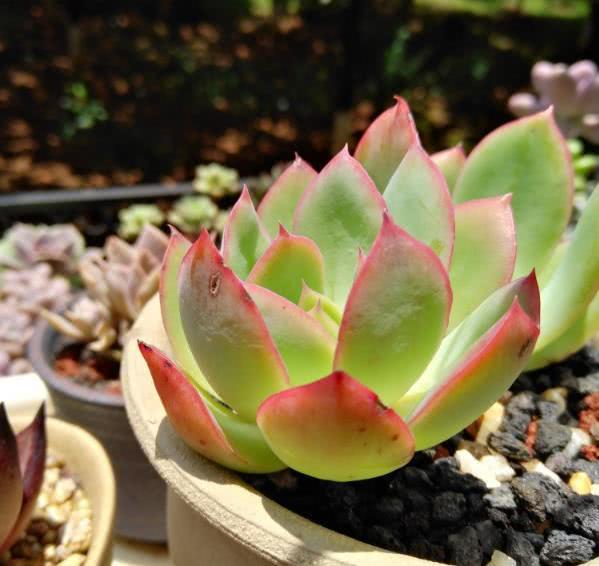
Yellowing leaves on succulents can affect their ornamental value, and if the yellowing is severe, it can also threaten the healthy growth of the plant. So what generally causes succulent leaves to turn yellow? How can you help the leaves recover quickly? When you water too much in summer, soil moisture becomes very high, and once the potting soil cannot drain excess water in time, it leads to root rot and mold in succulents. Some succulent growers notice a white, mold-like layer growing on their succulents at home, so how do we deal with this situation? Based on my observation, mold does not affect the growth of new succulent leaves, and improving the environment is enough.
There are many reasons succulent leaves turn yellow: if it is caused by insufficient soil drainage, then replace the soil with one that drains well; if it is caused by overwatering, then loosen the soil with a trowel and reduce the frequency of watering. If it is caused by insufficient light, then move it to a spot with plenty of light for care. If the soil is too hard and compacted, the water you pour cannot penetrate into the soil layer, so most succulent roots cannot absorb water and nutrients. The correct approach is to use a soil-loosening tool to pry the potting soil loose, making the soil loose and airy. Loosen the soil for your succulent by carefully inserting a trowel into the soil and gently wiggling it so the soil loosens and the water in it can evaporate quickly, and reduce the frequency of watering from then on.
We all know that the original growing environment of succulents is in arid tropical regions, so frequent rain easily causes mold in succulents. The best way to prevent and control this is not to let them get too much rain, and you must always control watering; ventilation is the most important thing. Indoor potted succulents easily develop yellow leaves due to insufficient light, so it is best to place them in a sunny, well-ventilated spot indoors to enhance photosynthesis, and when you have time, put them outside to sun for two hours. Insufficient fertility. If potted succulents are only watered, the fertility is very limited. Apply an organic fertilizer or a nitrogen-phosphorus-potassium compound fertilizer once every half month, and the plant will grow better, and yellow leaves will never come knocking again.
In everyday succulent care, also be careful not to pull off all the leaves as soon as you notice yellowing. This is because succulent leaves store quite a lot of nutrients, and pulling them off directly wastes those nutrients. One or two leaves really do not hold much nutrients, but once the number grows, the total amount of nutrients is also large. You can wait until their nutrients have been absorbed and they begin to shrivel before pulling them off. If you usually place it in a spot that is too dark, without sufficient light, it cannot synthesize chlorophyll normally, which also causes the plant's leaves to turn yellow, so you can move the succulent to a spot with plenty of light for care.
Succulents are afraid of cold and of stuffy heat, so they must be placed in a well-ventilated spot, and then watering must be strictly controlled. You can judge whether the plant lacks water by observing whether its leaves are plump. If they have shriveled, water a little in moderation. Generally speaking, succulents with thin leaves need slightly more water than succulents with thick leaves. Some flower growers take their succulents to the balcony or terrace to get rained on whenever it rains, and sometimes they get rained on continuously, which is not okay. One day of rain is fine; if they get too much rain, the succulents easily rot as soon as the sun comes out.
Cacti and succulents generally like warmth and a large temperature difference between day and night. Except for epiphytic cacti and species of the genus Haworthia, they need plenty of light, but it should be soft. For this reason, apart from a few species with flat stem segments and tall columnar species and certain Agave species, they should generally be cultivated in a greenhouse year-round. Most terrestrial cacti grow most vigorously at 28°C to 35°C during the day and 10°C to 15°C at night, and growth stalls when the indoor temperature is often above 35°C to 38°C.
This is a gathering place for succulent lovers, sharing succulent care tips; you are welcome to follow and join the conversation.