Snow lotus gets its name because it resembles a lotus flower, symbolizing pure white love, resilience and purity
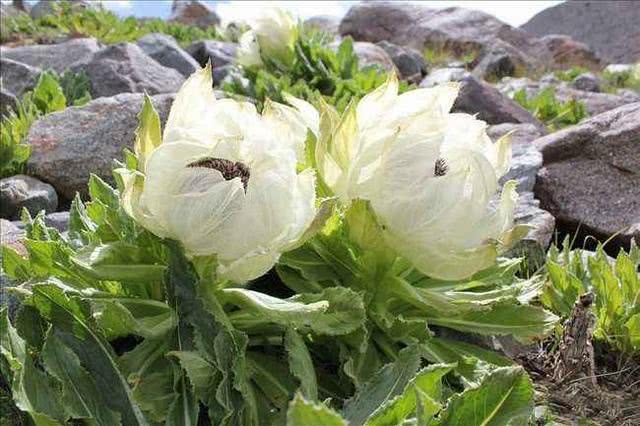
Snow lotus (a plant of the genus Saussurea in the family Asteraceae)
Snow lotus (scientific name: Saussurea involucrata (Kar. et Kir.) Sch.-Bip.), named snow lotus because its top resembles a lotus flower, abbreviated as snow lotus. It is a perennial herb, 15-35 cm tall. The rhizome is thick, with the neck covered by numerous brown leaf remnants. The stem is stout, hairless. The leaves are dense, the basal leaves and stem leaves are sessile, the leaf blades are elliptical or ovate-elliptical; the uppermost leaves are bract-like, membranous, pale yellow, surrounding the capitulum, with sharp teeth on the margins. There are 10-20 capitula, densely aggregated at the stem apex into a spherical compound inflorescence. The involucre is hemispherical, 1 cm in diameter; the involucral bracts are in 3-4 layers, with margins or entirely purplish-brown. The florets are purple. The achene is oblong. The pappus is dirty white. Flowering and fruiting period is July-September.
It is distributed in many high-cold regions of China, and also in Russia and Kazakhstan. It grows in rock crevices, stone walls and glacial till gravel flats near the alpine snow line, at an altitude of 2400-4000 m. The most abundant and highest quality snow lotus comes from the Tianshan Mountains. It can be used medicinally and also has some ornamental value. In 1996, China listed Tianshan snow lotus as a second-class protected plant. Tianshan snow lotus is the only snow lotus plant listed in the "China Plant Red Data Book" and is a national third-class endangered species in China. In 2000, Document No. 13 of the State Council explicitly prohibited the digging of wild snow lotus.
Morphological characteristics
Perennial herb, 15-35 cm tall. The rhizome is thick, with the neck surrounded by numerous brown leaves. The stem is stout, 2-3 cm in diameter at the base, hairless.
The leaves are dense; the basal leaves and stem leaves are sessile, the leaf blades are elliptical or ovate-elliptical, up to 14 cm long and 2-3.5 cm wide, with obtuse or acute tips, decurrent bases, sharp teeth on the margins, and hairless on both surfaces; the uppermost leaves are bract-like, membranous, pale yellow, broadly ovate, 5.5-7 cm long and 2-7 cm wide, surrounding the capitulum, with sharp teeth on the margins.
There are 10-20 capitula, densely aggregated at the stem apex into a spherical compound inflorescence, without pedicels or with short pedicels. The involucre is hemispherical, 1 cm in diameter; the involucral bracts are in 3-4 layers, with margins or entirely purplish-brown, acute at the apex, the outer layer sparsely covered with long soft hairs, the outer layer oblong, 1.1 cm long and 5 mm wide, the middle and inner layers lanceolate, 1.5-1.8 cm long and 2 mm wide. The florets are purple, 1.6 cm long, with a tube 7 mm long and a limb 9 mm long.
The achene is oblong, 3 mm long. The pappus is dirty white, in 2 layers, the outer layer small, bristle-like, 3 mm long, the inner layer long, feathery, 1.5 cm long. Flowering and fruiting period is July-September.
Origin and habitat
Snow lotus is mostly distributed in the Tianshan Mountains of Xinjiang (Urumqi, Bogda Mountain, Hoxud) and the Qinghai-Tibet Plateau. It is also distributed in Russia and Kazakhstan. [3] It is suitable for various complex climatic environments, usually growing below the alpine snow line. The climate is changeable, with unpredictable cold and heat, alternating rain and snow, the highest monthly average temperature 3-5°C, the lowest monthly average temperature -19 to -21°C, annual precipitation of about 800 mm, a frost-free period of only about 50 days, and the soil mainly alpine meadow soil. The lower altitude limit of the growing environment is 2400 m, and the upper altitude limit is 4000 m.
Growth habits
The environment in which snow lotus grows is extremely harsh; ordinary plants simply cannot survive in its growing environment, yet snow lotus can brave frost and snow and grow tenaciously in severe cold of dozens of degrees below zero and in an oxygen-poor environment with thin air. It is precisely this unique survival habit and distinctive growing environment that make snow lotus naturally rare, and also create its unique pharmacological effects and medicinal value.
The yield of snow lotus is extremely low. It takes five years for snow lotus to go from germination to flowering. Its seeds germinate at zero degrees Celsius and grow at three to five degrees Celsius. The seedlings can withstand low temperatures of minus twenty-one degrees Celsius, yet the actual growth period is less than two months. In just this short growth period, relying on its vigorous vitality, the snow lotus plant can exceed other plants in height by five to seven times.
Reproduction method
Due to its special growing environment, it takes 3 to 5 years to flower and bear fruit. During the flowering period, the seeds drift in the wind among the mountains, and only seeds that encounter a suitable environment can possibly germinate and grow.
Species status
Snow lotus is now rather scarce. Before the 1890s, snow lotus could be collected at an altitude of about 1800 m in some mountainous areas of Xinjiang, but after the twentieth century it has become hard to find below an altitude of 3500 m. In addition to the sharp decline in total resources, the diameter of the snow lotus head has also dropped from 30 cm to only about 10 cm.
Main values
Medicine
Main therapeutic effects
Snow lotus is warm in nature, sweet and bitter in taste, and enters the liver, spleen and kidney meridians. It has the effects of dispelling cold, strengthening yang, regulating menstruation and stopping bleeding, and is used to treat impotence, weakness of the waist and knees, irregular menstruation in women, abnormal uterine bleeding and excessive vaginal discharge, rheumatoid arthritis and traumatic bleeding, among other conditions. "Supplement to the Compendium of Materia Medica" records: snow lotus "is very hot in nature and can tonify essence and strengthen yang"; "Xinjiang Chinese Herbal Medicine" records: "snow lotus is warm in nature and slightly bitter, with the function of dispelling wind and removing dampness."
Snow lotus contains proteins, amino acids, flavonoids, alkaloids, etc. It has the effects of promoting menstruation and blood circulation, dispelling cold and removing dampness, stopping bleeding and reducing swelling, and eliminating toxins from the body.
Application in traditional Chinese medicine
Warming the kidney and strengthening yang. Used for impotence due to kidney deficiency and soreness and weakness of the waist and knees; used for irregular menstruation, abnormal uterine bleeding and vaginal discharge in women. For the former, it is combined with Cordyceps sinensis and soaked in liquor for drinking; for the latter, it is combined with Emei sanicle and codonopsis, and stewed with chicken for consumption.
Warming the meridians and dispelling cold. Used for cold pain in the lower abdomen in women, amenorrhea, retention of the placenta, and other syndromes. Take 15 g of snow lotus, add 100 mL of baijiu or yellow rice wine, soak for 7 days, take 10 mL each time, twice a day.
Dispelling cold and resolving phlegm. Used for cough due to lung cold, with profuse white phlegm. Take 1-1.5 g of the whole snow lotus herb, grind into powder and take with water, 3 times a day.
Dispelling wind and removing dampness. Used for rheumatic arthralgia and difficulty in flexing and extending the joints. Take 50 g of snow lotus, cut into sections, add 500 mL of baijiu, soak for 10 days, take 10 mL each time, twice a day. Or use snow lotus injection for intramuscular injection, 2-4 mL each time, which has a certain therapeutic effect on rheumatoid arthritis.
Used for snow blindness and toothache. Take 6-12 g of snow lotus, eat raw or decoct in water.
Used for traumatic bleeding. Take an appropriate amount of snow lotus, mash it and apply to the affected area.
Pharmacopoeia records
In the book "Supplement to the Compendium of Materia Medica" written by Zhao Xuemin in the Qing Dynasty, there are records such as "in the land of great cold, snow accumulates, and does not disperse in spring and summer; among the snow there is a grass, like a lotus with a single stem, graceful and lovely among the snow" and "in that land there is the Tianshan Mountains, with snow accumulating in winter and summer; among the snow there is a lotus, and the one from the summit of the Tianshan Mountains is the best." Nature and taste: bitter, slightly bitter, warm; functions and indications: clearing heat and detoxifying, dispelling wind-dampness, reducing swelling, relieving pain.
"Supplement to the Compendium of Materia Medica" records: "Snow lotus resembles a lotus in shape and reaches about a chi in height. It is produced in Ili and other places, and the one produced on the summit of the Tianshan Mountains is the best." It correctly records the shape and origin of snow lotus. Snow lotus is a perennial herb of the family Asteraceae, also known as snow lotus and stone lotus. It grows in rock crevices, stone walls and glacial till gravel flats near the snow line of the Tianshan Mountains, Altai Mountains and Kunlun Mountains in Xinjiang. The most abundant and highest quality snow lotus comes from the Tianshan Mountains.
Beauty
Beauty facial cream
It can accelerate skin metabolism, reduce wrinkles, keep the skin glossy and full, and delay aging. It also has a good therapeutic effect on facial freckles, liver spots, and other conditions.
Specific formula
25 g of snow lotus powder (one flower), 20 mL of fresh aloe juice, 30 mL of cucumber juice, 1 raw egg, about 10 g of flour, 5 g of granulated sugar, and a little essence. Mix well and place in the refrigerator to extend the shelf life. After applying this cream to the face, after 40-45 minutes, the facial cream will dry and form a film. At this time, gently wash off the cream with clean water. Persist once a week, and after a few times you will feel the skin is noticeably smoother and more elastic. If you do it for just 1 month, a fairly good effect will appear. If you persist, it will make the skin fair, tender and rosy, and it also has a marked effect on freckles and dark spots, and can also restore skin with frostbite or scars.
For melasma, you can use 30 g of snow lotus powder and 15 g of mung bean powder, mix well with a little egg white, and apply to the spots 3 times a day. After one month, melasma, liver spots, etc. can gradually fade.
Conservation status
Severe harvesting
Wild snow lotus reproduces by seeds and requires 6 to 8 years of growth. If it is pulled out by the roots, snow lotus cannot grow again in the same place. In the 1950s and 1960s, snow lotus could generally be collected on gravelly slopes at an altitude of about 1800 m. At that time, the area of snow lotus in Xinjiang, China was about 50 million mu, but now it is less than 10 million mu.
Every year from July to August is the season when wild snow lotus blooms in the Tianshan Mountains of Xinjiang. However, at this time every year, large numbers of lawbreakers come to crazily dig it up near the snow line above 3000 m. Relevant local experts have repeatedly stated that if this phenomenon is not curbed, within a few years, this precious species, the snow lotus, may disappear from the earth.
Protection measures
In order to protect Tianshan snow lotus, the Snow Lotus Protection Branch of the Xinjiang Wild Animal and Plant Protection Association of China launched public welfare publicity activities for snow lotus protection among pastoral areas and tourists in the Tianshan Mountains to stop indiscriminate harvesting. The Xinjiang Technical Institute of Physics and Chemistry of the Chinese Academy of Sciences also used cloning and tissue culture technology to artificially plant snow lotus at Tianchi in the Tianshan Mountains starting in 2004. Some snow lotus plants have already bloomed, and it is expected to open up new channels to replace the supply of wild snow lotus to meet the demand of the pharmaceutical market.
In 1996, China listed Tianshan snow lotus as a second-class protected plant. Tianshan snow lotus is the only snow lotus plant listed in the "China Plant Red Data Book" and is a national third-class endangered species in China. In 2000, Document No. 13 of the State Council of China explicitly prohibited the digging of wild snow lotus.
In 2007, the "List of Key Protected Wild Plants of the Xinjiang Uygur Autonomous Region (First Batch)" listed Tianshan snow lotus as a first-class key protected wild plant.
Article 344 of the Criminal Law of the People's Republic of China: Whoever, in violation of the provisions of the Forest Law, illegally fells or destroys precious trees or other plants under special state protection, or illegally purchases, transports, processes or sells precious trees or other plants under special state protection and their products, shall be sentenced to fixed-term imprisonment of not more than three years, criminal detention or control, and shall also be fined; if the circumstances are serious, shall be sentenced to fixed-term imprisonment of not less than three years but not more than seven years, and shall also be fined.
Plant culture
Folk legends
In the past, when alpine herders encountered snow lotus on their journeys, it was considered an auspicious sign, and they treated it as a sacred object. According to legend, this lotus in the snow was scattered by fairies when the Queen Mother of the West of the Jade Pool came to Tianchi to bathe, and the snow peak opposite, at an altitude of more than five thousand meters, is a beautiful mirror. Snow lotus is regarded as a divine object. Drinking the dewdrops on its bracts is believed to ward off evil and cure diseases and prolong life.
Plant flower language
Plant symbolism
Snow lotus represents pure white love, resilience, purity, and brings people hope.
Implied meaning
Pure white love, resilience, purity, bringing people hope, and also a symbol of holiness.