The Rafflesia flower is as huge as a lotus leaf, smells foul, and enjoys the reputation of being the king of flowers in the world.
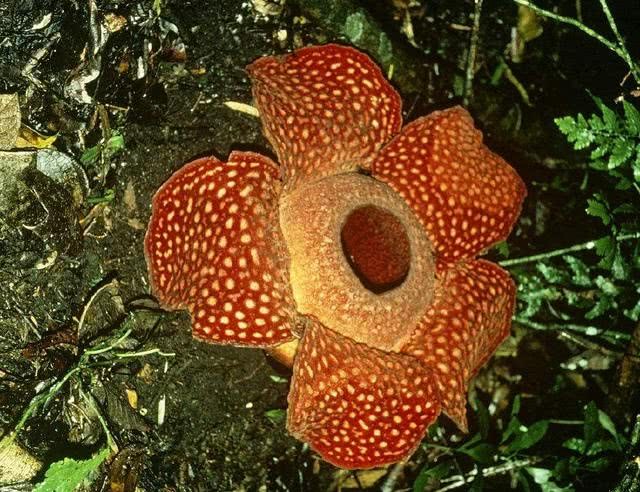
Rafflesia (the largest flower in the world)
Rafflesia is the collective name for 20 species of fleshy parasitic herbaceous plants in the genus Rafflesia [1] of the family Rafflesiaceae. Fleshy, parasitic herbs, parasitic on the roots, stems or branches of plants, without chlorophyll; the nutrient-absorbing organs are reduced to mycelium-like forms that invade the host's tissues. Leaves reduced to scales or absent. Flowers usually solitary, actinomorphic, unisexual, dioecious, with a united perianth. Stamens numerous to 5, without filaments; pistil composed of several united carpels; ovules extremely numerous, borne on parietal placentas, integuments 1-2 layers; style 1 or absent, stigma discoid, capitate or multilobed. Fruit a berry; seeds small, seed coat hard, with endosperm.
Native to tropical rainforests in Malaysia and Indonesia's Java, Sumatra and elsewhere. It is the plant with the largest flower in the world. Rafflesia is called Bungapatma locally, meaning "a flower as huge as a lotus leaf." It is famous for its enormous flower and foul odor, and enjoys the reputation of "king of flowers of the world." It is a saprophytic plant.
Discovery
The name Rafflesia comes from Sir Stamford Raffles during the British colonial period. In 1818, Sir Stamford Raffles and his friend Dr. James Arnold discovered the largest Rafflesia species at a place called Manna. Its species name "arnoldii" commemorates the leader of the scientific expedition that discovered this plant - the British naturalist Joseph Arnold.
The first botanist to discover a Rafflesia specimen was the French explorer Louis Auguste Deschamps (Auguste Deschamps) (1765-1842). He was a member of a French scientific expedition. During the expedition in the Asia-Pacific region, he spent three years investigating in Java. In 1797, he collected a specimen now known as Rafflesia horsfieldii. On the return voyage in 1798, his ship was sent to England, and as this was during the Anglo-French War, all his papers and notes were confiscated. In his lifetime, this expedition member did not see the dawn of this species being confirmed by the botanical world; it was not until 1954 that these materials were rediscovered at the Natural History Museum in London.
In 1818, the British botanist Joseph Arnold (1782-1818) and the statesman Sir Thomas Stamford Bingley Raffles (1781-1826, founder of modern Singapore) collected a specimen of another species - Rafflesia arnoldii, which grows in Sumatra. Shortly after being brought back by a Malay servant, Joseph Arnold died. Lady Raffles kept this specimen all along. To fulfill Arnold's last wish, she sent the completed drawings of the plant's form and color to Joseph Banks for preservation of the materials. Later, through the banker Robert Brown (1773-1858), they were transferred to the British Museum, where the resident botanical artist Franz Bauer (1758-1840) studied all the materials.
William Jack (1795-1822) was Arnold's successor in Sumatra. He knew Deschamps and also noticed various aspects of such species, and would find discrepancies with the facts in naming the newly discovered genus. He drafted an explanation to ensure the credibility of British botanists.
The type species of Rafflesia, commonly known as Rafflesia arnoldii, should originally have been named after Stamford Bingley Raffles, the first to describe the species, but it was ultimately named after the surname of the British botanist Joseph Arnold. This was decided at a meeting of the Linnean Society in London held in June 1820. The report published in the Philosophical Magazine that September announced this scientific name.
Morphological characteristics
Rafflesia is a fleshy parasitic herbaceous plant and not a true "man-eating flower." Their main axis is extremely short, with no leaves and no underground stem. The nutrient-absorbing organs are reduced to mycelium-like forms that invade the host's tissues, so the entire flower is all there is of it. Almost all the nutrients absorbed from the host are supplied to the growth of the flower. The flower diameter can reach 0.9144 m, with a maximum record of 1.4 m. The base of the Rafflesia is developed from the xylem of the host, and its shape closely resembles a wide-mouthed jar.
Fleshy, parasitic herbs, parasitic on the roots, stems or branches of plants, without chlorophyll; leaves reduced to scales or absent. Flowers usually solitary, actinomorphic, unisexual, dioecious, bisexual, very large (the largest flower in the world: Rafflesia, also known as Rafflesia arnoldii R. Br., about 1 m in diameter and weighing up to 7.5 kg, native to Sumatra.), perianth united, lobes 4-10 or absent, rarely free; male flowers: stamens numerous to 5, without filaments, arranged in 1-3 whorls around the column, or united into a tube in bisexual flowers, anthers 2-celled, dehiscing longitudinally or by apical pores, anther cells sometimes confluent, pollen often sticky, single or in tetrads; female flowers: pistil composed of 8-6-4 united carpels, ovary inferior, semi-inferior or superior, 1-celled or the placenta projecting near the middle to form many irregular cavities; ovules extremely numerous, borne on parietal placentas, integuments 1-2 layers; style 1 or absent, stigma discoid, capitate or multilobed. Fruit a berry; seeds small, seed coat hard, with endosperm.
The filamentous sprout of the seed can gradually spread within the stem bark without harming the host, until after a year and a half, when the seed has absorbed enough energy, it swells in volume, breaks through the seed coat and germinates a bud point of about 6 mm. After several months of slow growth, the flower bud gradually grows from the size of a table tennis ball to the size of a cabbage. After another month, the bud slowly opens, and complete blooming takes two days and two nights. The fully bloomed Rafflesia is brilliantly colorful, with the entire corolla bright red and dotted with white spots. The corolla is 50-90 cm, with 5 fleshy petals that are thick and tough, each petal about 5 cm thick and about 30 cm wide, and the total weight of the petals can reach as much as 10 kg. In the center of the flower is a large round nectary with a considerable capacity, able to hold 5-7 kg of water.
The plant is often parasitic on the roots or lower climbing stems of the trailing stems of plants of the genus Tetrastigma in the grape family under the leaf litter layer of tropical rainforests.
Habitat
Rafflesia grows in tropical rainforests at elevations of 500-700 m.
Growth habits
Because the growing area of Rafflesia has no division of the four seasons, it will sprout at any time of the year. From May to October each year is its main growing season. When it first emerges from the ground, it is only about the size of a table tennis ball. After several months of slow growth, the flower bud changes from the size of a table tennis ball to the size of a cabbage. Then the 5 fleshy petals slowly open, and by the time the flower is fully bloomed, two days and two nights have passed. It is hard to believe that the huge flower that Rafflesia has gone to such trouble to produce can only last 4-5 days, and during these 4-5 days, the flower will continuously release a peculiar stench, as foul as feces. Butterflies and bees are unwilling to pay it any attention, and large animals naturally avoid it, leaving some carrion-loving insects to pollinate it and act as matchmakers. When the petals wither, they turn into a pile of rotten black matter. Before long, the fruit also matures, hiding within it many tiny seeds, ready at any time to fall into the ground and seek a suitable place to germinate.
Rafflesia blooms only one flower in its entire life, and the flowering period is only 4 days. In the early stage of the bud opening, it has a fragrance, and afterward it gives off a pungent, putrid odor, hence the alternative name Corpse Flower. The foul odor emitted by the pollen attracts flies and other carrion-feeding animals to pollinate it. Squirrels are also very interested in the pollen, often licking from one anther to another. On the 4th day of the flowering period, the petals of Rafflesia gradually turn black and wither, turning into a pool of viscous black matter within a few weeks. A successfully pollinated female flower will gradually form a semi-decayed fruit within the following 7 months. A stunning flower bearing a rotten fruit is truly a wonder of the plant world. The fruit is spherical, about 15 cm in diameter, with a woody, brown skin. Beneath the skin it is filled with milky white, lipid-rich flesh, as well as thousands of tiny reddish-brown seeds.
Reproduction method
Although the flower of Rafflesia is very large, its seeds are extremely small and sticky, and are almost indistinguishable with the naked eye. Moreover, there is still considerable controversy in the scientific community about exactly how Rafflesia seeds are dispersed. Some scholars believe: "The seeds are trampled by deer, wild boars and the like into plants with damaged stem bark, and then reproduce."
Species research
Regarding the species classification of Rafflesia (also known as "giant flower"), scholars in Malaysia claim to have possibly discovered a new species of the genus Rafflesia. Plants of this genus are famous for their enormous flowers and foul odor. Forestry officials in eastern Terengganu state in Malaysia said they had discovered a special Rafflesia plant whose petals resemble those of a known species, while the internal form of the flower resembles that of another species.
Forestry official Roslee Jamaludin believes this may be a new species, a variety, or a form. Everyone is excited about the discovery. After examining known Rafflesia plants, no species has been found to have the same characteristics as it. Of course, before confirming that this is a new species, its characteristics must be observed more carefully.
Jamaludin said the exact location where this Rafflesia was found cannot yet be made public. When people found this Rafflesia, it was climbing on a tall tree. What is even more peculiar is that it has no stem and no leaves, growing on a kind of vine, and the entire flower is all there is of its body. Almost all the nutrients that Rafflesia absorbs from the vine are supplied to the growth of the flower.
According to the introduction, plants of this genus are famous for their enormous flowers and foul odor. Although Rafflesia is rare, it has been found in several countries in Southeast Asia. Its flower is enormous, reaching up to 1 m in diameter and weighing up to 10 kg, making it one of the largest flowers in the world. Harvard University botanist Charles Davis and his colleagues reported in the online edition of Science magazine that they used the latest DNA molecular marker technology to conduct comparative analysis of Rafflesia with a series of plants, and found that it should belong to the Euphorbiaceae in the plant family tree. Davis said that this Rafflesia, which lives among the understory plants of Southeast Asian tropical rainforests, generally parasitizes plants of the grape family, and the giant flower it produces is blood-red and gives off a putrid odor, which can be used to attract a certain kind of fly to pollinate it. Botanists generally classify plants with similar characteristics into the same family, but the flower of Rafflesia is astonishingly large, which is truly rare among flowering plants. In addition, because it is a parasitic plant, it lacks the typical structures of plants such as leaves and stems, and because of parasitism, it has absorbed many genetic characteristics of grape family plants, so scientists have never known which family it should belong to. The new research believes that Rafflesia should belong to the Euphorbiaceae, which surprised them greatly, because the flowers of Euphorbiaceae plants are only a few hundredths the size of Rafflesia. Digitalis, poinsettia and castor bean all belong to the Euphorbiaceae. That flowers differ so vastly in size yet belong to the same category is very puzzling. The next step is for them to conduct further research on Rafflesia, such as analyzing why its flower is so large and how it evolved.
Population status
Because of the little-known reproduction method of Rafflesia, it can only rely on natural dispersal. In addition, places where Rafflesia grows are regarded as fertile land and are used for other purposes; the lack of good protection has led to the gradual decline of Rafflesia.
Due to the impact of human activities such as logging and the opening of plantations, large areas of local rainforest are rapidly decreasing. The lack of a suitable environment has caused Rafflesia to decline year by year. In addition, local legend says that Rafflesia has medicinal value, with effects of tonifying the kidney and strengthening yang, and the extract prepared from flower buds is a good medicine for women during childbirth. Overharvesting by local people has put Rafflesia in serious danger of extinction.
The Indonesian government is also organizing botanists to search for and protect this plant. In 1984, the International Union for Conservation of Nature and Natural Resources listed Rafflesia as one of the "most seriously threatened endangered plants worldwide," calling on the world public to pay attention and begin protecting this largest and strangest flower in the world. In 1997, the Sabah Wildlife Conservation Enactment was formulated, and Rafflesia was made a protected plant. In 2002, the relevant authorities found that 44-83% of Rafflesia were outside protected environments, so they sent personnel to search for and monitor them, hoping that in the future Rafflesia and its growing environment would no longer be damaged.
Conservation level
The species of this genus "Rafflesia magnifica" has been included in the International Union for Conservation of Nature (IUCN) 2013 Red List of Threatened Species ver 3.1 - Critically Endangered (CR).