A 50 sq m small garden on a sixth-floor rooftop terrace: how can it have scenery in all four seasons?
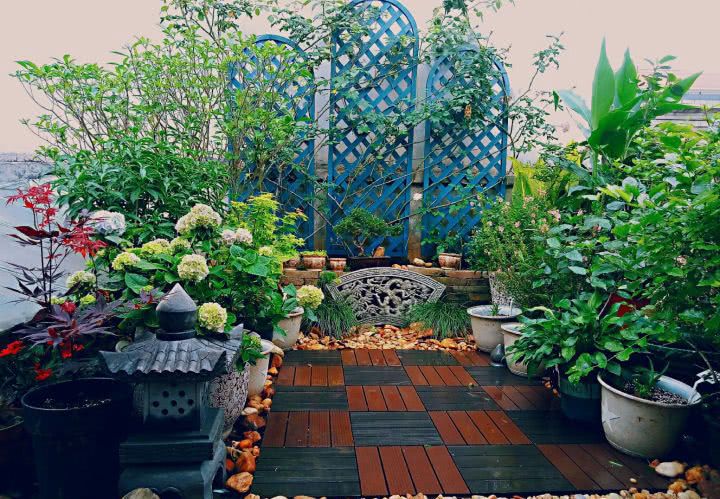
I have a small terrace garden. This is the sixth floor, a rooftop terrace of 50 sq m+, facing south with a north-facing back! A self-built building by the riverbank in the city center of a small city in the south! The small garden is already more than half done! The key to whether it is beautiful is plants + landscaping, achieving scenery in all four seasons?
Compared with balcony gardens and entrance gardens, roof gardens are independent, larger in area, and highly adaptable, but because they are located on a rooftop, the first things to consider are key factors such as fire safety, load-bearing capacity, waterproofing, and routine maintenance. Apart from lightweight shade trellises, flower stands, and the like, non-professional architects should not arbitrarily add heavy structures on the roof (important matters should be said three times!!)
As far as possible, do not choose flower species and small trees that root very deeply and grow upward quickly. First, this leaves hidden safety risks for the floor slab; second, it affects wind resistance.
Plants are living things, with individuality and characteristics. Every kind of plant is an encyclopedia. If you just want to plant something simply, then you can ignore my above description of the plant part, but do remember to refer more to the previous key factors: fire safety, load-bearing capacity, waterproofing, wind resistance, pest prevention, and fall prevention.
Plants determine their own growth rate according to the "container." If they are in sturdy ceramic or cement flower pots, then generally speaking, the growth rate is relatively slow (less than a few cm a year), suitable for ornamental use, and the work of care and trimming is also relatively easy.
If the roof temperature is too low, plants will enter dormancy or suffer frost damage, stop growing, or even die.
In that case, the light transmittance, ventilation, and warmth retention functions of the roof garden must all be considered thoroughly so that plants can be less troublesome.
Many herbaceous plants can withstand severe heat (after all, they are mainly subtropical and tropical plants), but they are not tolerant of low temperatures. Plants generally prefer warm, humid environments with sufficient light. The best environment is a transparent glass roof with some shading function, or the open air.
Japanese black pine, Chinese juniper, boxwood, crape myrtle, and elm are cold-tolerant deciduous woody plants and can generally overwinter safely outdoors in the south; hibiscus, pomegranate, and Vitex negundo var. cannabifolia are all cold-tolerant deciduous woody plants. Their leaves will fall, and new buds will sprout the following spring.