Crassulaceae succulents are not hard to grow in summer; water them well and they will still look beautiful in summer
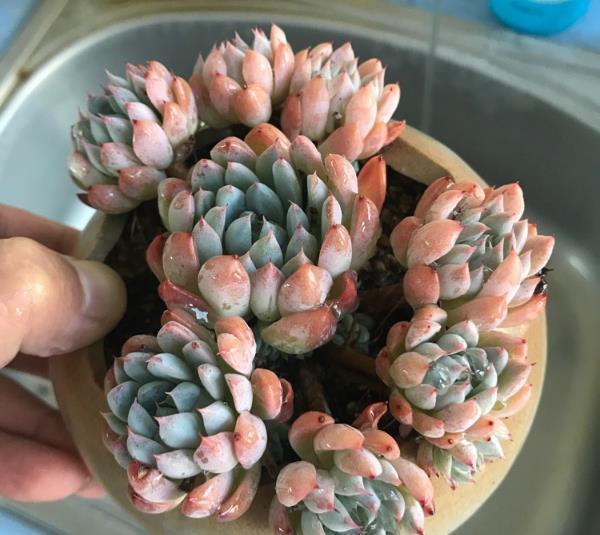
Crassulaceae plants are distributed across most of the Northern Hemisphere, with a great variety of species, about 35 genera and more than 1,500 species; China has 10 genera and about 240 species, plus a number of introduced species grown as ornamental flowers. Plants in this family are perennial succulent herbs, flowering in summer and autumn, with small but abundantly blooming flowers in every color. The epidermis has a waxy bloom, and the stomata are sunken, which reduces transpiration; they are typical xerophytes, with strong asexual reproduction, so that a picked leaf can be planted and will take root. Crassulaceae plants are short; because they are succulent, they use very little water and fertilizer, so they are extremely easy to grow for ornamental purposes. Because they are short and wind-resistant, do not need large amounts of water and fertilizer, and tolerate pollution, Crassulaceae plants have become the preferred plants for the currently popular roof greening.
Succulent plants that have fully entered dormancy are given water once a month, and this watering pattern differs from normal watering: use the soaking method, immersing the pot in water whose level is lower than half the pot's height for a few seconds; it does not need to be soaked through, only a slightly humid environment is needed. For Crassulaceae succulents in summer, the key points of care are: dormancy, ventilation, watering, and shading. Summer in Shanghai mostly enters the hot-summer pattern marked by the plum rain season in mid-June. Succulent varieties that go dormant in summer generally enter dormancy starting in June, and plants that are already dormant should be placed indoors in diffused light and ventilation or outdoors in a shaded spot.
Sempervivum succulents in the Crassulaceae family, also called houseleek, Guanyin rosette, and Buddha rosette, are one of the most common varieties among succulents and can be called the king of ordinary succulents. The leaves of Sempervivum have a peculiar shape, with clear and distinctive veins; it is relatively shade-tolerant and quite suitable for indoor arrangement. During the spring and autumn growing seasons, apply 1 application of rotted dilute liquid fertilizer or a low-nitrogen, high-phosphorus-and-potassium compound fertilizer about every 10 days. Fertilizer water should be light rather than concentrated; too much can easily cause fertilizer burn. The nitrogen content in compound fertilizer should not be high; too much can easily make the plant leggy. Sempervivum has low soil requirements, but fertile, loose sandy loam is suitable. You can use leaf mold, coarse sand, and vermiculite mixed at a ratio of 2:1:1, and add a small amount of plant ash and bone meal as a base fertilizer.
Actually, because everyone's care environment is different, semi-dormant succulent plants can have their watering interval adjusted according to their condition, usually watered once about every 2-3 weeks, still using the soaking method mentioned above, and the immersion time can be slightly longer than for fully dormant plants (the time should not be too long). Generally, I give the succulents a thorough watering four to five days before the plum rain season begins, and after placing them in a ventilated outdoor spot for three to four days, move them into an enclosed balcony. If under open-air growing conditions rain can be blocked, then they can continue to be grown outdoors throughout the plum rain season. Because conditions are limited, after the rainy season arrives I move the succulents indoors for care; throughout the plum rain season I do not water, only keeping the windows open for a few hours of ventilation each day.
Most Crassulaceae succulents like a low-temperature environment (about 5-18 degrees), a large temperature difference, and sufficient sunlight. The high temperature and humidity of summer often turn the leaves of Crassulaceae succulents into pieces of "jelly." The high summer heat is truly a major killer for Crassulaceae; besides strengthening ventilation, you have to start with the growing medium. Besides adjusting the medium, another key point is watering. During the winter growing season, water thoroughly each time, and water again once the medium is eighty percent dry; during the summer dormant period, wait until the medium is completely dry before watering, and give only half water while trying to avoid watering the plant itself; try to water after the sun has gone home, and do not water on rainy days or when air humidity is high.
After the rainy season, for those plants that have filled their pots, it is recommended to water from the bottom using the soaking method, but the soaking time should not be too long; better too little than too much. After watering, keep the environment dry and avoid water accumulating in the pot soil. For flowerpots that are not breathable or have relatively small bottom holes, you can prop up the bottom with a wooden stick or stone so that the drainage hole is above the ground, enhancing air permeability. Do not water on a fixed schedule or in fixed amounts. If the soil layer is six or seven centimeters, then water once the top two centimeters have dried through, that is, when the lower soil still has forty to fifty percent moisture; too dry harms the roots, too wet rots the roots. If you are not sure, insert a toothpick into it normally to keep track of the soil's dryness and moisture at any time. In winter, water at noon on clear days; in spring and autumn, water in the evening or early morning (evening is more recommended), so that by the time the sun comes out the soil is already fairly dry, avoiding too much moisture and stuffiness; in summer, control water, and watering can be done in the evening of cool, clear weather.
This is a gathering place for succulent plant lovers, sharing succulent care tips; you are welcome to follow and exchange ideas.