Succulent leaf cuttings always fail to survive, and the difficulty in rooting may be because you missed this one step
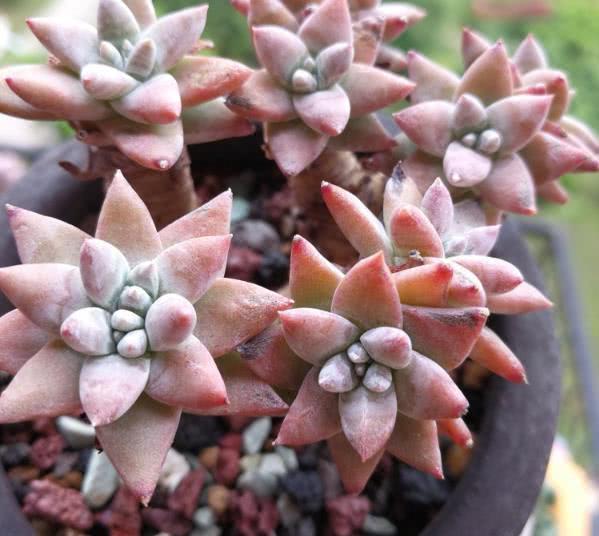
Actually, when it comes to succulent leaf cuttings, no matter how much attention you pay to the details, if you haven't found the right time and mistakenly believe that spring or autumn is the best time, then you are very much mistaken. In fact, it is just the opposite: the best time for leaf cuttings is summer and winter, when roots and shoots emerge more easily. In places with heating, winter is much the same as spring and autumn. The slowest season for leaf cuttings is summer, when shoots do not emerge easily and the leaves are also prone to turning to mush. Sometimes after taking leaf cuttings in the best season, an extremely harsh spell of weather follows, which is a great test of the succulents' condition; some stop growing entirely, and some even turn to mush, rot black, or stall as seedlings.
As for the steps of taking succulent leaf cuttings, the first is to select healthy leaves, then place the healthy leaves in indirect light to dry for 2-5 days so the wounds heal. During this process, the leaves may shrink slightly or wrinkle; if the leaves are healthy, this does not matter at all, and the leaves will begin to sprout and root in the air. Leaf cuttings have requirements for the moisture of the potting soil: too wet and the leaves rot easily, while completely dry soil is not good for rooting, and after rooting it is also not good for root growth, so you can only keep it slightly relatively moist, especially the surface soil. Generally, before taking leaf cuttings, use a spray bottle to moisten the surface soil.
If it is summer or winter, twist the leaves off and place them in a very dry place, preferably wrapped in paper. Most people choose to place the succulents on dry soil; in short, the environment needs to be dry, because this way you can leave them there longer and then wait for the next season. Choosing the right season for leaf cuttings can increase the survival rate. When repotting succulent leaf-cutting seedlings, you also need to pay attention: try to avoid light, and good ventilation is enough. If your leaf-cutting seedlings are really plump and full, you can try giving them a little light, but there must be a ventilated environment.
Most species in the Crassulaceae family and the Haworthia genus of the Liliaceae family can be propagated by leaf cuttings. However, a few varieties have a very low survival rate from leaf cuttings, such as Aeonium, Echeveria 'Tolimanensis' types and Agave victoriae-reginae, as well as varieties carrying their genes. Because leaf cuttings need appropriate moisture retention, it is recommended not to use terracotta pots; plastic pots and tin pots are recommended. The pot needs drainage holes. A flat pot is best, and doing it directly in a 7 cm-high seedling tray saves even more space. After the succulent leaf cuttings are arranged, place the pot in a ventilated environment without direct sun exposure, and spray water when the soil surface dries. A small amount of sunlight and bright indirect light are best (below 20 degrees, you can also give them strong sun through glass). During this period, these little ones absolutely love moisture~ as long as you do not keep them soaking in water.
After succulent leaf cuttings sprout, many situations can arise, such as sprouting only without rooting. There is no need to worry too much; this is equivalent to about 80% success. As long as the old leaf does not die and you let the little seedling grow slowly, it will definitely root after a certain amount of time, just as simple as rooting a broken-off branch by cuttings. When there is neither rooting nor sprouting, then you need to check the substrate at that spot to see whether it was damaged when it was twisted off, or whether a layer of skin from the stem is still attached; you can gently pull it off, which will make sprouting easier, and then all that is left is to wait quietly.
A small seedling that has rooted and sprouted is very healthy and has already grown quite large, while the mother leaf is still very healthy. This is the most hoped-for situation and also the best. When the seedling exceeds two or three centimeters, you can try gently shaking the mother leaf and slowly twisting it off, so that it becomes a new leaf again, and you can try leaf cuttings again and recycle it. Many people use a spray bottle to spray water onto the leaves, which is very bad, as it makes the leaves die more easily. With the mother leaf continuously providing nutrients, the seedling will grow healthier and much faster.
This is a gathering place for succulent plant lovers, sharing succulent care tips. Welcome to follow and exchange ideas.