How to deal with moldy, spotted leaves on plants during rainy days? Treat them in time to prevent the whole plant from dying
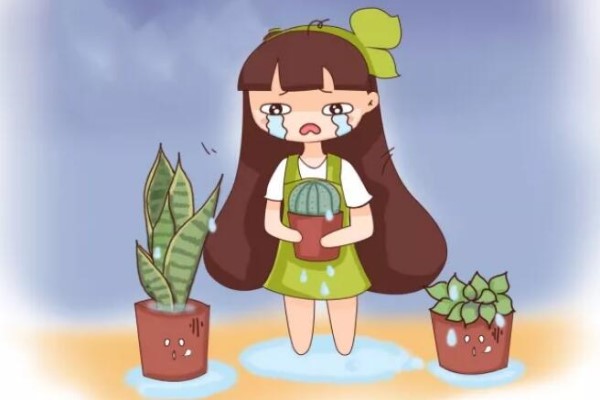
Waterlogging in flower pots
On rainy days, flower pots easily become waterlogged for two reasons: rainy days are very humid and there is little evaporation, so if you still water normally, the flowers can only absorb a small part, and the rest cannot evaporate and accumulates in the pot; flowers left outside in the rain get rained on for a day or two at a time, and the rainwater far exceeds what the flowers need.
Solution 1: Water less on rainy days, and flower pots must have holes
This method is mainly for prevention and to avoid water accumulating in the pot. On rainy days you must water less, especially for flood-sensitive flowers like the money tree, clivia, and kalanchoe, since the air humidity is already sufficient. If they are left outside in the rain, the bottom of the pot must have holes, and the holes in large flower pots should also be a bit bigger.
Solution 2: Put bricks under the pot to isolate it from the water source
For flowers left outside in the rain, do not place them directly on the ground. First, the water in the pot cannot easily drain out, and second, touching the wet ground is the same as soaking in water, which easily leads to bacterial infection and root rot. We can put two bricks under the flower pot and expose the small holes at the bottom of the pot, and then even a day of rain is nothing to fear!
Solution 3: Turn on a fan for ventilation, and find a way to dry them out
If your flower pot stays damp for 2 or 3 days, immediately stop watering, put it in a ventilated place, and if necessary blow a fan on the flowers to speed up evaporation; in serious cases, still take the flowers out together with the soil, let them dry, and once they are almost dry, put them back in the pot.
Various flower diseases
After a rain, flowers easily get sick, mainly showing on the leaves. You must be careful with the following situations!
Black spot disease: every year during the summer rainy season, the leaves of flowers after being rained on develop black spots, and they spread quickly, so within a few days the flowers become bare stems.
Solution: Sprinkle wood shavings on the pot surface, spray medicine
Spread some wood shavings, coal cinders, bamboo charcoal, and the like on the pot surface to isolate bacteria in the soil. After the rain stops, spray some carbendazim on the leaves, then do not let them get rained on again, and place them on an indoor ventilated balcony or similar for the effect.
Anthracnose: caused by insufficient light, high humidity, and inadequate ventilation on cloudy and rainy days. It is especially common on foliage plants such as orchids, pothos, money trees, and monstera, with yellow water-soaked necrotic areas on the leaves.
Solution: Clean up rotting leaves in time, apply fungicide
Yellow leaves and rotting leaves in the flower pot must be cleaned up in time. Some fungicide can be mixed into the soil, and some coal cinders can be added to the soil surface. When watering, definitely do not spray the leaf surface, as it spreads easily; just water directly into the soil. Directly cut off diseased leaves, and apply some gentian violet or Dakin's solution to the wounds to disinfect and sterilize.
Powdery mildew: the air humidity on rainy days is high, and mushrooms even grow in many flower lovers' pots. White fluffy threads appear on the leaves, and roses, geraniums, chrysanthemums, gloxinias, and clematis are all prone to powdery mildew.
Solution: Apply sulfur, ventilate frequently
Rub the sulfur soap from home on cement into powder form, then sprinkle the sulfur powder on the diseased parts of the leaves. Be sure to maintain ventilation. Whether placing them on a balcony or windowsill, or blowing a fan, ventilation is the key. Directly remove severely affected leaves, and apply some carbendazim or Dakin's solution or gentian violet to disinfect.
Wilt disease: some flowers wilt as soon as it rains, and there is no stopping it. Take clematis for example; it is so expensive, and it dies before a rain even passes. It really hurts. I hope it is not too late for Huahua to say this today.
Solution: Choose the right variety, sprinkle a handful of plant ash when it rains
Among clematis, the Integrifolia group has little wilt, the Florida group is next, and group 2 has the most wilt. Flower lovers had best act according to their means when buying. To avoid wilt, when it rains you can sprinkle a handful of plant ash on the soil surface of the clematis, which sterilizes and reduces moisture.
Rain brings pests
There are already many bugs in summer, and it is even more common when growing flowers. Especially when it rains, all the little bugs come out. How do you deal with them?
Small flying insects: some small flying insects buzz around the flower pot all day, endlessly annoying. It is actually because the potting soil is too wet, and the white little worms you find in the soil are their larvae.
Solution: Ventilation treats the root cause, mosquito coils kill the insects
If you want to completely eliminate small flying insects, you must maintain a ventilated flower-growing environment and not water too much, otherwise nothing else will work. If you cannot treat the root cause, you can also light mosquito coils around the flowers, or break the mosquito coils into pieces and stick them into the soil along the pot edge, and the small flying insects will immediately be knocked out.
Scale insects: in summer some flowers (especially succulents) easily get scale insects. The insects cling tightly to the flowers and multiply more and more. Killing them one by one is not a solution either, so what should be done?
Solution: Alcohol kills the insects
Use the medical alcohol commonly kept at home (concentration 30-50%), dip a cotton swab in it and wipe the leaves, wiping both the front and back. If you find it troublesome, you can put it in a small spray bottle and spray, but be careful not to spray too forcefully. Around 6-8 pm is the time when the effect is more obvious.
After reading these methods
Have all you flower lovers learned them
Hurry and save them
No more fear on rainy days~