Sempervivum succulents are easy to grow and readily form dense clusters, hiding a beauty few people know about.
Foreword
Follow the Encyclopedia - Meet the Beautiful (WeChat ID: duoroubaike)
The main text begins:
Thanks to the author [Qingchen] for theoriginal submissionsharing
Edited and compiled by: Encyclopedia Jun
Location: Kunming, Yunnan
Sempervivum is the collective name for plants of the Crassulaceae family, genus Sempervivum (scientific name: Sempervivum). Sempervivum is still relatively niche in China, and sempervivum enthusiasts can be said to be an extremely small group. The common varieties on the market are none other than Sempervivum tectorum (hens and chicks), Cobweb Houseleek (Sempervivum arachnoideum), the large red cobweb houseleek, Purple Peony, and so on.
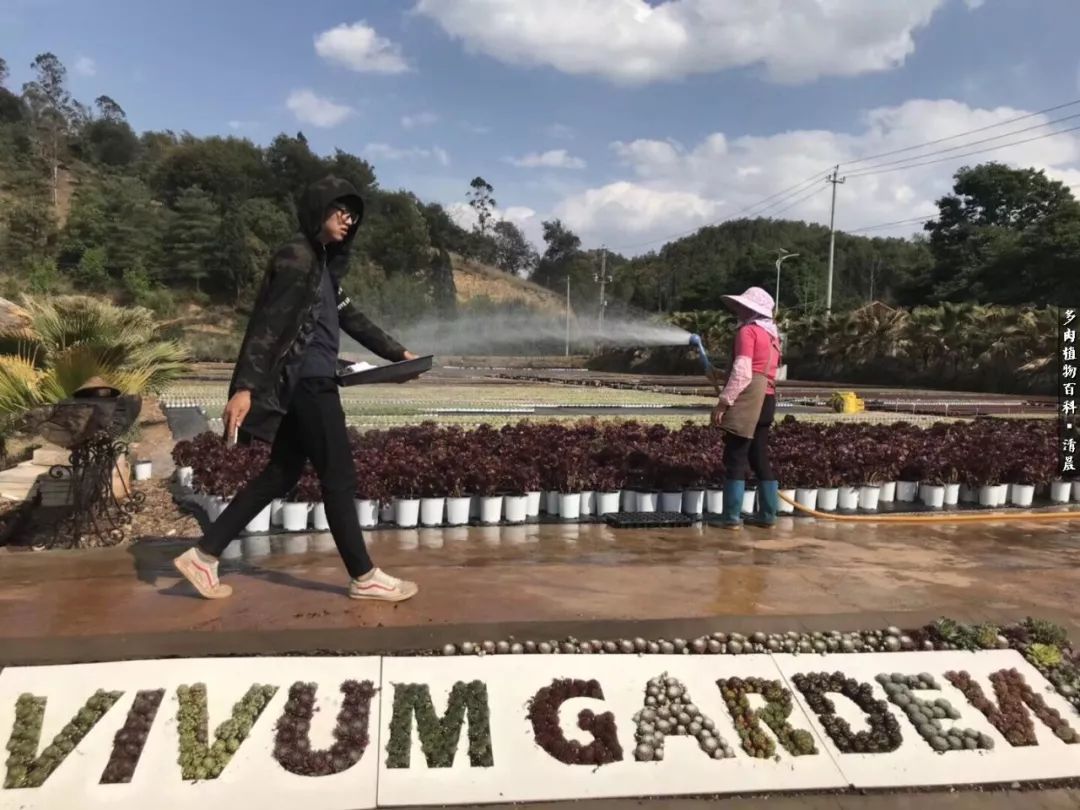
(Some of the images in this article were taken at Kunming Vivian Horticulture)
Sempervivum is an alpine-type succulent plant that enjoys a sunny, cool and dry environment. It suits acidic, neutral and alkaline soils alike. Aside from providing appropriate shade and avoiding scorching sun exposure during the high temperatures of summer, it needs full sunlight in all other seasons, and watering should be restricted in winter. It can withstand low temperatures of -20°C. During the high heat of summer and the cold of winter, the plant is in a dormant state. The relatively cool spring and autumn seasons are its main growing periods, and it requires ample sunlight. Insufficient light will cause the plant's form to become loose and not compact, affecting its quality and ornamental value, whereas plants grown in ample light have thick, plump leaves, a compact form, and bright leaf color, looking very beautiful.
Taxonomically, sempervivum belongs to the Crassulaceae family, genus Sempervivum, and originally lived on the high mountains of south-central Europe. This place is full of barren gravel, so its leaves became thick and juicy in order to store precious water and nutrients. The mountain wind is biting cold, so the entire plant contracts into a rosette shape to avoid being broken or dried out by the wind.
Below, using my limited knowledge of sempervivum, I will introduce some of the sempervivum varieties I like. However, the sempervivum family is far too vast, and I can only introduce a small portion. If everyone likes it, I will gradually introduce more to you in the future.
Paper Kite:
Mustang: (Actually, I can't tell the difference between Mustang and Dark Elf either)
Easter Egg:
Dark Elf:
Elegance:
Though covered in fuzz, it is not at all afraid of severe cold, an elegance draped in frost
Susanna Cobweb:
Sunflower Cobweb: (a cobweb variety with a fragrance)
Cobweb sempervivum has a vast family, with more than 300 members. Sunflower Cobweb, Susanna, Black Widow and Cotton Candy are only a part of them, and there are many cobweb varieties whose names I cannot even recall. Below, let me show you some pictures I borrowed from a German sempervivum website.
Sempervivum covered in ice and snow. So many friends in the north who love succulents but gave up because of the severe cold can try growing sempervivum. They definitely won't freeze to death, and who knows, you might even fall hopelessly in love with this variety of sempervivum?
The main taxonomic controversy within the genus Sempervivum is the division between this genus and the genus Jovibarba. Jovibarba and Sempervivum are very similar in morphology, but the most obvious differences are: Jovibarba flowers have 6 petals, occasionally 7, while Sempervivum has 8~18; Jovibarba flowers are yellow-white and bell-shaped, while Sempervivum flowers are pink-toned and star-shaped. The difference in non-flowering plants is: Sempervivum grows side shoots from the leaf axils near the base of the rosette to reproduce; while Jovibarba's side shoots grow close to the leaf center, looking as if they split off from the center of the leaves. Even though some species have side shoots that grow lower down, Jovibarba's side shoots are all spherical, smaller than sempervivum seedlings, with more compact leaf arrangement.
The aristocrat among sempervivum - Jovibarba, a magical variety whose dark-toned leaves are edged with gold or silver, similar to the icy edges of the Moon Shadow series, making it fascinating.
What is even more peculiar, however, is Jovibarba's method of reproduction. Jovibarba's reproduction differs from that of other kinds of sempervivum. Below, let me show you some of Jovibarba's other methods of reproduction.
Take a healthy Jovibarba plant that needs to be propagated (now is the moment to witness a miracle)
Find a sharp scalpel, and with a swift cut, slice it into 4 pieces like cutting an apple.
Then let the wounds dry, and insert them into a pot. After a period of growth, the Jovibarba cut into pieces will grow into a complete Jovibarba plant.
Sempervivum growing experience (personal experience, for reference only): Sempervivum is an alpine-type succulent plant that enjoys a sunny, cool and dry environment. In the rainy season with high humidity and high temperatures, sempervivum is prone to turning to mush. Kunming has a lot of rain in summer, so I generally use a soil mix with about 80% granules for sempervivum. I prefer to use terracotta pots for planting, as the water dries out relatively quickly and it is not easy to suffocate the sempervivum. Because my geographical conditions are relatively superior to other places, I generally grow them outdoors all year round, but in areas with higher temperature and humidity in summer, I recommend providing shade and using as little water as possible or stopping watering altogether.
Like the genus Aeonium, sempervivum will die after flowering, but before flowering it produces a large number of offsets, and in addition the seeds produced after flowering fall to the ground and grow into new plants, not withering even in winter, instead multiplying more and more every year. Thus Europeans believed it could live forever (in fact, sempervivum dies after flowering, but often leaves behind countless descendants before dying). The Latin genus name of Sempervivum, Sempervivum, is composed of two words: semper (forever) and vivus (living).
The native land of sempervivum is very barren, yet it still grows well. So in daily planting, I rarely use fertilizer (because I feel that without fertilizer it already clusters up very quickly, and if I used fertilizer, wouldn't it go even crazier? I can't afford to keep buying pots). But in large-scale production planting bases, a certain amount of slow-release fertilizer is generally mixed in to accelerate growth and speed up offsetting.
Many people think sempervivum easily gets mealybugs. Actually, all succulent plants are prone to mealybugs. During the growing process, you should pay attention to regularly clearing away dead leaves to eliminate the breeding ground for mealybugs. When planting, add a certain amount of Xiaobaiyao or Xiaoziyao to the soil, which can provide a certain degree of protection. If pests have already occurred, you can spray Huahuashen and Jiebizhi, but be sure to pay attention to safety and the concentration of the medication.
Sempervivum easily forms large clusters, especially during the spring and autumn growing seasons. A single head can produce several or even dozens of offsets. As long as conditions are suitable, the offsets can even take root without touching the soil. Some varieties, once they grow to a certain size, will detach from the mother plant and set up on their own, and after a few months will form a new cluster.
Below, let me show you some more beautiful pictures:
What I have introduced to you is merely a drop in the bucket of the sempervivum family. I am also just an enthusiast who has only recently started out. Perhaps every succulent lover has one or two kinds of sempervivum at home, more or less. I hope today's introduction can give everyone a new understanding of sempervivum. I also hope the ranks of sempervivum enthusiasts can gradually grow.
Succulent culture needs you and me to promote it! Remember to share good articles so that more people fall in love with succulents! Use the power of plants to influence and heal the people around us!
Reward information
This article is purely for sharing, and the author has not enabled rewards. After reading, don't forget to give the author a little like at the bottom right corner of the end of the article to encourage them!
Advertisement ADVERTISEMENT
This article has beenexclusively authorizedby the author to the WeChat public account: Succulent Plant Encyclopedia (ID: duoroubaike). The content of the article does not represent the views and stance of the public account! The Encyclopedia has signed with a third-party internet copyright protection company and has launched network-wide rights protection. Unauthorized private reprinting by other platforms is strictly prohibited! If piracy is discovered, infringement liability will be pursued! Netizens are welcome to report it!