The corpse flower is a rare and endangered plant,legend has it that it is the evil spirit guarding Solomon's treasure
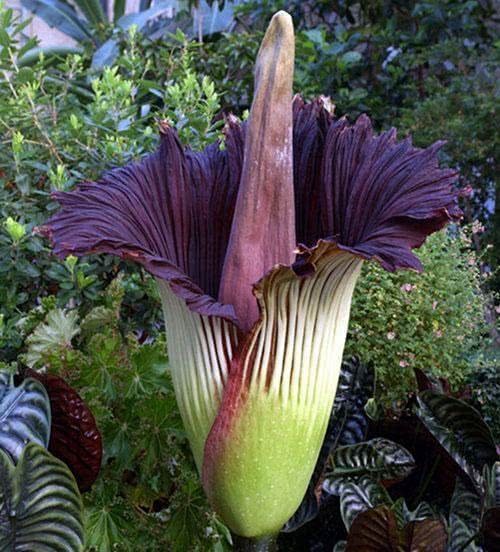
Corpse flower (titan arum)
The corpse flower is a perennial herbaceous plant of the Araceae family,also known as the "corpse flower" or giant arum,and it has an even more vivid name,"the stinking corpse arum." The corpse flower is native to Sumatra and is a rare and endangered plant worldwide;under artificial cultivation,it flowers very rarely.
Morphological characteristics
The titan arum has an underground tuber;it flowers first,and after the flowers fade it grows leaves. The huge inflorescence grows directly from the tuber,on the short,thick flower stalk spreads a broad bract that is green outside and purple inside,resembling a petal,known as the spathe;the spathe is folded around its sides in a trumpet shape,brilliantly colored,over 1 m tall,and its upper opening often reaches 1.5 m in diameter;in the center of the huge spathe stands a hollow,fleshy spadix,like a giant candle set in a candlestick. The inflorescence grows rapidly,able to grow about 10 cm in a day,and during such rapid growth it emits some "clicking" sounds. The inflorescence is nearly 3 m tall. Male and female flowers grow on the same inflorescence;the female flowers bloom first,and only after one or two days do the male flowers bloom. The female and male flowers of the same plant do not bloom together at the same time,which prevents self-pollination. The entire inflorescence gives off a smell resembling rotting flesh,and this smell attracts carrion-feeding beetles and flesh flies to pollinate it.
Botanists have found that the titan arum blooms on average only once every 7 years,and each time it blooms the flowering period is very short,only about two or three days.
Once pollination is complete,the titan arum's tall spadix and huge spathe collapse and begin to rot. When the bright red fruit ripens,the spadix and spathe have completely decayed. The ripe,brightly colored fruit is devoured by birds and dispersed through their droppings.
The titan arum not only has a huge inflorescence,but its leaves are also very large. The titan arum does not bloom every year;in years when it does not bloom,only one leaf grows from the tuber each year. This leaf is very large,able to grow to 6 m tall and 5 m wide;its petiole is green and shaped like a tree trunk,and the top of the petiole splits into several branches,each branch bearing many small leaflets,so that a single leaf looks like a "tree."
When the growing season ends,after the underground tuber has stored enough energy,the old leaf withers and falls,and the tuber enters a dormant period of about four months or so.
The titan arum is a rare and endangered plant worldwide;under artificial cultivation,it flowers very rarely.
Distribution range
Native to Sumatra. It is found in Asian tropical rainforests. Some botanical gardens already have artificially cultivated specimens.
Related legends
And its distant ancestor,the "corpse flower," has long been extinct for a thousand years;this devil's flower,with its bewitchingly gaudy colors and eerie fragrance,creates one trap of illusion after another,luring people toward death,and in legend the "corpse flower" is the evil spirit guarding King Solomon's treasure.
Cultivation records
The wild titan arum grows only in the tropical rainforests of Sumatra,Indonesia. The scientist who first discovered this plant was the Italian botanist Odoardo Beccari[2],who first saw this plant in Sumatra in 1878 AD. The titan arum does not often bloom in the wild to begin with,and in artificially cultivated environments the individuals that do bloom are even scarcer. In 1889,the titan arum cultivated at the Royal Botanic Gardens,Kew,in London,England,bloomed for the first time;this was the first record of flowering under artificial cultivation,and since then there have been about sixty flowering records. The titan arums cultivated at the New York Botanical Garden bloomed in 1937 and 1939 respectively. This was the earliest flowering record within the United States. Today,the number of artificially cultivated titan arums has gradually increased,making the titan arum no longer a rare and uncommon plant. In botanical gardens around the world,there are generally more than five related reports each year about the titan arum blooming.
A titan arum grown by the Botanical Garden of Bonn,Germany,in 2003,with a flower height of 2.74 m,became the tallest cultivated flowering plant in the world,and this record is entered in the Guinness World Records. On October 20,2005,the Wilhelma Zoological-Botanical Garden in Stuttgart,Germany,grew a titan arum with a flower height of 2.91 m,breaking the previous record set by the Botanical Garden of Bonn.
New research findings
A group of researchers published an article on January 11,2007,in the journal Science,stating that the corpse flower discovered in a scientific expedition in 1818 in the tropical rainforests of Sumatra originated from an ancient plant family that was originally characterized by small flowers. In fact,many plants in the same family produce flowers only a few millimeters wide.
The corpse flower has many bizarre characteristics,and for a long time scientists have been trying to figure out exactly which plant family it belongs to. The corpse flower is a parasitic plant;it steals nutrients from other plants and tricks insects into pollinating it.
Charles Davis,a botanist at Harvard University who led the study,said that the origin of the Euphorbiaceae plant to which the corpse flower belongs can be traced back to about one hundred million years ago in the Cretaceous period,which was also the last era in which dinosaurs lived. Flowering plants are thought to have first appeared at that time. The researchers deduced that after about 46 million years of evolution,the outer dimensions of the flowers produced by the corpse flower have increased 79 times,and today its rate of evolution has slowed.
Main value
Horticultural cultivation and ornamental value.