Succulents watered with rainwater in summer develop thick, plump leaves and strong, sturdy roots
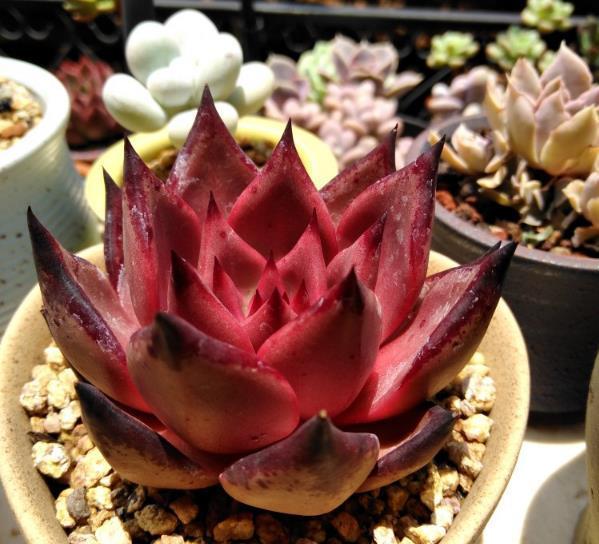
In cool, breezy weather, you can boldly let your succulents get rained on before weather like this arrives. Succulents have relatively high ventilation requirements, but as long as ventilation can be maintained, there is nothing to worry about. Spring succulents can also be rained on; after the succulents are rained on at that time, you will feel as if they grew overnight. Thunderstorms are very good for succulents. Why is that? Because thunder is a high-voltage discharge of tens of thousands of volts in the sky, and this is nature's best way of fixing nitrogen. Nitrogen in the air will be turned into nitric acid by the high-voltage discharge and fall into the soil with the rainwater. If organic fertilizer is used, or plant ash, leaf mold, or humus soil, the rainwater falling with nitric acid will combine with substances in the soil to form nitrates essential for plant growth, which is beneficial for absorption by succulents.
Because the nitrogen content in water is very low, most plants grown at home rely on fertilization to obtain nitrogen. With rainwater that is relatively rich in nitrogen, it is naturally equivalent to applying nitrogen fertilizer. Thus, we see many articles advocating watering flowers with rainwater. Another benefit of rainwater is that its oxygen content is relatively high. Why is the oxygen content high? Because as rainwater falls, it disperses into raindrops, and the contact area with air becomes very large, so more oxygen dissolves into it. Moreover, the lower temperatures at high altitudes are also more conducive to increasing the solubility of oxygen in water.
A flower-growing friend said last time that she is located in Guangzhou, and she grows succulents on the north terrace, which I highly recommend. She originally thought that the north terrace, well, had already avoided most of the time with strong sunlight, so she did not provide shade. But then an afternoon shower came, and the rain was not light; it nearly soaked the succulents through. Shortly afterward, the sun came out and shone right into the north terrace. The next day, two of her succulents immediately developed black rot. Therefore, rain that suddenly falls in high-temperature weather should be avoided as much as possible. The rhythm of blazing sun, rain, and then blazing sun again will certainly quickly kill all kinds of succulents.
Succulents can be rained on. In one watering cycle, one or two days of rain is enough. During the rainy season, there is no need for long-term continuous rain exposure; if conditions allow, provide some rain protection. After all, there are not many benefits, and they will not become more beautiful; instead, it may accelerate leggy growth and fading. After the temperature rises (around 30°C), rain exposure, especially long-term rain exposure, can easily cause problems. When the temperature is not high (below 20°C), a rain shower can wash away the dust and make them look a bit more fresh and dewy. But in April, May, and June, when the temperature rises, sometimes rain lasts for weeks in a row, and long-term rain exposure makes various diseases and leggy growth more likely. It is recommended to provide appropriate rain protection. For example, let them get rain for one day a week, then provide cover afterward, and once the medium is almost dry, let them get rain again, treating it as watering with rainwater.
There are also several situations to note. It is not recommended to let succulents get rained on during continuous overcast and rainy days. Without a good ventilation environment, dampness spreads through the air, which is not conducive to the survival of succulents. If the weather after rain is muggy and humid, or extremely hot, rain exposure is not recommended, because soil moistened by rainwater contains a lot of water. If the next day is muggy and humid, or extremely hot weather, this is a cruel test for succulents. Succulents grow almost close to the ground, and moisture cannot dissipate, making them very prone to rot. If your succulents are hit by hot afternoon rain, there is a life-saving method: without hesitation, simply water them again with relatively cool tap water, and on that day try to avoid exposing them to blazing sun again, letting them rest in a shady place for half a day.
Light rain is generally called "one-inch rain", meaning that even if it rains for a day, it can only wet the surface of the ground to a depth of one inch. Even if this amount of rainfall is used to water a black square pot, it cannot soak through, so if succulents are rained on by this kind of light rain, there is actually no need to worry at all. If the soil of succulents has become compacted, they can also be rained on. With this kind of soil, it is already very difficult to water thoroughly unless the entire pot is placed in water, but if there are many pots, that is very troublesome, so letting them get rained on is quite good.
This is a gathering place for succulent lovers, sharing succulent care tips. You are welcome to follow and exchange ideas.