Heatwave Hits: How Plants Beat the Heat and Cool Down
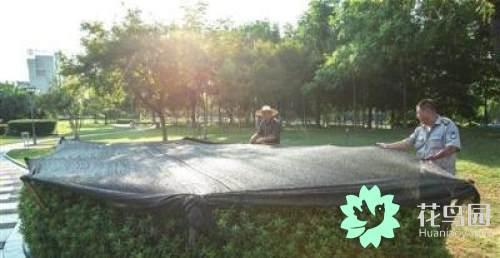
To cope with the sauna-like heat of recent days, people have been resorting to all kinds of methods, but how do plants make it safely through the summer? Reporters have learned that to fight the heat, flower growers can stagger their watering around the hottest hours, increase the amount of water plants drink, and set up black "sunshades" over newly planted plants, and other methods to help plants get through the ordeal of the scorching summer.
Method 1: A "sunshade" over the heads of newly planted plants
Recently, reporters noticed that in the green spaces along both sides of the road, the tops of many small trees were covered with black gauze, and newly planted plants had been "covered up", which seemed rather strange. Landscape experts told reporters that this is because these newly planted plants, especially Chinese privet (Ligustrum quihoui), boxwood (Buxus) and golden-leaf forsythia (Forsythia), are still rather tender, their root systems are not particularly well developed, and their own ability to absorb water and resist heat is still insufficient, so some artificial protection is needed. This black gauze can effectively block direct sunlight and prevent newly planted plants from being scorched.
Method 2: Large-leafed plants should "drink" 30 percent more water each day
To cope with the ongoing high temperatures, watering should be increased for some drought-intolerant plants. Landscape experts say that for drought-tolerant plants such as purple-leaf plum (Prunus cerasifera), as long as they have already established, they can make it through the summer without special watering, but for drought-intolerant large-leafed plants, especially lawns that have just been mowed, constant patrols and extra watering are needed. "A lawn that has just been mowed receives more sunlight, and the cut surfaces also increase water evaporation, so watering needs to be increased by about 30 percent, and maintenance costs rise accordingly. That is why this city tries to reduce the area of lawn in landscaping projects and increase the area of native trees and shrubs, in order to lower maintenance costs."
Method 3: Water plants in the cool of early morning and evening
Generally, when the temperature exceeds 30°C, you must not water flowers, grass and trees under the direct sun, otherwise the plants will be "choked" by it, which is bad for their growth. For this reason, watering should be done as far as possible in the early morning or in the evening when the temperature is relatively low, avoiding watering during periods of high evaporation; at other times, plants are given pest-control care, lawn weeds are cleared, and saplings are pruned.
Unable to "eat" enough while constantly "sweating": sustained high temperatures do great harm to plants
What harm do the relentless sauna-like days do to plants? Landscape experts told reporters that high temperatures mainly disrupt the balance between photosynthesis and respiration. For plants, photosynthesis is equivalent to people's eating activity, the process of absorbing nutrients, while respiration is just the opposite, a reaction in which plants consume energy. The optimum temperature for respiration is always higher than the optimum temperature for photosynthesis, so when the temperature is too high, respiration exceeds photosynthesis, putting plants in a state of "starvation"; if this goes on for a long time, plants die of "starvation".
High temperatures can also promote transpiration, making plants "sweat" heavily, disrupting their water balance and leaving them wilted and dried out. Tianjin lies in the warm temperate zone, and in summer plants are in their flowering and fruiting period, which is the period most vulnerable to heat damage. When plants encounter high temperatures during flowering, flowering time comes earlier and the total number of flowers per day decreases, which in turn affects normal fruiting.
Dormancy, drooping leaves, rolling into needles: plants have their own clever tricks for beating the heat
Experts from the Institute of Landscaping and Greening say that besides the special care people give plants, many plants actually have their own clever tricks for beating the heat.
Dormancy - some animals choose to hibernate in winter, while many plants go dormant in summer, such as begonias (Begonia), when their growth slows and they easily get through the hot summer. But experts also warn that such dormant plants do not need much watering, because an overly wet root-zone soil environment can easily cause root rot.
Drooping leaves - when faced with high temperatures, plants actively close their stomata; before the stomata close, a large amount of water also evaporates through the leaf surface and is released, and at this point the plant shows a softening phenomenon, and the drooping leaves protect the plant inside from excessive sun exposure.
Leaves becoming needle-shaped - such plants include the various pines and cypresses, the masters of heat avoidance among plants; their leaves have naturally degenerated into needles precisely in order to reduce water evaporation in summer.