Succulent soil mixes need to be breathable, water-retentive and nutritious so the leaves can grow plump and beautiful
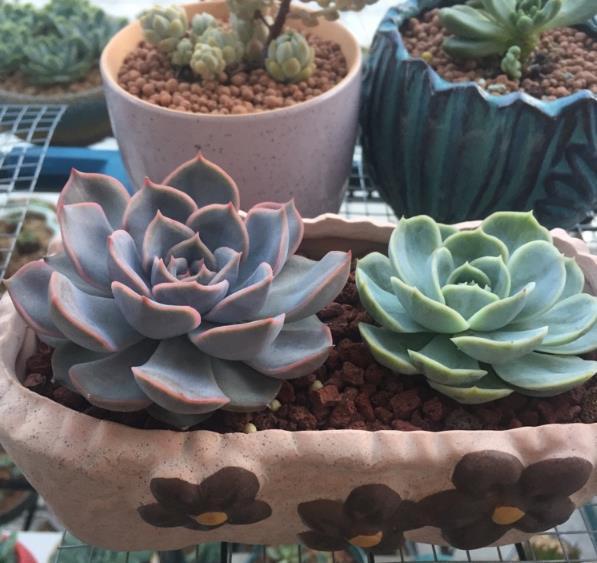
What kind of succulent growing medium counts as high quality? Simply put, it should be a loose, breathable, well-draining sandy loam with a certain crumb structure that can supply the nutrients plants need during their growing season. When mixing it, pay attention to a reasonable balance of organic growing media and inorganic growing media, and avoid overly fine, dusty particles. Succulent soil mixes must be breathable and have a certain water-retention capacity, and of course they also need nutrients to provide the succulents with nourishment. Serious growers can use the following mix: on top, akadama or rainbow stone as a top dressing; underneath, 40% peat plus 50% grit (akadama, kanuma, rainbow stone, vermiculite, pumice, etc.) plus 10% plant ash.
What does breathable mean? It means that when you pour water in, it immediately flows out of the bottom of the pot. That is the ideal. Depending on the plant, add a little peat or whatever. What growing media you use depends on your own habits; there is no rule that you must use a particular one, so for beginners, as long as the mix is breathable and water runs straight out of the bottom of the pot when you water, that is enough. After all this rambling, you should at least have a rough understanding of growing media, and there is no need to ask every day what growing media is best. Kite's growing media: cinder mixed with a small amount of peat, pure cinder, pure river sand, or river sand mixed with a small amount of peat; sometimes a little perlite or vermiculite is added.
Succulent seedlings need a higher proportion of peat, because seedlings have a weak water-storage capacity, while older, established plants can take more grit, which keeps a better plant shape. The plant's growth can be proportional to the grit ratio: the bigger the plant, the more grit you can add. The same goes for watering: seedlings do not need water restriction. For succulents to develop beautiful colors, temperature difference is also a very important factor. If in spring and autumn the outdoor day-night temperature difference exceeds 15 degC and they are grown outdoors, within three days the whole pot of succulents will change color. Of course, this basically depends on the weather, unless your home has special conditions that allow temperature control.
The soil in which the succulent Lithops live in South Africa is basically all sandy soil. South Africa has mostly desert soils, chernozems, Mediterranean soils and so on, and the common feature of these soils is that they are low in humus, that is, low in organic nutrients, and high in minerals. In other words, the native soil of Lithops is rather loose and breathable, with not too much organic matter and a lot of sand. Of course, for the vast majority of us, it is impossible to go to Africa and bring back some soil to grow succulents; all you can do is use local soil to imitate the native soil as much as possible, and one of the most important principles is the looseness and breathability mentioned above.
All plants need sunlight, but not all plants like strong sunlight. Many beginners ask Kite, can they be exposed to the sun right after potting? Yes, plants need sunlight, but we also have to wait until they have grown stable before giving them sunlight. If we rush to let them see the sun, not only will the roots grow poorly, but the plant itself may also gradually dehydrate and die.
When caring for succulents, do not apply things rigidly; reference material is dead and may not suit your growing environment, so you need to adapt flexibly, and only then can you grow the plants better. During the dormant period there is even less water; since they are dormant, as long as the roots do not dry out and die excessively, that is enough, and a small amount of water is still necessary. For ordinary succulents grown at home, because the pots are small and there is little soil, if you do not give a single drop of water throughout the entire dormant period, some varieties will die completely. On the point of watering, flower lovers should refer to more sources and master it flexibly according to their own environment.
This is a gathering place for succulent lovers, sharing succulent care tips; you are welcome to follow and join the discussion.