The king of ancient poisons that poisons you with a single sniff: why do farmers use it to feed pigs and get rich?
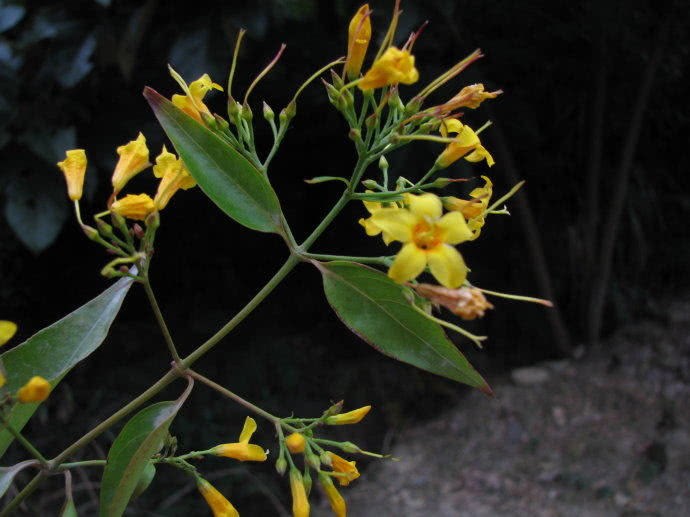
Our country is rich in vegetation resources, and on its high mountains and plains there are countless varieties of trees, flowers, grasses and other plants. Among them, most plants are mild and harmless, while a small number of plants, because they contain violently toxic substances, have become the famously notorious "poisonous weeds" of history. The most famous of these is a plant with yellow flowers; it is said that the poisonous weed Shennong ate last after tasting all the hundred herbs was this one, and because he ate one of its leaves his intestines broke and he died, so the ancients called it "gut-breaking grass." Its toxicity is comparable to arsenic, and it is easy to pick, so it was once the "king of poisons" in ancient times.
Even though its toxicity is fierce, its name is very beautiful: it is called "Gouwen" (Gelsemium elegans). But do not be fooled by this name; if you really go and "kiss" it, your life may be "hooked away" by it, because it is a "beauty like a snake and scorpion." Gouwen bears showy yellow flowers shaped like those of honeysuckle, and its flowering period is from May to November, which happens to overlap with the blooming time of honeysuckle. Some people who did not understand it once mistook it for honeysuckle and picked it to boil in water and drink, which ended in poisoning and hospitalization, and excessive consumption even led to death. In fact, many ancient Chinese medical texts contain detailed records of it, among which the Bencao Gangmu Shiyi mentions it many times.
Inthe Bencao Gangmu Shiyi it is recorded: "(Gouwen) mixed into incense and burned makes people lose consciousness."The smoke that drifts out after burning Gouwen will poison and render unconscious anyone who takes a single sniff, showing how strong its toxicity is. In addition, the pollen of Gouwen is also toxic, so it is advisable not to sniff it when you see it in the wild. Modern research and analysis have found that the reason Gouwen contains severe toxicity is that it contains multiple gelsemium alkaloids,and after accidental ingestion it damages the human digestive, blood circulation and respiratory systems. Generally, eating 10 young leaves will cause a fairly strong poisoning reaction, so when you see it in the wild, do not pick it just because it looks nice, and if you accidentally eat it, go to the hospital for treatment as soon as possible.
Although Gouwen is toxic, it is also a Chinese herbal medicine whose main effects are killing insects and relieving itching, breaking accumulations and drawing out toxins, and in ancient times it was often used externally to treat skin diseases and arthritis. Because Gouwen is highly toxic, it is used relatively little today, but in the southern regions it has a special use, namely feeding livestock and poultry. For animals such as pigs, sheep, cattle and chickens, it not only has the effect of expelling parasites but can also increase the animals' appetite and prompt them to put on fat. Therefore farmers along the coast of South China like it very much, and at pig farms they add Gouwen in small doses according to a certain ratio (no more than 0.2%), which can greatly increase the animals' weight gain rate while saving feed.
This practice also existed in ancient times, and in the Bencao Gangmu it is recorded:"If a person mistakenly eats the leaves of gut-breaking grass, it is fatal, but if a sheep eats it, it becomes very fat."Many farmers therefore saved a good deal of cost in raising pigs and sheep and made their fortune from it, so local farmers also call Gouwen "pig ginseng." Friends, do you know this beautiful "Gouwen"?