A 10-yuan Chinese herb turned into a bonsai, one pot is worth a fortune
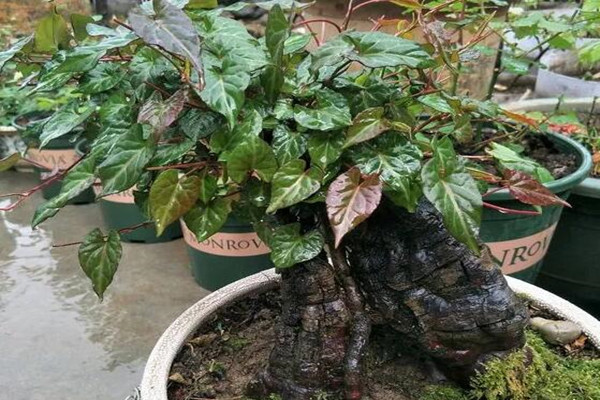
He Shou Wu (Polygonum multiflorum)
He Shou Wu has the effects of darkening hair, lowering blood lipids, and anti-aging.
1. Digging in the mountains
He Shou Wu mostly grows beside valley shrubs at an altitude of 200-300 m. Now is the most suitable season for digging He Shou Wu. You can harvest a big piece of He Shou Wu without spending a single cent!
2. Depth of burying the roots
When planting He Shou Wu, it is best to expose more than half of the rhizome outside the soil. However, if the roots of He Shou Wu are not very intact, you can appropriately increase the depth of burying in the soil.
3. Watering
He Shou Wu likes a moist environment. When transplanting for the first time, water it thoroughly. Usually, keep the potting soil from being in a state of water shortage, but do not let it become waterlogged, otherwise the tuberous roots are prone to rot.
Lingzhi (Ganoderma lucidum)
Lingzhi has the effects of tonifying qi and calming the mind, alleviating cardiovascular and cerebrovascular diseases, and enhancing the body's resistance.
1. Digging in deep mountains
Wild lingzhi can be found on dead trees in primeval forests, but now there is less and less. Flower friends can choose to buy cultivated lingzhi for a few dozen yuan per jin. Whether digging or buying, be sure to choose lingzhi with a tree stump, and it can be planted directly into a pot.
2. Light and temperature
Under low-temperature and weak-light conditions, the color of the lingzhi cap is darker and thicker. In summer, it can be placed on a north balcony for care, which will make it more ornamental than lingzhi growing on a south balcony.
3. Adjusting the temperature difference
At normal room temperature, the lingzhi cap grows relatively quickly, but in a low-temperature environment, the lingzhi stalk tends to elongate. During the growth of lingzhi, the ratio of cap to stalk can be adjusted by increasing the temperature difference, so as to shape it.
Selaginella (Selaginella tamariscina)
Selaginella, also called Jiusi Huanhun Cao, has the effect of resolving blood stasis and stopping bleeding.
1. Spore propagation
Selaginella mostly grows in the hilly areas south of the Yangtze River, on rocks under shrubs. Flower friends who do not have the conditions to dig it can use spore propagation. Select branches with mature spores, place them on moist sandy soil, and new plants can grow in a few months!
2. Soil and pots
For planting selaginella, it is best to choose sandy soil with high humus content. When planting, the original exposed aerial roots are best left outside. The flowerpot should be a shallow pot or one with good drainage.
3. Watering
Watering should be carried out according to the state of the leaves, as long as the leaves are kept from curling. Do not frequently let it suffer water shortage and curl, as this can easily cause branch shrinkage and affect its ornamental value.
Goji (Lycium chinense)
Goji has the effects of relieving fever and stopping cough, and can also resist fatigue and aging, making it especially suitable for women.
1. Seed propagation
Spend a few yuan to buy some goji seeds, soak them in warm water overnight, rub off the fruit skin and pulp, and sow the seeds in the soil. To improve the survival rate, before sowing, the seeds can be mixed with sand at a ratio of 1:3, sprayed with water, and sprouted.
2. Light
In summer, goji enters a dormant period, so strong direct sunlight is fatal to it. For it to pass the summer healthily, it is best to place it in a cool, ventilated place with diffused light. Flower friends who do not have the conditions can choose to set up a shade net.
3. Watering
Try to choose a watering time before 9 a.m.; watering in the evening makes it prone to powdery mildew. Watering depends on whether the potting soil is dry or wet. If it is completely dry, water it thoroughly.
Honeysuckle (Lonicera japonica)
Brewing honeysuckle as tea can clear heat and relieve summer heat, and ease sore throat.
1. Cutting propagation
Select a relatively robust honeysuckle branch, remove the lower leaves, and insert it into the soil. During growth, continuously cut off the slender branches and remove the vigorously growing buds to carry out dwarfing treatment.
2. Soil
For planting honeysuckle, it is best to use mountain soil, or a culture soil made mainly of mountain soil with an appropriate amount of leaf mold and coal ash, etc.
3. Light
Honeysuckle likes a sunny environment. Although it is also shade-tolerant, insufficient light can easily cause leggy branches and affect its ornamental value. Therefore, it is best to place it outdoors or on a south balcony with sufficient light.
Boxwood (Buxus)
Boxwood has the effect of dispelling rheumatism, and also has a certain relieving effect on abdominal bloating, toothache, and stomachache.
1. Cutting propagation
Select relatively tender boxwood branches in summer, flatten the bottom, and insert them obliquely into sandy soil. Avoid direct sunlight, and frequently spray water to keep them moist.
2. Watering
Boxwood likes a moist environment. Keep the bonsai soil moist. In summer, water once in the morning and once in the evening, and frequently spray the leaf surface to keep it moist.
3. Pruning
During the growth of boxwood, promptly cut off leggy branches and branches that affect the shape. After fruiting, promptly remove the fruit, otherwise it will consume nutrients.
Have you seen these beautiful and practical bonsai?
If you have more beautiful bonsai at home,
welcome to download the Yanghua Daquan APP and upload pictures,
and share them with flower friends~