Turn one pot of fuchsia into ten, and after 5 years of growing them, she never loses one in summer
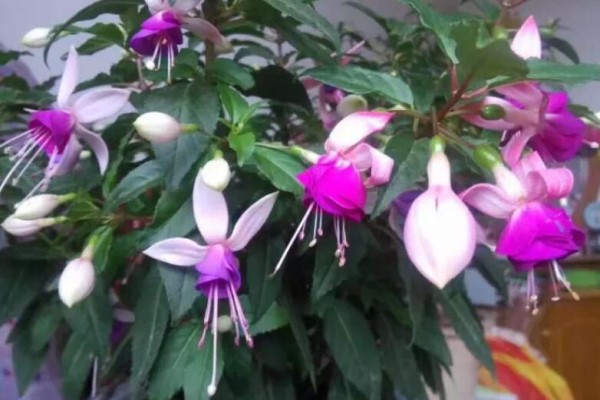
1. Fuchsia cuttings
I personally like fuchsias very much and have grown quite a few. Here I recommend to all flower lovers that several of my fuchsias were all grown from cuttings harvest. Best done in spring and autumn, at temperatures above 18-20 degrees. Cut 10 cm to 12 cm small sections from its middle and lower parts, keeping 2 to 3 small leaves.
I always soak them in rooting water for about 20 minutes first, as this gives a higher success rate for rooting. After soaking, take them out to dry, then insert them into a sterile and moist pot of sandy soil.
Place the inserted fuchsias in a cool place and do a good job of keeping them moist. After about 15-20 days they will root and sprout new leaf buds. Continue cultivating them like this for about 40 days, then they can be divided and planted in pots for normal care.
2. Soil mixing
I mix my own soil for growing flowers. Fortunately, right outside my home there is leaf mold soil, which really saves a lot of trouble. I like to find leaf mold soil piled up from straw, screen out impurities, dry it in the sun for a few days, then store it in a cool place at home. This soil is very nutritious, and ordinary flowers can all use it!
Besides leaf mold soil, my soil mix is generally sawdust + leaf mold soil + river sand + compound fertilizer + soil insecticide. As soon as the fuchsia seedlings are planted, they quickly adapt to the pot and even grow very fast.
I also use some ordinary garden soil, putting the prepared nutrient soil on the upper layer, so the seedlings grow more firmly.
3. Fertilizer
Many flower lovers' plants bloom little or not at all, and I think it may be because of too little fertilizer. With a soil mix like the one above, you still need to add some extras. For example, I line the bottom of the pot with some pine cones, all picked up when I go out. They provide both air permeability and fertilizer.
Also, when the fuchsia is growing new buds, sending out branches, and before flowering, spray the leaves with a 0.25% potassium dihydrogen phosphate solution, three times a month, about ten days apart. This guarantees your flowers will bloom abundantly. Almost all of my plants are forced to bloom this way.
4. Keep in a ventilated, semi-shaded place
When growing fuchsias, pay attention to ventilation and place them in a spot at home with scattered light and semi-shade, avoiding direct sun exposure in summer. If not ventilated, it is easy to trigger gray mold. Gray mold starts as just small mold spots, and in severe cases the branches rot and die.
5. Pruning
Fuchsias also need proper pruning and pinching, removing side buds and doing proper branch bending, and other methods. Prune overly dense branches, inner branches, leggy branches, weak thin branches, and diseased or dead branches. After pruning, it is easy to produce more branches and even achieve a full pot, so don't be reluctant to cut!
6. Pests and diseases
Fuchsias, like many flowers, are also prone to pests. I am a fruit grower and have seen many insects. I am very professional at killing insects. Here I will say more about methods that can be used for almost all flowers, for everyone's reference.
Observation: When the temperature is high at noon and the light is strong, insects are more active. At this time, observe the back of the flower leaves, and it is easy to see clearly exactly what insects are causing trouble.
Timing for killing insects: No matter what insecticide you spray, it is best to evenly spray both the front and back of the flower leaves after 5:00 p.m., preferably without dripping. Do not spray only once and repeat, because at this time the temperature is low and there is no light, pests take longer to absorb the pesticide and are more likely to be poisoned to death. In addition, the pesticide does not evaporate easily, so it can effectively kill insects.
I have tried many insect-killing methods, bought quite a few pesticides, and also made homemade insecticides. Here I will tell you the two most effective ones:
a. Homemade laundry detergent insecticide
Before using neutral laundry detergent to kill insects, first dissolve it with boiling water. Do not dissolve it with cold water, because cold water cannot dissolve the laundry detergent granules. Once the granules stick to the plant leaves for 3-5 days, necrotic spots will appear, and in severe cases the entire leaf will be burned to death or even fall off.
After adding boiling water to the laundry detergent and stirring evenly, let it settle and cool, then add the required amount of water for mist spraying. Mixing method: 0.5 g laundry detergent + about 400 g water. I first dissolve the laundry detergent and then add water. You can also mix enough water all at once and use it directly.
Spray the laundry detergent water directly on the back of the leaves, do not pour it into the soil. Laundry detergent water irritates the roots, so pay attention to this, otherwise your flowers will be killed by your care again.
b. Buy insecticide
I think imidacloprid and abamectin are relatively effective. Before spraying, first read its instructions clearly, mix with water according to the instructions, stir evenly, put into a spray bottle, then spray on the leaves with insects. Aphids are poisoned in about half an hour to one hour, and some will show their rear ends raised high. Red spider mites slowly change from red to black.
Two hours after spraying, you can also spray water on the leaves to rinse off residual pesticide, then move the plant to a cool, ventilated place for a few days to avoid leaf burn, scorched leaves, curled leaves, and similar problems.
7. Repotting
Another point is repotting. It is best to repot once a year, and nutrition is generally not a problem. I do not pick a season for repotting either. I even repotted recently, but adapting to the pot in summer is relatively difficult. I suggest everyone best repot into a larger pot with the roots kept together with the soil.
8. Autumn and getting through summer
Fuchsias like a semi-shaded and cool environment, with a suitable temperature of about 18-28 degrees. Above 30 degrees they enter a dormant period, so in summer it is best to water less (water only when the soil is dry), place them in a cool and ventilated place, and when it is hot, sprinkle water on the ground around the flower pot to keep it moist and lower the temperature.
After reading this flower lover's careful explanation
Have you learned it
Want to discuss with more flower lovers
Then chat a few more words~