This flower spits out little beads, grow 1 pot and it blooms 365 days a year, with 100 flowers at a time
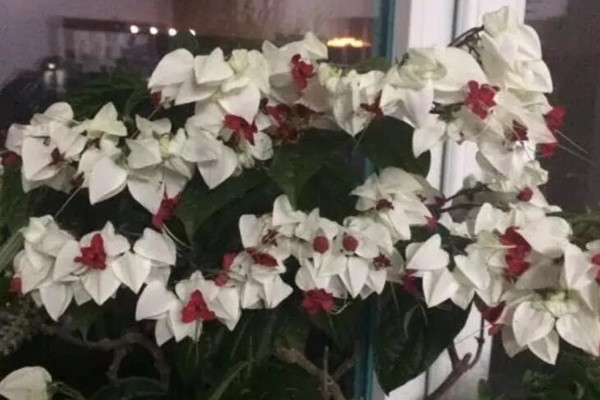
What does the bleeding heart vine look like?
First, let me show you what the bleeding heart vine actually looks like, and how beautiful it is when it blooms.
So why is this flower called the bleeding heart vine? Because the outer ring of its calyx is all white, with only a dot of red in the center of the flower, like a single spot of red, symbolizing good fortune and wishes coming true, which is why it is deeply loved by many flower lovers.
How do you care for the bleeding heart vine?
1. Plenty of sunlight
If you want the bleeding heart vine to grow vigorously and bloom as soon as possible, sunlight is essential. It is best to place it on a south-facing balcony or south-facing windowsill so it receives plenty of sunlight. If there is not enough light, it easily leads to leggy stems. But in summer when the temperature is high, you still need to pay a little attention to shading it at noon.
2. Water frequently
If you want the bleeding heart vine to grow vigorously, you must ensure sufficient water. But the bleeding heart vine is also quite sensitive to water. Once there is too much water, it will only grow leaves and not bloom, and the leaves may even turn yellow and fall off, and in the end even the roots will rot. So water it whenever you touch the surface of the potting soil and find it dry.
When the bleeding heart vine is blooming, do not spray water on the petals, otherwise the flowering period will be shortened. Especially since there has been a lot of rainy weather recently, it is best to keep it indoors, and absolutely do not let the flowers of the bleeding heart vine get wet.
3. Apply enough fertilizer
The bleeding heart vine likes fertilizer quite a lot. About every 7-10 days, you can apply 1 time of dilute cake fertilizer water. Before flowering, stop applying nitrogen fertilizer and add more phosphorus and potassium fertilizer, such as bone meal fertilizer, potassium dihydrogen phosphate, etc. Usually you can also mix in a bit of 0.2% ferrous sulfate solution to prevent the leaves from turning yellow.
4. Prune frequently
The bleeding heart vine is considered a climbing flower. If you want the plant shape to look better, you must pay attention to frequent pruning. Usually, pinch and top it more often, and prune promptly after flowering to avoid consuming nutrients. When the bleeding heart vine is nearing the end of flowering, the white stamens on the outside will also turn red. Once the red parts wither, just cut them off.
How does the bleeding heart vine propagate?
The bleeding heart vine is mainly propagated by 2 methods: sowing and cuttings.
After the bleeding heart vine blooms, as long as you leave it alone, before long you will see it produce small black seeds. Collect the seeds and plant them again next spring.
But most people still use cuttings to propagate it.
1. When you normally pinch and top it, you can keep the trimmed bleeding heart vine branches and use them as cuttings.
2. Trim the branches a little, keeping at least 2-4 leaves on each cutting. Then prepare a disposable paper cup, fill the paper cup with vermiculite, and insert the bleeding heart vine branch about 1/3 deep.
3. If you are worried that rooting will be slow, you can also just find a bottle and root it in water. The rooting rate is also very high! In summer when the weather is hot, it can root in about 10-15 days.
4. Once the cuttings of the bleeding heart vine have rooted, you can prepare loose, breathable nutrient soil and transplant them into flower pots! First let them recover in a cool, ventilated place for 1-2 weeks, then move them into the sun for normal care.
What should you do if the bleeding heart vine does not bloom?
Reason one: lack of nutrients
If the bleeding heart vine at home does not bloom, it may be caused by a lack of nutrients.
Solution: When the bleeding heart vine is forming buds, we can bury a few unsalted peanuts or sunflower seeds in the pot, or pour in 1 spoonful of waste oil replaced from the range hood, which can encourage the bleeding heart vine to bloom more.
Reason two: no pruning and leggy growth
If the bleeding heart vine only grows leaves and does not bloom, it may be because it was not pruned, causing the whole plant to grow leggy.
Solution: If you want the bleeding heart vine to bloom more and grow wildly less, you can prune frequently, especially cutting it back promptly after the flowers fade, to preserve its nutrients, so that it quickly sends out more side branches. It is enough to keep the plant within about 25-30cm.
Reason three: too much watering
If the bleeding heart vine is watered too much, it will cause the phenomenon of only growing leaves and not blooming.
Solution: If you find that the bleeding heart vine has not been blooming, you need to control its water. Water it thoroughly 1 time only after you touch the potting soil and find it completely dry. Repeat this several times, and you will see the bleeding heart vine sprout flower buds.
That is all for today's introduction!
After reading this introduction,
are you tempted?
Do you want to hurry and get a pot of bleeding heart vine to grow?