The saying that a person nurtures a teapot for three years, and the teapot nurtures the person for a lifetime, has been proven true
1. When you open this article, I believe you must be a friend who cares greatly about the quality of life, and who appreciates elegant taste and practical art with rich cultural tradition.
2. The cultural characteristics and spiritual functions contained in Zisha teapots are also unique. Zisha teapots come in rich and varied shapes - some exquisite and delicate, thought-provoking; some bold and generous, refreshing to the heart. Together with inscribed poems and paintings of profound meaning carved on the surface of the pot, they add even more of a scholarly air, and the aesthetic characteristics of Zisha teapots are cultural factors.
3. Integrating calligraphy, seal carving and painting into one, as expressed on Zisha teapots, concentrates the essence of Chinese culture.
4. The art of Zisha shaping unifies these many essences of Chinese culture together, forming an extremely elegant cultural and artistic temperament.
The old shopkeeper's monologue
How to choose a teapot?
There are so many varieties of Zisha teapots, so how do you choose a good one that satisfies you? Fangrun suggests that you choose carefully from"clay, shape, workmanship, inscription, function"these 5 aspects.
Clay
According to modern scientific analysis, the molecular structure of Zisha clay is indeed different from that of other clays, and even the same Zisha clay can have different structures, with subtle differences. Thus, because the raw materials differ, the functional effectiveness and the sensory experience they give people also differ.
If the functional effectiveness is good, then the quality is fine; otherwise the quality is poor. If the sensory experience is good, then the quality is fine; otherwise the quality is poor. So in evaluating whether a Zisha teapot is good or bad, the first thing is the quality of the clay. Compared with other pottery clays, one notable feature of Zisha is that it feels different to the touch. Touch an object that is not Zisha, and it is like touching a glassy object - sticky to the hand; but touch a Zisha object and it is like touching bean paste - fine without being greasy, very comfortable. So in evaluating a Zisha teapot, the feel of the pot's surface is very important
Shape
How to evaluate these shapes is also "the benevolent see benevolence, the wise see wisdom" - everyone has their own preference, and it cannot be forced. There are countless teapot shapes in Zisha, and we should not follow others blindly in thinking which shape is good and which is not. Just like schools of art, there is no distinction of good or bad, yet in the performance of a play of that school one can still see excellence or inferiority. I think the archaic and unadorned is best, the bold and generous is next, the delicate and elegant is next, and the playful is next again. What is the reason? Because the Zisha teapot is part of the entire tea culture, the artistic conception it pursues should be the artistic conception pursued by the Way of Tea: "indifferent and peaceful, transcendent and refined," and the archaic and unadorned is precisely the most harmonious with this atmosphere, so the archaic and unadorned is best.
Workmanship
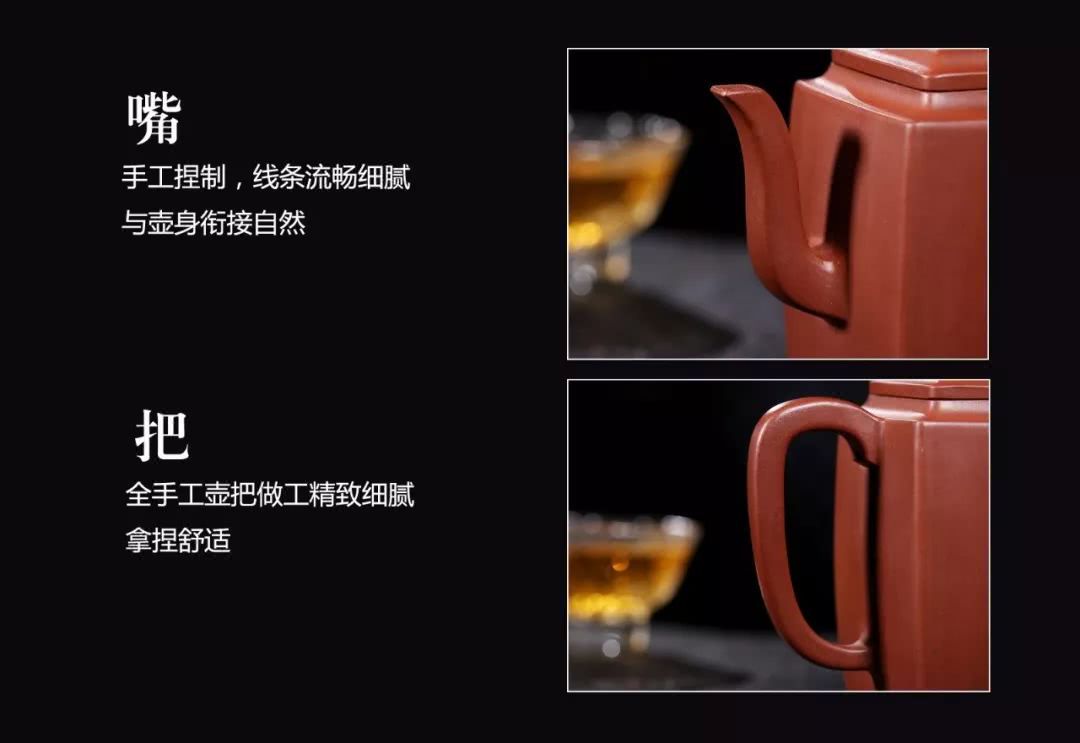
Points, lines and planes are the basic elements that make up the form of a Zisha teapot. In the process of forming a Zisha teapot, they must be articulated with complete clarity, just like fine brushwork painting - the start and end of the brush, the turns and bends, the rises and falls, all must be clearly rendered. A plane must be smooth when it should be smooth, and textured when it should be textured; a line must be straight when it should be straight, and curved when it should be curved; a point must be square when it should be square, and round when it should be round - none of it can be the least bit vague. Otherwise, it cannot be considered a good teapot. According to the special requirements of the Zisha teapot forming craft, the spout and the handle must be absolutely on the same straight line, and the weight must be balanced; the joint between the mouth of the pot and the lid must be tight. This is also a requirement of "workmanship."
Purely hand-made Zisha tea utensils are very different from machine-made ones. The truly fine workmanship is fine and precise, the whole is beautiful, and the surface of the pot feels rough to the touch.
Inscription
Throughout history, Zisha teapots have been priced according to the maker, and teapots by famous masters command a hundredfold price. This is especially prominent in a commercial society. In this way, many imitations of famous masters' work easily appear on the market, and forged fakes are commonplace, so one must be especially careful when buying a famous teapot.
Function
The biggest difference between Zisha teapots and other works of art is that they are works of art with strong practicality, and their "art" lies entirely in being "savored" through "use." If the meaning of "use" is lost, the art no longer exists. So one must never neglect the functional beauty of the pot.
[The functional beauty of Zisha teapots]
1. Moderate capacity
2. Appropriate height
3. Tight-fitting lid
4. Smooth pouring
According to the current tea-drinking habits of people in southern China (including Hong Kong, China and Taiwan, China), generally two to five people drink together, and a capacity of 350 ml is best. That capacity is just about four cups, and lifting and carrying it requires only one hand, so it is called a "one-hand pot." The height of a Zisha teapot has its own uses. A tall pot that is small is suitable for brewing black tea; a short pot that is large is suitable for brewing green tea, but it must still be moderate - too tall and the tea loses flavor, too short and the tea easily overflows from the lid, greatly spoiling the mood. What also spoils the mood is a spout that pours poorly: a few tiny gunpowder tea pellets, once in the pot, all become large leaves and easily block the outlet, so today's pots have, according to tea drinkers' habits, been changed to a single-hole spout, making the flow noticeably smoother than before. The requirement that the pot's lid fit tightly, so that when water is poured over the pot it falls into the tea tray and does not get into the pot, seems to have little to do with functional beauty, but in fact it is for the sake of hygiene, and it too must be mentioned. All of these are common standards.
Zisha teapot culture
One very important reason why the art of Zisha teapots originated, developed and became famous in Yixing is its unique, high-quality Zisha clay, renowned throughout the world. There are many places that produce Zisha, so why are Yixing's Zisha teapots so famous? It is not only because of exquisite craftsmanship and the emergence of generation after generation of masters; the real reason is that the Zisha produced in Yixing is fine in quality, high in iron content, and after firing into vessels has good water absorption and air permeability, so that when used to brew tea, the color, aroma and taste are all excellent. Therefore, the first criterion for judging whether a teapot is good is to look at the clay material - whether it is authentic Yixing original-mine Zisha.
The beautiful small city of Yixing carries the dreams of teapot makers - it is both life and love. Rather than saying we are making teapots, it is better to say we are passing down a craft...
Thanks to nature's gifts, using her countless scars to create wealth for the human world. China is proud because of Zisha, and Yixing is proud because of you.
In our own backyard, in the old house, all the Zisha raw ore we bought is selected and then piled here to weather in the open air, and over time it is covered with weeds. Nowadays many merchants, in order to save time and resources, buy clay material directly from clay-processing factories, but the clay from the factories either easily turns out to be fake, or has not been weathered or aged enough, so buying and making it ourselves feels more reliable.
Selecting clay material is daily essential work - a good pot must use good material! The aging room is quite particular; it must maintain an appropriate temperature, and the door must not be opened casually for coming and going.
Insist on selling only genuine Zisha
Preserve the original true color of Zisha
Everyone says the waters of Zisha run deep, but I am a straightforward person and do not like beating around the bush. Four generations of my ancestors have been a teapot-making family, and I have a certain affection for Zisha. But no one is perfect, and no gold is pure; Zisha products each have their own characteristics during firing, and it is impossible for every teapot to be exactly the same. No matter what problems you encounter, you can contact us at any time, and we will certainly give you a satisfactory answer. For anything we have done poorly, we ask for your generous understanding!
We will announce the latest Zisha teapots we make on WeChat
The old shopkeeper's heartfelt words
1. Insist on selling genuine Zisha
A gentleman loves wealth but obtains it in the proper way. From the day I began learning the craft, I have carefully followed the teachings of my father and forebears, insisting on selling genuine Zisha and never selling fakes to seek exorbitant profits. A craftsman should cherish his reputation as much as he cherishes his life.
2. Insist on selling good goods
A good Zisha teapot mainly depends on two aspects: first, good material, and second, good craftsmanship. The quality of the craftsmanship mainly depends on the mindset of the craftsman. "Slow work produces fine results" - slowness is also an attitude. In pursuit of perfect craftsmanship, we must pay more in time cost, and I believe that people who truly understand Zisha will appreciate this attitude.
3. Insist on telling the truth
As for the issue of products and prices, I do not quite agree with the saying "good goods are not cheap," especially in the Zisha industry. Many Zisha teapots double in price once the titles of "senior craftsman" and "purely hand-made" are attached, but the fact is that many friends are cheated. I am no master, but I have made teapots for 30 years, and my skill is no worse than a master's. The original intention of running this shop is to restore the true price of Zisha.
Insist on selling only genuine Zisha, resolutely reject chemical teapots, and preserve the original true color of Zisha!
Making Zisha is not only a skill, but also a blessing and a devotion that must not be desecrated!
Aged clay material must be kept in a dry, sealed environment; our family stores three-year-aged Dicaoqing clay, which has strong plasticity, and the teapots made from it will not crack.
First make the body of the pot well, and after careful refinement and adjustment the surface is as smooth as jade; carefully refine the body and the handle - do not look down on these small parts, for they are truly the finishing touch.
The neatness of the pot's mouth directly affects the pot's airtightness, so be extremely cautious; you can imitate my teapots, but you cannot imitate my signature and dedicated seal.
The benefits of drinking tea from a Zisha teapot
Several methods for identifying genuine Zisha
Generally, genuine Zisha teapots have a plain, unadorned color rather than a gaudy one. They are heavy rather than bright, and bright tones usually mean oxidized metal has been added, which may have adverse effects on the body. In addition, Zisha teapots shrink during firing, and different clay materials have different shrinkage rates, presenting different wrinkles.
Pour freshly boiled water into the pot and pour it down along the body of the pot, then cover it with the lid. You will see that the water does not flow down along the surface, but is slowly absorbed. The lid slowly becomes moist, and then slowly dries. This is because Zisha has a double-pore structure, a sign of good breathability, and can serve as one basis for judgment.
Yixing Zisha clay is mainly composed of clay, quartz, mica and so on. These minerals make a Zisha teapot feel fine and smooth to the touch, but not glossy (which distinguishes it from porcelain and glazed ware). A Zisha teapot that feels glossy is either made of fake clay or has a problem in some step of the process, and you should buy it with caution.
Zisha teapots have relatively high density; weigh it in your hand and there is a sense of heft. The poorer the teapot, the lower its density and the more insubstantial it feels. To judge the quality of a Zisha teapot by its weight, you must frequently handle high-quality Zisha teapots and grasp their sense of weight.
Opening and nurturing a Zisha teapot
[Opening the pot]A newly kilned Zisha teapot does not have much luster and is dull and lightless, and it cannot be used directly to brew tea, so a new pot first needs to be "opened," the purpose being to remove impurities and fire heat from inside the pot.
1. Warm-upRinse the newly bought Zisha teapot inside and out once to remove surface dust, then put it into an oil-free cooking pot, add water three times its height and boil for 15 minutes. In this way the earthy smell and fire heat of the teapot will be removed.
2. Reducing fire heatPut tofu into the teapot, add twice its volume of water and boil for 5 minutes. The gypsum contained in tofu has the effect of reducing fire heat, and can also decompose residual substances in the teapot.
3. Nourishing,Cut sugarcane open and place it in the cooking pot. If there is no sugarcane, you can add some sugar, then boil for another 5 minutes. The natural sugars of sugarcane can give the teapot an unprecedented nourishment.
4. Rebirth,Choose your favorite tea leaves and put them into the teapot to boil for 5 minutes. In this way the teapot is no longer a "lifeless" dead object; after being reborn, having absorbed the essence of the tea leaves, the first brew is already enough to leave fragrance on the tea drinker's lips and teeth.
[Nurturing the pot]A truly good pot - just having good clay, good workmanship and a good inscription is still not enough. It must also go through "nurturing" and "handling" to make the pot's internal structure change, so that the body of the pot becomes finer, moister and softer, full of spirit, warm and moist like fine jade.
A dedicated pot for a dedicated use, one pot serving one tea
Because the body structure of Zisha is relatively special (double-pore structure, molecules arranged in scale-like fashion), it can adsorb the infusible substances from the tea liquor (the water absorption rate of Zisha teaware is 1.6%-7.05%), prompting changes in the body of the pot and allowing it to give off the aroma of the tea brewed in it. For tea lovers who are fond of pots and good at drinking. After obtaining a Zisha teapot, having gone through "opening" and care, and having removed the earthy smell of the Zisha teapot, try the pot with several kinds of tea. According to your own preference, finally decide which tea this pot will brew, and thereafter never change, achieving "a dedicated pot for a dedicated use, one pot serving one tea."
Wipe frequently
During the process of brewing tea, use a cotton damp tea towel carrying the brewed tea liquor to wipe the body of the pot, which can effectively help keep the teapot clean and tidy. Frequently receiving the nourishment of tea liquor can prompt changes in the texture of the teapot body. Note that when wiping with the tea towel, do it carefully and do not rub too hard. For some pots whose "workmanship" has curves and a "dribbling" shape, be careful to promptly wipe the tea liquor below the spout, so as to avoid, over time, defects in the overall "patina" of the pot caused by poor care. At the junctions of the spout and handle, the inner mouth and outer edge of the lid, the knob and other junctions, wipe carefully; these "out-of-the-way places" easily accumulate grime and will affect the overall care effect of the teapot.
For some special models, we do not make them often, so we cannot guarantee that they are in stock in time. If you need them, please call in advance to inquire, or place an order! Generally speaking, every new pot we make will be announced on WeChat, so please follow us in time.
* We will announce the latest Zisha teapots we make on WeChat;
* To set your mind at ease,
* Before shipping, we can show you photos on WeChat first;
* Follow us in time and share the charm of Zisha teapots together on WeChat;
* Photos are taken as-is, with no lighting setup and no processing;
Commitment
⊙Do things with a clear conscience, do your duty as a person
⊙They are all Zisha teapots made in our own home
⊙100% genuine, 100% authentic Zisha
The above content is provided by the merchant Pincha Xiuxin