Jixueteng is an alternative name for various plants in the phylum Angiospermae, family Fabaceae (Leguminosae), subfamily Faboideae (Papilionoideae).
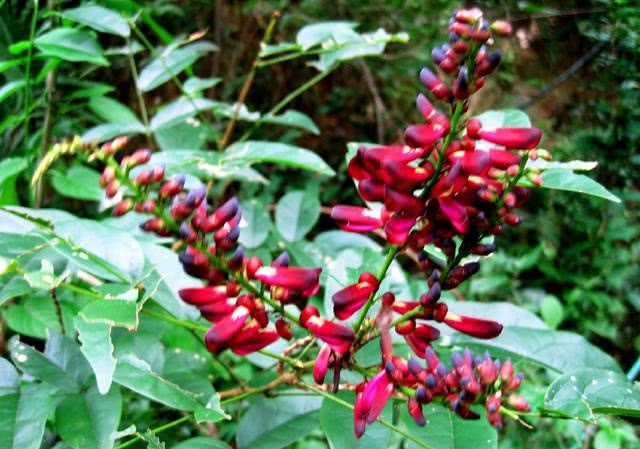
Jixueteng (plant)
Jixueteng is an alternative name for various plants in the family Fabaceae, phylum Angiospermae, class Dicotyledoneae, subfamily Faboideae. It is an evergreen woody liana, hairless, with new branches dark green and several triangular bud scales persisting at the base.
It grows in forests below 1800 m in altitude. It is distributed in southwestern Yunnan (Baoshan, Fengqing, Lincang, Gengma) and Guangxi; it also occurs in northeastern Myanmar.
Morphological characteristics
The stem is dark purple-green, with grayish-white lenticels; the main root is yellowish-brown, and the cross-section is dark purple. The leaves are papery, elliptic or ovate-elliptic, 6-13 cm long and 3-6 cm wide, with the apex abruptly narrowly short-acuminate or gradually acuminate, the base broadly cuneate or rounded-obtuse, the margin entire or with sparse callose denticles; lateral veins 7-10 per side, nearly the same color on both surfaces when dry, with densely distributed extremely fine white glandular dots beneath.
Flowers unisexual and monoecious. Male flowers: tepals creamy yellow, 14-18, with transparent fine glandular dots and ciliate margins; the largest tepal of the middle whorl ovate or elliptic, 10-17 mm long and 8-10 mm wide; the receptacle ellipsoid, with the apex elongated into a cylindrical shape and conically protruding beyond the stamens; the androecium ellipsoid or nearly spherical, 6-8 mm in diameter, with about 60 stamens; stamens 0.8-1.5 mm long; filaments and connective united into a broad flattened inverted trapezoid, the apex transversely oblong-elliptic; the anther cells are 2/3 the length of the stamen, with distinct filaments; pedicels 7-15 mm long. Female flowers: tepals similar to those of the male flowers but larger; the gynoecium ovate or nearly spherical, 8-10 mm in diameter, with 60-70 pistils; the apex of the style bears a crown-like stigma, extending downward from the middle to the base; ovules 3-5, superimposed on the ventral suture.
The aggregate fruit is nearly spherical, 5-10 cm in diameter; the mature carpels are obovate, with a thick leathery apex and 4-5 angles. The flowering period is May-June, and the fruit ripening period is September.
[Notes] (1) There are many varieties with the same name, commonly including: the Millettia genus plant Millettia dielsiana Harms ex Diels. (Fengcheng Jixueteng, Guanchang Xueteng, Shan Jixueteng); the Millettia genus plant Millettia reticulata Benth., which is used as Jixueteng in some areas of southern China; Millettia nitida Bent., whose root is used as Jixueteng in medicine in the Guangdong and Guangxi regions; the Mucuna genus plant Mucuna sempervirens Hemsl., which is used as Jixueteng in Fujian; Mucuna birdwoodiana Tutch., whose vine is called Xuefengteng in Guangzhou and is sometimes mixed and used as Jixueteng; and the Sargentodoxa genus plant Sargentodoxa cuneata (Oliv.) Rehd. et Wils. of the family Sargentodoxaceae, which is used as Jixueteng in the Beijing region.
(2) Yunnan Jixueteng Gao is not made by decocting the vine stems of the aforementioned Fabaceae Jixueteng source plants; it is mainly obtained by decocting slices of the vine stems of Kadsura interior A. C. Smith and K. heterolita (Roxb.) Craib of the genus Kadsura in the family Magnoliaceae. The commercial product is often called "Fengqing (formerly Shunning) Jixueteng Gao." This paste is not a single-ingredient paste and often also requires the addition of Achyranthes bidentata, safflower, black beans, glutinous rice and maltose, etc., prepared together. There is also a so-called "Luquan Jixueteng Gao," which is obtained by decocting the vine stems of the Fabaceae plant Craspedolobium schochii Harms and is often a single-ingredient paste. Because the sources of the medicinal material differ, their therapeutic effects are also inconsistent.
[Excerpt] Chinese Pharmacopoeia
Growing environment
On field edges, sunny hillsides, roadside thickets or coastal sand dunes at altitudes of 200-3000 m, usually parasitic on various plants of the families Fabaceae, Asteraceae, Zygophyllaceae and others.
Distribution range
Produced in Heilongjiang, Jilin, Liaoning, Hebei, Shanxi, Shaanxi, Ningxia, Gansu, Inner Mongolia, Xinjiang, Shandong, Jiangsu, Anhui, Henan, Zhejiang, Fujian, Sichuan, Yunnan and other provinces. It grows in Iran, from Afghanistan eastward to Japan and Korea, and southward to Sri Lanka, Madagascar and Australia.
Main value
The seeds are used medicinally and have the functions of tonifying the liver and kidneys, replenishing essence and strengthening yang, and stopping diarrhea.
Character identification
The stem vine is flat-cylindrical, slightly curved, 2-7 cm in diameter. The surface is grayish-brown, sometimes with grayish-white patches visible; where the cork layer has fallen off, it appears reddish-brown, with obvious longitudinal grooves and small dot-like lenticels. The texture is hard and difficult to break, and the fractured surface is irregularly lobed.
Xueteng slices are elliptic, long rectangular or irregular oblique slices, 3-10 mm thick. The cut surface of the xylem is reddish-brown or brown, with numerous vessel pores arranged irregularly; the phloem has resinous secretions, reddish-brown to blackish-brown, arranged alternately with the xylem to form 3-10 eccentric semicircular or circular rings. The pith is small and one side. The odor is slight, and the taste is astringent. Those with abundant resinous secretions are considered better.
Microscopic identification
Transverse section of the stem vine: cork cells in several to several dozen layers, slightly lignified to lignified, some containing brown substances. The phelloderm is 2-4 layers of cells, containing brown substances. The cortex is narrow, with more than 10 layers of cells, containing yellowish-brown substances; stone cells are numerous, scattered in groups, with obvious lamellae and pit canals, the cell lumina filled with reddish-brown substances, and a few containing calcium oxalate prisms; some surrounding parenchyma cells contain calcium oxalate prisms, and the walls of crystal-containing cells are lignified and thickened; secretory cells are few and scattered. The vascular bundles are anomalous, with phloem and xylem arranged alternately to form several eccentric rings. The outermost part of each phloem ring is a sclerenchyma band composed of stone cells and fibers; the cells on both inner and outer sides of the band sometimes contain calcium oxalate prisms; the secretory cells of the phloem are often several to more than 10, arranged tangentially in layers, containing yellowish-brown, reddish-brown or golden-yellow secretions; fiber bundles are numerous and scattered, and the surrounding cells contain calcium oxalate prisms to form crystal fibers; stone cells are few and scattered; rays 1-4 cells wide, curved, mostly compressed. The cambium is obvious. Xylem vessels are mostly solitary or in pairs side by side and scattered, about 400 um in diameter, some with brown block-like substances attached to the inner wall, mostly crescent-shaped; xylem parenchyma cells mostly surround the vessels, with slightly thickened walls, mostly containing brown substances, with secretory cells scattered among them; wood fibers also all form crystal fibers, arranged almost in layers; xylem ray cells have obvious pits, some containing brown substances. The pith is small, eccentric, with numerous secretory cells around the pith.
Powder characteristics: reddish-brown.
Stone cells mostly in groups, rectangular, subrounded, triangular or square, 10-80 um in diameter, some cell lumina containing reddish-brown pigment; a few containing calcium oxalate prisms.
Fibers in bundles, with pits and lumina not obvious; the cells around the fiber bundles contain calcium oxalate prisms, forming crystal sheath fibers.
Secretory cells containing reddish-brown resinous pigment are numerous, arranged in strips or irregular masses.
Vessel fragments are mainly bordered-pitted.
Cork cells polygonal in surface view, with oblong pits in the walls.
Xylem parenchyma cells with fine, dense pits.
Chemical identification
Chemical identification by thin-layer chromatography: take 2 g of the fine powder of this product, extract under reflux with ethanol, concentrate the extract under reduced pressure to an extract-like consistency, add silica gel (Qingdao Marine Chemical Factory, 60 mesh) at 3 times the weight of the extract, mix well, air-dry at room temperature (or bake dry), pack into a short column, elute with chloroform until the eluate is almost colorless, then switch to chloroform-methanol (8:2) for elution. Concentrate the two eluates separately to dryness for sample application.
Use formononetin and protocatechuic acid as reference substances. Apply the samples to a silica gel G high-performance thin-layer precoated plate, with chloroform-methanol (9:1) as the developing solvent. The developing distance is 10 cm. Observe under ultraviolet light (254 nm). The spots of the eluate that correspond in position to formononetin and protocatechuic acid show dark purple fluorescent spots.
Dietary therapy value
Jixueteng is bitter with a slight sweetness and warm in nature; it enters the liver, heart and kidney meridians; its red color enters the blood, and its moist quality moves and disperses; it has the effects of activating blood and relaxing the sinews, and nourishing blood and regulating menstruation; it mainly treats rheumatic arthralgia, numbness of the hands and feet, limb paralysis, irregular menstruation, sluggish menstruation, dysmenorrhea, amenorrhea and leukopenia.
For treating pain of the waist and knees caused by wind-dampness, rheumatic arthralgia and limb numbness, it is often combined with safflower, peach kernel, red peony root, earthworm, astragalus, angelica, salvia and others. For irregular menstruation, amenorrhea and dysmenorrhea, it is often used together with cyperus rotundus and motherwort.
Medicinal value
Efficacy and effects: the root and stem are Yunnan Jixueteng
Used medicinally to enrich the blood and promote blood circulation, and to free the meridians and activate collaterals.
1. Effects on the hematopoietic system
2. Effects on coagulation and fibrinolysis
3. Inhibitory effect on the heart and blood pressure-lowering effect
4. Anticancer effect
5. Regulation of lipid metabolism
Clinical application
1. Treatment of leukopenia caused by radiotherapy: Jixueteng 30 g, astragalus 15 g, jujube 5 pieces. Decoct in water and take.
2. Treatment of aplastic anemia: Jixueteng 60-120 g, eggs 2-4, decoct 8 bowls of water down to a little more than half a bowl, 1 dose per day, taken over the long term.
Medication contraindications
Use with caution in those with yin deficiency and hyperactive fire.
Nutritional knowledge
Introduction to Jixueteng knowledge:
Jixueteng is the vine stem of the Fabaceae plant Spatholobus suberectus. Spatholobus suberectus is a woody liana that grows in mountain valley forests, by streams and in thickets. It is distributed in Fujian, Guangdong, Guangxi, Yunnan and other places.
The vine stems are harvested in autumn, the branches and leaves removed, sawn into sections and sun-dried. Or they are sliced fresh and sun-dried.
The vine stem of Jixueteng is flat-cylindrical, 2 to 7 cm in diameter, grayish-brown on the surface, hard in texture and difficult to break, with the fractured surface irregularly lobed and reddish-brown in color. The slices are 3 to 10 mm thick; the cut surface of the xylem is reddish-brown or brown with numerous vessel pores; the phloem has resinous secretions, reddish-brown to blackish-brown, arranged alternately with the xylem to form 3 to 10 eccentric semicircular or circular rings, with the pith one side; the odor is slight and the taste is astringent.
Those with abundant resinous secretions are considered better. Supplementary information on Jixueteng:
Processing: take the original medicinal material, remove impurities, sort by size, wash clean, soak until thoroughly penetrated, cut into thin slices and dry; or steam until soft and cut into thin slices while hot, then dry. After processing, store in a dry container in a ventilated and dry place, and protect against mold and insects.
Dietary therapy effects of Jixueteng:
Jixueteng is bitter with a slight sweetness and warm in nature, and enters the liver, heart and kidney meridians; its red color enters the blood, and its moist quality moves and disperses; it has the effects of activating blood and relaxing the sinews, and nourishing blood and regulating menstruation;
It mainly treats rheumatic arthralgia, numbness of the hands and feet, limb paralysis, irregular menstruation, sluggish menstruation, dysmenorrhea, amenorrhea and leukopenia.
Guidance on preparing Jixueteng:
1. It can treat pain of the waist and knees caused by wind-dampness, rheumatic arthralgia and limb numbness, and is often combined with safflower, peach kernel, red peony root, earthworm, astragalus, angelica, salvia and others.
2. It can be used for irregular menstruation, amenorrhea and dysmenorrhea, and is often used together with cyperus rotundus and motherwort.