Cymbidium won't bloom? An orchid farm owner accidentally reveals the reason
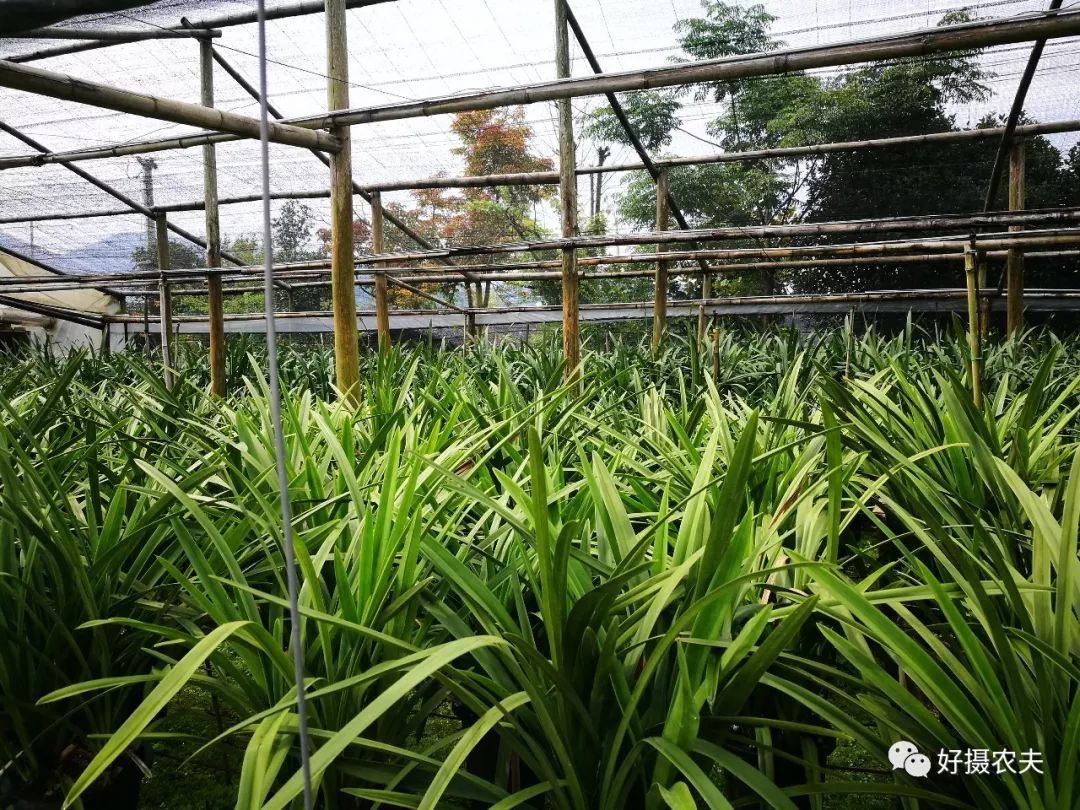
Cymbidium is a flower that has become very popular with the public in recent years. Recently, many friends told Haoshe Nongfu that after buying a Cymbidium and taking it home, it won't bloom again the next year. Why?
For this reason, Haoshe Nongfu specially visited a Cymbidium farm, and while chatting with the owner learned some experience in growing Cymbidium. Today, I'll share it with fellow orchid enthusiasts.
The Cymbidium grown at the orchid farm are all brought in as one-year seedlings. All Cymbidium seedlings are tissue-cultured seedlings; there are no wild varieties or the like. At present, only a small number of Taiwan-funded and Japanese-funded companies, based in Taiwan, China and Japan, have the technology to cultivate Cymbidium seedlings, and their professional expertise is very strong.
Cymbidium needs four-year seedlings to bloom, so the farm's seedlings come in four age grades, from one-year to four-year seedlings. There is an interesting and little-known fact here: if in a given year the four-year seedlings (all budded) are not completely sold, they will not be kept for the next year. That's because the cost of keeping them is greater than the cost of selling them, which is to say the farm will voluntarily give up on five-year seedlings.
The four-year budded seedlings the farm prepares for sale generally have fat leaves and strong roots. If orchid enthusiasts take them home and don't repot them the next year, the root system won't have enough space to grow, and the seedlings will slowly turn yellow and suffocate, then become infected with pathogens.
The growing medium used for Cymbidium at the orchid farm is pure bark, with no fertilizer value at all. For fertilizing, the farm uses imported slow-release fertilizer supplied by the seedling company. And if you don't change the growing medium after taking it home and want to rely on the medium in the original pot to get the Cymbidium to bloom, that's simply unimaginable.
The vernalization of Cymbidium is even more particular than that of Chinese Cymbidium (Cymbidium goeringii). Even in the climate of Haoshe Nongfu's hometown, Cymbidium still needs a chosen location for vernalization. When the farm owner talked about this with Haoshe Nongfu, he couldn't help but sigh that good locations are now too hard to find. Every year during the four months from June to October, vernalization is required in mountainous areas at an altitude of more than 600 m, and by the time they come down the mountain in mid-October, they have all produced flower spikes. Because the farm is fairly large in scale, finding a plot of land at such a high altitude is a bit of a challenge.
In fact, when chatting with Haoshe Nongfu, the owner also said that after four-year Cymbidium seedlings have bloomed, they basically have no value for further growing, and very few seedlings older than five years can bloom. And most Cymbidium buyers just want something festive during the Spring Festival, buying a pot to put at home, and not many people expect it to bloom again.
So that's how it is. Haoshe Nongfu also feels the power of technology. Why does Cymbidium fail to bloom year after year, yet people keep buying it year after year? It's just for the festive feeling!