When does monkshood bloom? Flowering period and growing environment
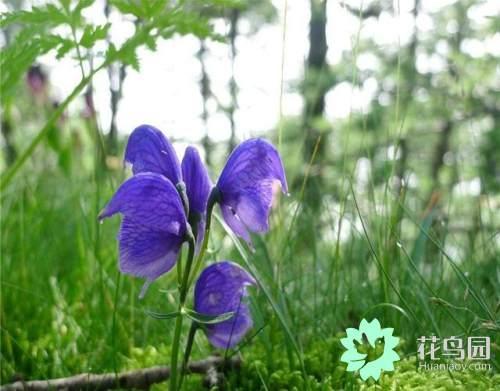
Introduction: Today I'd like to tell you about an ornamental plant, and this ornamental plant is monkshood. I'm sure some friends must know it - the flowers of monkshood are especially beautiful. In fact, monkshood not only has ornamental value but also medicinal value. When I was very young, I heard the elders in the village say that monkshood has the effect of dispelling rheumatism, so the elders in the village rather liked to keep a few plants of monkshood at home. Monkshood is fairly widely distributed, mainly grown in relatively large concentrations in several areas such as Sichuan, Yunnan, Shanxi, and Guizhou.
I. Introduction to monkshood
There are two kinds of monkshood. The one produced in Zhangming is the mother of the aconite, the Sichuan monkshood - what people today call Sichuan monkshood. It produces offspring in late spring, so it is said that what is harvested in spring is monkshood, while in winter the offspring have already formed, so it is said that what is harvested in winter is aconite. The tianxiong, wuhui and cezi are all forms that produce many offspring and are named by their appearance; if the plant produces few offspring or has only a single head, then these several forms do not exist. The one produced in Jiangzuo, Shannan and other places is the monkshood listed in the *Shennong Bencao Jing*, which people today call wild monkshood. Hence it is said that its juice, when decocted, becomes shewang. Hongjing did not know that there are two kinds of monkshood, and took the monkshood that is the mother of aconite to be the monkshood used for making shewang, which led various scholars to doubt and disagree. Before the Ming dynasty, Sichuan monkshood and wild monkshood were mostly collectively called monkshood. Wild monkshood: mainly produced in Zhejiang, Liaoning, Jiangsu and other places.
II. The growing environment of monkshood
Monkshood prefers a warm and humid climate. It is best to choose a site with ample sunlight, loose surface soil with good drainage, and medium-fertility soil. It is highly adaptable, but continuous cropping should be avoided. Because monkshood is a perennial herbaceous plant, cultivation generally uses tuberous root propagation. Plant in the first or second ten days of December, when the soil temperature at 10 cm below the surface is above 10°C; new fibrous roots emerge after 7 days. Generally, those planted 20 days before the winter solstice root first and then sprout, giving a higher yield; those planted 20 days after the winter solstice sprout first and then root, giving a lower yield.
In western Sichuan, southern Shaanxi and western Hubei, it is distributed at an altitude of 850-2150 m; in Hunan and Jiangxi it is distributed between 700-900 m; in the coastal provinces it is distributed between 100-500 m. It grows on mountain grassy slopes or in thickets. It is also distributed in northern Vietnam. The type specimen was collected in Yantai, Shandong.
After harvesting the previous crop of monkshood, such as rice, corn, vegetables, wheat, or Coptis chinensis, plow and sun-dry the soil, let it weather thoroughly, and break the soil up fine. Make beds 100-130 cm wide, 16 cm high, with a ditch 26 cm wide. Apply decomposed stable manure or compost on the beds, more than 15000 kg per hectare, turn it into the soil, mix thoroughly, and level the bed surface into a rounded, arched shape.
III. The flowering period of monkshood
The flowering period is from September to October, and the fruiting period is from October to November.
The above is the introduction to monkshood. For more knowledge, you can also consult our other articles. Growing monkshood is a very good choice, and I hope everyone can study it well. For friends who want to grow monkshood, I personally think it is a good choice. Monkshood is not only ornamental, but when the flowering period is over it can also be sold on the market as medicinal material. However, everyone must manage the temperature, water, and fertilization well, as well as the choice of soil. Well, that's all for today's explanation about monkshood. Thank you for watching.