Growing grapes on a balcony is very simple; with this method you can grow them easily
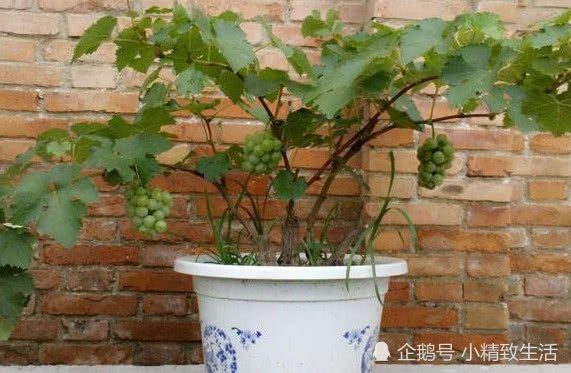
In recent years, because vegetables and fruits on the market contain pesticide and chemical fertilizer residues, the green method of growing vegetables on a balcony has gradually won people's favor. While people use their own labor to become self-sufficient and obtain green vegetables and fruits, they also spark their own interest and cultivate their own character; eating melons and vegetables they grew themselves brings a satisfying sense of achievement. So, did you know that in addition to growing vegetables, a balcony can also grow grapes? Besides the benefits mentioned above, growing grapes on a balcony also lets the grape trellis shade the balcony, bringing a trace of coolness to the home in summer.
To grow grapes on a balcony, two conditions are needed: enough soil and no less than 6-8 hours of sunlight per day. For the planting stock, choose fast-producing varieties; in only two years you can pick grapes. Below, let us learn in chronological order how to grow grapes on a balcony through to maturity and harvest.
First year, January
Selecting seedlings and planting. First, seedling selection: beginners or people in areas with relatively heavy rain can choose easy-to-grow varieties such as Kyoho, Summer Black, Hanxiangmi, White Banana, Moldova, and Yushuihong. One-year grafted seedlings are best; one-year seedlings are in their growth period, can bear fruit in the second year, and produce a full crop in the third year. Those so-called 5-year seedlings and 8-year seedlings from a certain Qian on a certain Bao are all scamming people; even if they were real, such old trees have already grown very weakly, and after planting it is very difficult to get a full crop.
Now for the pot and soil. If your balcony is big enough, you can directly build a flower bed, which is best. If not, that is fine too; choose a container that is big enough and deep enough. Wooden boxes and foam boxes are both fine, and the diameter should be no less than 30 cm. You can spread some weeds and leaves at the bottom of the flowerpot, then fill it with a mixed soil of 5 parts garden soil + 1 part sawdust or perlite. When planting the seedling, spread the roots out, then cover with soil and press lightly, and water thoroughly once. Try not to fertilize, because the root system is not yet well developed, and fertilizing easily burns the roots.
First year, April-June
By early April, the grafted grape seedlings begin to sprout. After sprouting, remove the plastic film at the graft union, then among the buds emerging above the graft interface, keep the strongest one, and remove all the other buds above and below the graft interface.
After this bud becomes a cane, once it grows its 8th leaf, begin pinching. After pinching, summer buds begin to sprout at the base of each leaf. The summer buds sprout and form secondary shoots; remove the topmost summer bud, and for summer buds in other positions, keep one leaf per bud and repeatedly pinch. The purpose of this is to force the uppermost winter bud to sprout and grow, because the characteristic of winter buds is that each level is thicker and stronger than the previous one, and winter buds are the buds of next year's fruiting canes. Winter buds will not emerge until next spring. Before that, the topmost summer bud should be repeatedly pinched each time with 7, 6, 5, and 4 leaves left, while the summer buds of other leaves should be repeatedly pinched with one leaf left. Because this is a potted grape, try to keep only a single cane. After it grows to a certain extent, use string to tie the cane to the trellis, and promptly remove all tendrils to avoid nutrient loss.
When the grape seedling begins to grow tendrils, you can apply some nitrogen fertilizer made by dissolving urea in water. Be sure to follow the principle of light fertilizer applied frequently. After the seedling grows larger, you can appropriately apply a compound fertilizer dissolved in water once a week, and you can appropriately add some organic fertilizers such as cake fertilizer and chicken manure, but be sure not to overdo it. In May-June, after the leaves grow larger, you can use 0.2% urea and monopotassium phosphate dissolved in water to spray foliar fertilizer on the front and back of the leaves. After entering the plum rain season in June, the leaves need Bordeaux mixture sprayed on the front and back to prevent disease.
First year, July-November
In July, grapes enter the flower bud differentiation stage, which is the key to determining next year's full harvest. At this time, you can apply a small amount of boric acid and zinc sulfate to the potting soil, and spray the leaves with a solution of monopotassium phosphate plus urea. August and September are the hottest times, so be sure not to let the grapes lack water; generally water once in the morning and once in the evening. In October and November, grapes continue to enter the root growth stage; continue to use 0.2% monopotassium phosphate as a light fertilizer applied frequently, but absolutely do not make it too concentrated, otherwise the grapes will be fertilized to death.
First year, December
In December, the grape leaves will fall off completely, and this is when pruning begins. For each main cane cultivated this year, keep 5-6 buds at the bottom, and prune away the rest of the branches above. If it is a single cane, you can keep a few more buds; generally, keeping the single cane at a height of 1.5 m is enough.
Second year, April-May
In April of the second year, the winter buds kept last year will sprout, and flower clusters will emerge at this time. At this point, be sure to apply as little nitrogen fertilizer as possible or none at all, and also water as little as possible, just keeping the soil from drying out, so as to avoid flower drop. In May, the grapes will bloom.
Second year, June
In June, you can see that the grapes have set small fruits. At this time, after spraying Bordeaux mixture once on the fruit clusters, you can bag them to prevent disease and birds. After the grapes have set fruit steadily, they begin to need heavy fertilizer and heavy water to promote fruit growth; at this time, you can water with urea solution to increase nitrogen fertilizer.
Second year, mid-June-August
Finally the harvest season has arrived. At this time, you can apply more potassium fertilizer, which will make the grapes large and sweet. Now you can pick the fruits of your hard work and taste them; remember to share!
The above was organized and published by Xiao Jingzhi Life. Due to limited expertise, errors and omissions are unavoidable; you are welcome to leave comments below with criticism and corrections!