Have you ever noticed such a special flower?
The plum rain season has arrived, and it rains every day. Actually, I don't dislike the rain. Raindrops fall into my flower pots and nourish my plants in a way that no amount of watering on my part could ever achieve. People here call rainwater "sky-fallen water." If plants are always kept indoors and start to grow poorly, they will suggest putting them outside to get some sky-fallen water.
But the constant rain kept disrupting my plans to visit Dripping Water Rock. Today, when I saw the rain had let up a bit, I hurried over to Dripping Water Rock to take a look. As I drove up the mountain road, it was shrouded in mist, and the distant mountain scenery was not very clear. There was not a single pedestrian on the road. I drove all the way to the parking lot next to Baoshou Temple and parked the car. As soon as I opened the door, I felt a rush of fresh air greeting me. There was wind blowing, and fine threads of rain were hitting my body.
The plants beside the parking lot had grown even more lush. What amazed me was that the bushkiller vine (Cayratia japonica) had already set fruit. When I came some time ago, their flowers had just been budding. Now they had already produced green fruits. I felt like a step in between was missing, and this was due to my negligence and laziness. Nature is changing at every moment. I don't know what else I have missed. If I want to make up for this lesson, I will have to wait until next year.
The bushkiller vine's tendrils have climbed over many places, looking quite spectacular. Li Shizhen said: "Its five leaves resemble those of white ampelopsis, hence it is called black ampelopsis, commonly known as five-clawed dragon." He also said: "It grows abundantly along field ridges and ditches. Its vine is soft and angular, each branch with one tendril, and always five leaves. The leaves are long and glossy, with sparse teeth, green on top and pale beneath. In the seventh and eighth months, it forms clusters of buds, greenish-white. The flowers are as large as millet grains, yellow, with four spreading petals. The fruit is as large as a black nightshade berry, green when young and purple when ripe, containing fine seeds inside. Its root is white, the larger ones as thick as a finger, one to two chi long, and when pounded it is very slimy." It seems that in the Compendium of Materia Medica, quite a lot is written about the bushkiller vine.
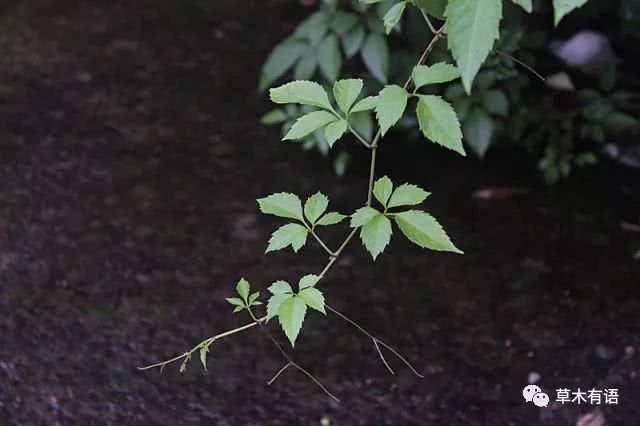
The leaves of the bushkiller vine are indeed very interesting. They are pedately 5-foliolate. If you look carefully at the leaves, the five leaflets are arranged like a bird's foot. The central leaflet is oblong or elliptic-lanceolate, and the lateral leaflets are elliptic or oblong. The petiole of the central leaflet is especially long, while the lateral leaflets are sessile or have short petioles. It's just that a bird's foot clearly has only four toes. The bushkiller vine's leaves feel more harmonious and symmetrical. If it is not flowering, the bushkiller vine and Jiaogulan (Gynostemma pentaphyllum) are quite difficult to distinguish. However, the nodes on the old stems of the bushkiller vine are red. With just this one trick, the two species can be told apart.
The inflorescence of the bushkiller vine is axillary and is a compound dichasium. A dichasium is a determinate inflorescence, with the flowering order opening from the center outward. The terminal flower opens first. After it blooms, the inflorescence axis below the terminal flower produces one branch on each side, with flowers at the tips of the branches, and each branch again branches on both sides, and this repeats. A compound dichasium is an inflorescence composed of several dichasia. This kind of inflorescence is a bit complex, and it looks somewhat like a diagram of some molecular structure.
The flowers of the bushkiller vine are often overlooked by us because they are really too small. But under my macro lens, I saw a different side. The calyx of the bushkiller vine is saucer-shaped, small and inconspicuous. There are 4 petals, triangular-ovate, rolled backward, and green, easily mistaken for the calyx. There are 4 stamens. The lower part of the ovary is adnate to the disk. The style is short, and the stigma is slightly enlarged. The disk is well developed and 4-lobed. Looking carefully, the disk somewhat resembles a small candlestick. The scene we see is like a table of people sitting around playing mahjong, and the color combination is also very beautiful. I guess the bushkiller vine must have put all the tasty things in the disk, so that when pollinating insects visit the flowers, they can just lean over the plate and eat their fill.
Because of differences in development, within the same inflorescence, some are oval flower buds, some are small flowers in bloom, and some have already formed green fruits. Of course, in the end they will all turn into spherical fruits, dark purple when mature. If these fruits could be preserved completely and pressed into specimens, they would really make a nice handicraft. Of course, pressing the fruits into specimens would be quite difficult.
I was very lucky. On the way down the mountain, I saw a very large bushkiller vine flowering by the roadside. I had thought I would miss those small flowers, but it seemed they could still be made up for. I was slowly fussing about alone in the fine rain. Just then, a person from the village below came over, saw me with a tripod photographing flowers, and said: "What's there to photograph about this? But you people are different. When you photograph these things, they look beautiful. I tell my daughter that what's shown on TV cannot be trusted, it's all staged like this. You have to look at the real side of things."
I flipped through the photos I had taken to show him and told him: "I didn't stage these. These are all real. It's just that you have never really looked at them carefully."
Author: Xiaowanzi
Images: Xiaowanzi