Why are the roots, stems and leaves all sturdy, yet the flowers so slender?
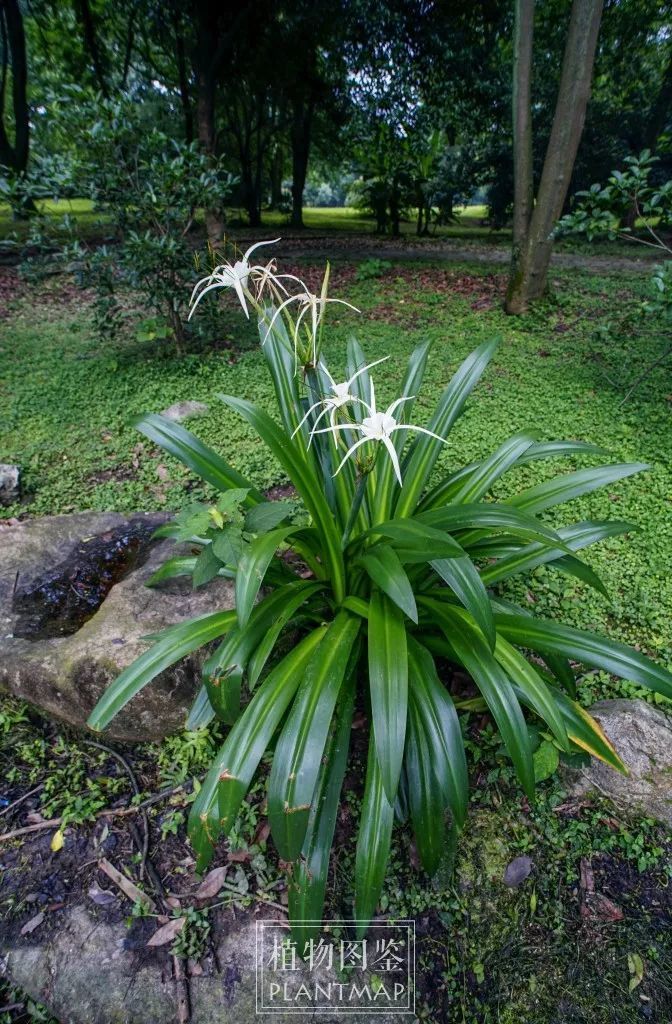
Hymenocallis littoralis is an aquatic-wetland plant, suitable for planting in shallow water, and it also tolerates drought fairly well, so it can be grown on land too.
[Hymenocallis littoralis] Amaryllidaceae >> Hymenocallis
In the Hangzhou area, Hymenocallis littoralis begins blooming in early July. The flowers are pure white and have a mysterious look; but the blooms wither quickly too, and they look best only during the first few days after opening.
A newly opened Hymenocallis littoralis flower is pure white, with six slender petals spreading outward and drooping slightly, giving it a languid yet not dispirited appearance.
At the base of the petals grows a distinctive frill. Regarding this skirt-like structure, the Flora calls it a "cup (staminal cup)". Indeed, on closer look, it does not grow at the base of the petals but at the base of the stamens, linking the six stamens together. So it turns out this is a skirt worn by the "men".
The tips of the stamens are green, with the anthers attached at the top in a versatile manner, looking shaky and rather unstable. At the center of the stamens is a pistil that is just as slender.
Hymenocallis littoralis is also known as spider lily and plant lily. Indeed, its slender petals and stamens easily bring spiders to mind. But why is it called "water ghost"? Well, nobody has ever seen a real water ghost anyway, so what if the person who named it guessed right?
As mentioned earlier, Hymenocallis littoralis flowers wither quickly. A single flower stalk can produce as many as eight blooms, but often only one or two look fairly perky. July and August in Hangzhou fall right in the thunderstorm season and typhoon season, which also speeds up the finale of Hymenocallis littoralis.
The large clumps of green leaves of Hymenocallis littoralis are very appealing and full of vitality, giving a bit of a tropical plant feel. It is indeed a tropical plant. In South China, Hymenocallis littoralis is a commonly planted species under trees, evergreen all year round. In Hangzhou, however, its aboveground parts wither in winter. But for a tropical plant, being able to overwinter outdoors in Hangzhou is already quite remarkable. Therefore, places in Hangzhou where you can see Hymenocallis littoralis are not that many; there are some at the Hangzhou Botanical Garden, and they are planted in the water features of some commercial streets by West Lake.
The two images above show Crinum asiaticum
By contrast, Hymenocallis littoralis's close relative Crinum asiaticum lacks this cold hardiness and can only stay tucked away in a greenhouse. Many people cannot tell Crinum asiaticum and Hymenocallis littoralis apart, but the differences between them are actually quite obvious. The "skirt" of Hymenocallis littoralis's stamens is the most striking identifying feature. In addition, Crinum asiaticum is also considerably larger in size.
Author: Jiang Mouren
Images: Jiang Mouren
This work is licensed under the (CC BY-NC-ND 4.0) license agreement
Please retain the above statement when reposting