Papaya prices fell this year; farmers say ups and downs are normal and more effort should go into expanding export channels
Summer brings a bounty of diverse fruits, and bananas and pineapples have successively seen price drops. Papaya has also been affected, with prices starting to fall in early June, even dropping to 7 to 8 yuan per kilogram, below the monitoring price of 14.5 yuan. According to auction market prices at Taipei Agricultural Products Marketing Corporation, prices had rebounded to 14 yuan yesterday. Zeng Yaping, director of the promotion section at the Linnei Farmers' Association in Yunlin County, said that good weather in the first half of the year led to an abundant papaya harvest, but recent rain has made papayas prone to water damage, and with many substitute fruits available, prices have fallen.
However, Li Xiecang, who has grown papayas for over thirty years and serves as general manager of the Changzhi Jiannong Fresh Fruit Production Cooperative in Pingtung County, believes that papayas can be harvested year-round, unlike pineapples whose season ends once harvested, so prices will rebound afterward, and the slowdown in sales is only temporary.
Looking at papaya by the numbers: the papaya price and volume change chart shows that papaya planting area has not increased, prices changed steadily in the past, and this year's prices are clearly lower than last year's, but farmers judge this as a normal fluctuation rather than a collapse caused by oversupply.
With plenty of fruit on the market, papayas do not store well and prices remain low
The day before yesterday, the Taipei Agricultural Products Marketing Corporation auction price for papaya was 14 yuan per kilogram, compared with 38.3 yuan per kilogram in the same period last year, a drop of nearly 70%. However, in the past two years, typhoons drove prices up; this year the climate has been mild and all crops are abundant, causing a large price decline.
"Papaya prices really weren't great for a while." Zeng Yaping pointed out that Linnei's papaya planting area is about 200 hectares, accounting for one-tenth of Taiwan's total. Good weather in the first half of the year produced high yields, but recent continuous rain has caused severe water damage to papayas, and market acceptance has not been high, so of course prices have fallen.
Zeng further stated that various fruits are currently in abundant supply, consumers have many choices, and papayas do not store well, all of which are factors causing the price drop. Some farmers at the production site have indeed abandoned their harvest because it does not cover costs. Zeng observed that since the end of May, papaya prices have remained sluggish all the way, saying, "Prices have fallen before, but not for this long."
Shi Xiuyuan, director of the supply and marketing section at the Liugui Farmers' Association in Kaohsiung, also said that Liugui's planting area is about 60 hectares and the harvest is now mostly finished. "The problem now is that market prices cannot be raised, and there are many substitute fruits." Many fruits are currently in abundant supply and prices are all on the low side, so consumers naturally do not want to buy papayas at high prices, though there is no slowdown in sales either.
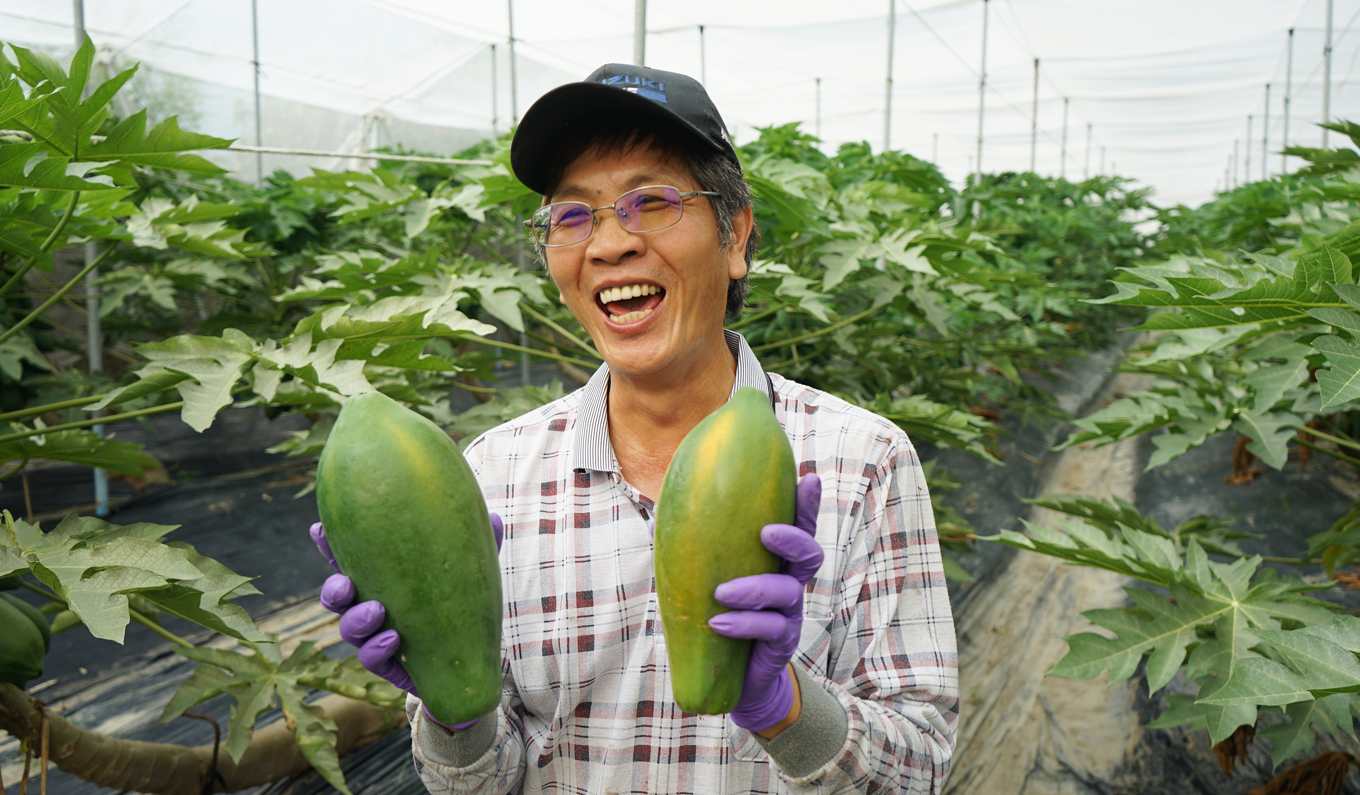
Domestic market demand is small, and exporting is another important sales channel. Zeng Yaping emphasized, "When facing an abundant harvest, rather than offering subsidies, it is better to work hard to find sales channels." The Linnei Farmers' Association previously tried exporting, but due to high export costs, quarantine issues, poor storability, and farmers believing they could get better prices selling at the market, plus prices rising in winter, it gradually stopped exporting.
"Taiwan's market is small, and without export channels, as long as Taiwan has favorable weather, every kind of fruit will see slow sales." Li Xiecang, who has run export operations for decades, said that export volumes cannot expand now, and less than 1% of Taiwan's papayas are exported.
Li Xiecang emphasized that exports previously focused on the mainland market, but in recent years Southeast Asian countries have risen, cultivating and managing in farm-style operations with cheap labor and land. "Taiwan has no advantage, so how can it compete? It cannot always rely only on quality; someday others will catch up with us."
Li said that for exports, farmers all have to negotiate and find their own way out, and "the government should encourage and reward export subsidies so that everyone will work harder at exports and supply and demand can reach balance."
Meinong Farmers' Association: exports to Singapore began this year
Zhong Qinghui, general manager of the Meinong Farmers' Association in Kaohsiung City, said that Meinong's papaya planting area is about 120 hectares, and after seeing papaya prices fall at the end of May, it began exporting to Singapore. The Meinong Farmers' Association purchases from farmers at 27.5 to 30 yuan per kilogram and has so far exported about 50 metric tons. "This number is not very large, but doing a little is still worthwhile and can play a role in stabilizing prices."
Regarding papayas' poor storability, Zhong said that shipping to Singapore takes about five to seven days, and the farmers' association works with farmers who have production and sales traceability records to ensure consistent quality. In addition, farmers are asked to harvest papayas at a lower degree of ripeness so they can be stored longer. Shipping containers have already been sent to Singapore one after another, and the response has been good.
However, Zhong also said that to export to more distant countries, new varieties must be developed to overcome the storability problem. "If preservation technology cannot overcome it, there is no way to export."