Growing wisteria is very simple: with a courtyard, you can have purple mist crowning your gate every year
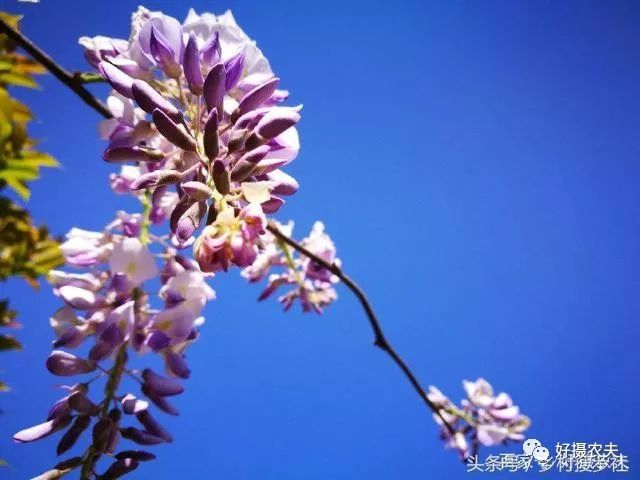
Purple mist from the east: purple is the color of wealth and good fortune in Chinese hearts. Among flowers, the one with the richest purple is undoubtedly wisteria. Many flower lovers are now starting to plant it in their own courtyards, but to grow wisteria well and make it bloom in full abundance on the branches year after year, there are still some finer points to observe.
This wisteria was dug down from the mountain by Hao She Nong Fu during the 2016 Spring Festival. The wild stump was not too old, and its diameter at 1.5 m was only about 10 cm. Because the spot for planting wisteria at the gate of the house had a trellis about 3 m high, this wisteria was cut to a length of 3 m, so that after planting it could reach the trellis directly.
In the first year (2016), it did not bloom much, probably because after transplanting it needed a process of re-rooting. When Hao She Nong Fu dug it on the mountain, most of the roots were sawed off, because otherwise there would have been problems with transport. Wisteria roots can be heavily pruned at transplanting without affecting the survival rate.
There are several points to note when planting wisteria. If these are done well, there is no need to worry about it not blooming. First, wisteria grows more easily and blooms more abundantly and vividly in sunny places. On mountains with poor light, it mostly produces long vines and leaves, and the flowers are not vigorous. So Hao She Nong Fu feels the planting position for wisteria should be sunny.
When digging the planting hole, make it as large and as deep as possible. Put the surface topsoil into the hole, then place the wisteria stump in. If there is well-fermented organic fertilizer to fill the hole, so much the better; it is very beneficial for that year's sprouting. Newly planted wisteria needs to be fixed to a post; after fixing, it will root much faster. Wisteria rarely has pests; just pay attention to controlling aphids every April, specifically by spraying with imidacloprid.
In autumn, before the wisteria leaves fall, apply a three-element compound fertilizer (nitrogen, phosphorus, potassium) at the roots. To fertilize, dig a ring-shaped trench around the roots and cover with soil after applying. Autumn fertilization lets the wisteria plant accumulate energy so that next year it can push out branches and bloom more vigorously.
At Spring Festival it can be pruned: cut away the excess branches so that the limited energy produces better flowers. After blooming, wisteria forms a kind of fruit, like a knife, which rural people call sword bean. Remove all the wisteria fruit so it does not consume too many nutrients and affect next year's blooming.
If you have a courtyard, and if you do as described above, in less than two years your courtyard will have purple mist from the east.