Although Cordyceps sinensis is precious, the damage caused by harvesting it to the Tibetan region is even more serious
When Cordyceps sinensis is mentioned, the first thought that comes to my mind is that it is precious. Indeed, Cordyceps sinensis is a precious Chinese herbal medicine, mostly growing in China's Tibet, Qinghai, Yunnan, Sichuan and other regions. It is a strange combination of insect and grass. Since ancient times, China has had the habit of consuming Cordyceps sinensis.
The effects of Cordyceps sinensis
China's classical medical work Compendium of Materia Medica contains records about Cordyceps sinensis. Cordyceps sinensis has certain tonic and medicinal value. Cordyceps sinensis has the effect of improving human immunity. It also has effects such as fighting cancer, relieving fatigue, and regulating the liver. As people's understanding of Cordyceps sinensis continues to grow, the price of Cordyceps sinensis has also kept rising, and harvesting in the Tibet region has become increasingly serious.
Methods of harvesting Cordyceps
Cordyceps sinensis is a fungus unique to the Qinghai-Tibet Plateau region. The effects of Cordyceps sinensis were mentioned above, and precisely because of these effects, the harvesting of Cordyceps sinensis has been quite serious in recent years. There are still many regions where Cordyceps sinensis grows, but because of their advantageous geographical environment, Qinghai and the Tibet region produce Cordyceps sinensis of the best quality. This has also brought great threats to these two regions.
Because Cordyceps generally grows in areas above 3000 m in altitude, Cordyceps usually begins to grow in May and can be harvested in June. However, driven by profit, many people start digging before June, which very easily causes landslides.
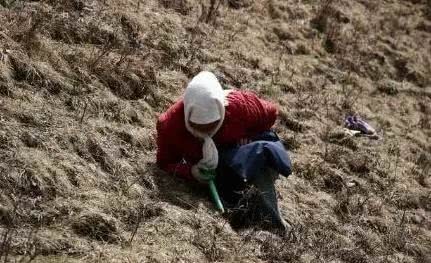
The harvesting method is to dig into the mountain body with a small shovel. Sometimes there are quite a lot of Cordyceps, and a 1 sq m area may have more than a dozen Cordyceps, so driven by profit, many people often start digging before the Cordyceps have grown well. Pits of various sizes often appear on the meadow, with a depth of about 10 cm, yet very few people backfill them. And because people repeatedly search for Cordyceps and repeatedly trample the meadow, the growth of meadow vegetation is seriously affected.
Researchers once conducted an experiment. In the 1960s, digging up one Cordyceps in Yushu left a pit the size of a fist, and as a result, 40 years later this pit still existed and had even expanded. From this one can imagine how serious the harm of large-scale Cordyceps digging is.
However, we all know that the vegetation in Qinghai and the Tibet region is very fragile. Once destroyed, it is very difficult to restore, causing severe soil erosion and vegetation damage. Not only that, it will also cause problems such as a decline in the quality of Cordyceps and a large reduction in Cordyceps.
The above comes from Science Xingnong.