Monthly Care Points and Precautions for Black Pine Bonsai
[Bonsai Practitioner's Reflections]
Text | Xiamen, Fujian @Zhou Yingzhi
Whenever the sun rises at dawn, a beautiful day begins again! Get up in the morning, look in the mirror, and ask yourself: do you want to live an ordinary life or create your own incredible one? Life is like subtraction; every page torn away can never come back, so please live each day well and cherish each day. Tomorrow you will thank today's desperately hard-working self! The greatest tragedy in life is not death, but living without purpose!
[Experience Exchange]
Monthly Care Notes for Black Pine Bonsai
Recommended text | Flowers & Trees Bonsai
Recommended images | Ouyang Yucheng
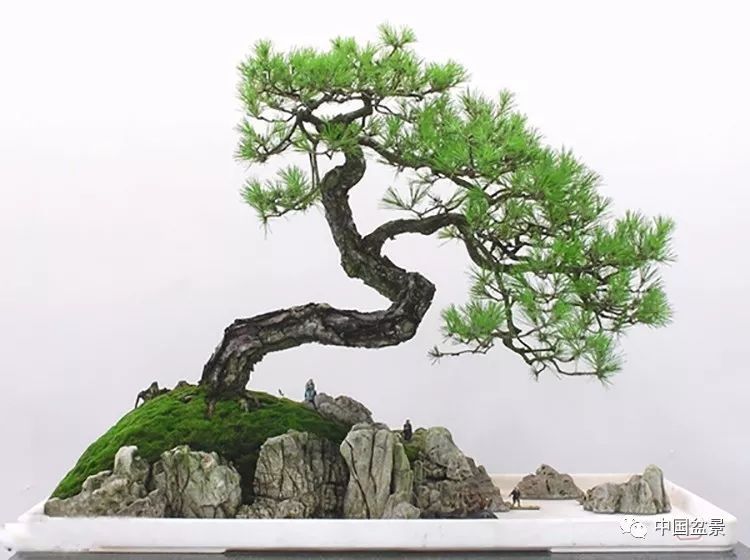
Black pine bonsai is one of the pine bonsai. Its majestic, rugged, vigorous and upright posture, together with its spirit of enduring cold without decline and unyielding tenacity, is praised by the world and deeply loved by bonsai enthusiasts. Black pine is also called white-bud pine, an evergreen tree of the Pinaceae family. Its height varies with the growing environment: in fertile, loose soil with deep layers, the plant can reach as high as several dozen meters, while in poor soil and harsh environments it grows no taller than a chi.
The bark of black pine is grayish-black, with scaly cracking; the cone is conical-ovoid, turning brown after maturing from September to October; the winter buds are silvery-white and cylindrical. The leaves are needle-shaped, two needles per bundle, thick and hard, clustered on short shoots; the needles are hard and thick, with sharp tips, dark green and glossy. The branches spread horizontally and are arranged in whorls, giving an antique and elegant posture. The crown of black pine is conical when young and becomes flat and fan-shaped when old. Black pine is native to Japan. It has been widely introduced and cultivated in Zhejiang, Jiangsu, Anhui and other places in China. Monthly management of black pine bonsai is as follows:
January
Black pine is in its dormant period, so wiring for shaping, branch thinning and needle plucking can be carried out. Except in extremely cold regions, it can overwinter outdoors. Because winter monsoons can easily dry out the potting soil, attention must be paid to watering.
February
This is the coldest time of the year, and also the most suitable time for black pine wiring for shaping, branch thinning and needle plucking. A 30-40 times diluted lime-sulfur mixture can be sprayed to prevent pests. Spraying lime-sulfur mixture can both prevent pests and diseases and strengthen the tree's vigor.
March
In March, the earth returns to spring, temperatures rise, and winter buds begin to sprout. Late March is the best time for repotting. When repotting, the vertical roots of young trees should be cut off, and tangled roots should be corrected and cut off. During repotting, dull tools and excessive drying of the roots will harm the tree.
April
Repotting should be completed before mid-April as much as possible. Within ten-plus days after repotting, no fertilizer should be applied; afterward, heavy fertilizer and heavy watering are fine. Begin fertilizing. Black pine likes water and fertilizer, and more application is fine. The pot can be rotated once every 2--3 weeks to ensure even light exposure.
May
The winter buds have grown long and candle-shaped. On vigorous trees, the crown and branch tips will appear especially thick and strong. When the buds stop growing and the needles show green, pinch them off by hand according to medium bud length (using scissors may cause death).
June
The new buds have grown into needles; at this time, carry out the bud-pinching and short-needle method. Except for weak buds that need to be strengthened, cut the buds from their base, leaving only last year's old needles, about five groups of needles per branch. After about 1--2 weeks, secondary buds will appear.
July
This is also a good period for bud pinching. After bud pinching, the tree's water absorption will temporarily weaken. At this time, fertilizer can be withdrawn, and fertilizing can resume when the secondary buds grow out.
August
Carry out bud selection on the secondary buds. Trees with sufficient water and fertilizer will produce secondary buds 1--2 weeks after bud pinching; among them, some strong branches may sprout 4--5 buds. If not handled, the branch tips will grow into clusters and ruin the tree shape.
At this time, tweezers can be used to remove buds in the up-down direction, keeping two buds horizontally. Generally, strong upper branches keep weak buds, and weak lower branches keep strong buds, so as to balance the tree's vigor.
September
Pay attention to late-autumn high temperatures, and spray water on the leaves frequently in the evening. The secondary buds are in a period of vigorous growth, so ensure sufficient water and fertilizer. For buds with poor growth, foliar fertilizer can be sprayed once a week.
October
External growth has basically ended, and the tree turns to storing energy internally for winter. Ensure sufficient fertilizer supply to strengthen the branches and trunk.
November
At this time, the tree's form and leaf color are the most beautiful of the year. Maintain sufficient fertilizer before the end of the month.
Carry out needle plucking. In principle, all old leaves left during bud pinching are removed; for new leaves, depending on whether the branch is weak or strong, strong branches keep 4 groups, weak branches keep 5 groups, and especially weak branches are not needle-plucked.
December
The tree enters dormancy. This is the best period for needle plucking and branch pruning. Pruning for shaping will harm the tree, so after the work, pay attention to keeping it warm and retaining water. Lime-sulfur mixture can be sprayed once.
(This article was compiled and recommended by "Flowers & Trees Bonsai"; copyright belongs to the original author)
Wonderful replay:
Chinese bonsai welcomes you!
Enjoy at any timeadmirethe bonsai exhibition hall
Promote bonsai culture, exchange bonsai techniques!
Appreciate bonsai art, share a happy life!