Ornamental trees are suitable for container growing and can be kept indoors without any problem.
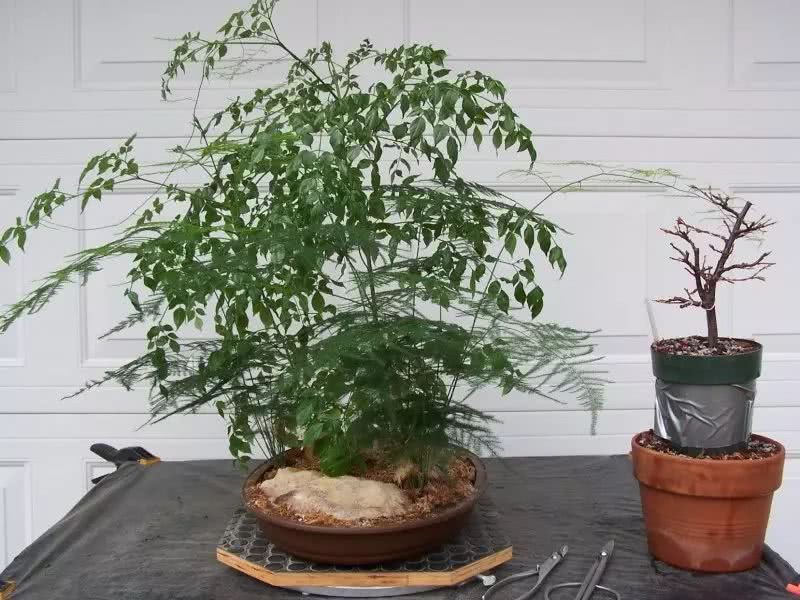
When choosing an ornamental tree to grow in a pot, you need to pick the right variety. Trees grown in containers can add even more brilliance to your home. Besides the common large foliage plants such as the money tree, fiddle-leaf fig and Radermachera sinica, you can also choose some more unusual ornamental trees. The ornamental trees below are all especially suited to being planted in a courtyard or on a balcony, and with the right environment they will grow well.
Trees bring a feeling of tranquillity, beauty and wildness to a whole space. If you do not have a very large yard but still want to grow some landscape trees, you just need to choose the right varieties so they can grow in a pot, and you also need to pay attention to regular pruning to stop the plants from growing too tall.
1. Choose a suitable container
To grow an ornamental tree, choose a container with fairly large drainage holes, and ideally one with a certain amount of weight so that it will not be blown over by the wind after the tree is planted.
You can add some wood shavings, pebbles or broken tiles to the bottom of the container to prevent water from collecting in the pot. The container should not be more than twice the volume of the tree's roots, otherwise waterlogging and root rot are likely.
2. Points to note when planting
Ornamental trees are generally planted after the frost has completely ended, when the temperature is stable at around 18 degrees, so that the young ornamental tree can be transplanted directly into a new pot. Prepare some loose, fertile, well-drained soil. After planting the ornamental tree, water it thoroughly and place it in a ventilated spot with bright light.
3. Choose a suitable tree species
1. Fig
If you want to grow some fruit-bearing trees, the fig is a good choice. You can pick some compact varieties, and when growing it in a pot you can set up a support to help hold the trunk against the branches.
The spot where you keep the fig needs about seven hours of scattered light each day. If there is too little light the leaves tend to turn yellow, and in summer you should provide some shade. If you water too much, the leaves also tend to turn yellow.
2. Olive tree
The olive tree itself is a very cold-tolerant plant and can live for 1000 years. An olive tree grown in a pot will not live that long, but it can still be kept for many years. If you live in a cold climate, you can move the olive tree indoors to overwinter, placing it by a windowsill with bright light, away from heating and air conditioning.
Normally the spot where you keep the olive tree needs about six hours of direct light a day, and you generally water only once the soil about 3~5 cm below the surface has dried out.
3. Maple
The red maple is very well suited to being grown in a pot. It grows very slowly and has a fairly shallow root system. You can choose some compact varieties, and the planting spot should be away from overly intense light and strong wind. Prune away any withered branches promptly.
4. Pittosporum
The pittosporum tree looks somewhat like the Schefflera, and it is also a very attractive ornamental plant. The plant is fairly compact, but its branches and leaves are very vigorous, so it needs regular pruning to prevent excessive growth and straggliness. The spot where it is kept should be ventilated and receive plenty of light each day, and the growing environment should stay warm and humid all year round. During the growing season, water regularly to keep the soil moist.
5. Compact conifers
Some compact varieties of fir, cypress, hemlock, Cathaya, juniper and pine are suitable for growing in pots. They are very low-maintenance and do not need frequent care, and their foliage comes in different colours, forms and textures. They also grow very slowly and can stay in the same container for about 5 years. They can also be kept outdoors in the cold season, providing some fresh, bright colour in winter.