Classic line from Dying to Survive: There is only one disease in this world, and it is called being poor.
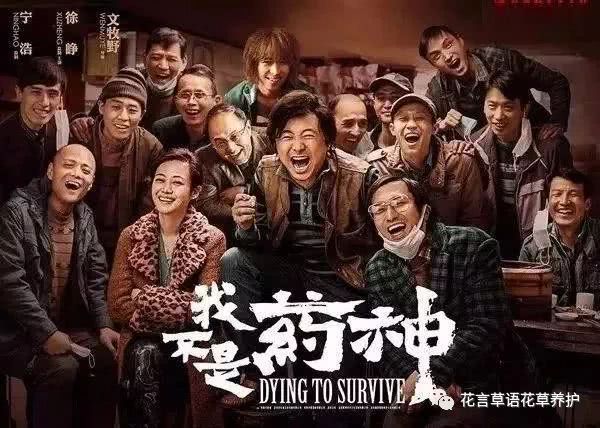
These past few days, WeChat Moments, Weibo and so on have all been flooded with Dying to Survive.
Douban rating 9.3.
What kind of movie could possibly earn such high praise? You have to know that our people have always been very strict.
Could it be that China has no good movies left? Wrong! Look at the fine works of recent years: Youth, 7.7; Forever Young, 7.6; even a movie as breathtaking as Let the Bullets Fly only got 8.7.
A movie with a score of 9.3 is indeed rare in China, so why did Dying to Survive get exactly this score? What makes it worthy?
The reason is that it is real enough!
Cheng Yong, a middle-aged man who has achieved nothing, because of domestic violence, his wife married a rich man instead, his father, suffering from a hemangioma and with no money for surgery, and he can only watch helplessly as his own biological son emigrates with his stepfather, while he himself is powerless.
He opened a health supplement store, business was bleak, and he could not even pay the rent. His life was worse than a dog's.
Lu Yishou, a chronic myeloid leukemia patient; once you get this disease, you need to take a drug called "Swiss Glivec" to keep the condition under control, but this drug is too expensive, 40,000 yuan per bottle, and one pill costs 200 yuan. This drug cannot be stopped; it requires lifelong medication, and the sky-high medical costs will eat you out of house and home.
When Lu Yishou got this disease, his wife was already 5 months pregnant. At that time, all he thought about all day was suicide, wanting to free himself through it, but when he saw the moment his child was born, he decided to keep living; he wanted to hear his child call him: Daddy!
In order to stay alive, Lu Yishou found Cheng Yong. He told Cheng Yong that in India there was a generic version of "Swiss Glivec," with exactly the same efficacy as the Swiss Glivec sold at sky-high prices in China, and it cost only 500 yuan. He asked Cheng Yong to buy it for him at 5,000 yuan per bottle.
Looking at his father, whose life was hanging by a thread because there was no money for treatment, and because there was no money, he could only watch as his son was taken away.
Cheng Yong decided to take the risk.
One needed money, the other needed life.
So they began smuggling "Indian Glivec."
But although they got the medicine, they could not sell it.
At this time, Lu Yishou thought of the leader of the patient group, Liu Sihui.
Liu Sihui, a single mother, whose daughter also had chronic myeloid leukemia, and whose husband left without saying goodbye when he learned of their daughter's condition. In order to buy the sky-high-priced medicine to treat her daughter, she had to go to nightclubs to dance on a pole, had to endure humiliation from the manager, and often had to bring men home.
When she learned that Cheng Yong could prolong her daughter's life, she reached a consensus with him without hesitation, and under her call, the group leaders all rushed over. Cheng Yong sold them the medicine at a 20% discount, and they decided to help Cheng Yong sell the medicine.
Peng Hao, a 20-year-old young man from the countryside, after being diagnosed with chronic myeloid leukemia, ran away because he was afraid of implicating his family, and helped people at a pig slaughterhouse, killing pigs while waiting to die.
For Peng Hao, he did not know how many pigs he would have to slaughter to afford a single bottle of the sky-high-priced medicine, so he directly snatched a few bottles from Lu Yishou's hands. Afterward he was caught by Cheng Yong and Lu Yishou. After a beating, Cheng Yong discovered that Peng Hao had given all the snatched medicine to fellow patients. Seeing that he was loyal and also pitiful, Cheng Yong softened and told him to sell medicine together with them.
More and more people were selling medicine, and Cheng Yong decided to secure the distribution rights for China. He needed someone who could speak English.
Pastor Liu appeared.
Pastor Liu was also a chronic myeloid leukemia patient. He often organized fellow patients at the church to pray, praying that God would bless them in fighting the disease. After learning that Cheng Yong was smuggling, Pastor Liu said, this is illegal and will be punished by God.
Cheng Yong told him, God cannot save people; if people want to live, they can only save themselves.
So Pastor Liu accepted it and also joined Cheng Yong's team.
With Pastor Liu's help, Cheng Yong successfully secured the distribution rights for "Indian Glivec" in China.
Just like that, Cheng Yong went from an unsuccessful small-time aphrodisiac seller to suddenly becoming the "medicine god" in the mouths of patients. While receiving countless banners sent by patients, he also extracted huge profits from this smuggling.
Patients had life-saving medicine, Old Lu could watch his son grow up, Sihui did not have to sell her body, Peng Hao did not have to wait for death, Pastor Liu did not have to pray every day, Cheng Yong became a wealthy man, his father's surgery went smoothly, and his son was kept by his side. Everything was so harmonious and comfortable.
At this time, Zhang Changlin appeared.
Zhang Changlin, a fake medicine dealer, had his scam exposed and his venue smashed by Cheng Yong and others at a fake medicine sales event.
Later, after investigation, Zhang Changlin learned that Cheng Yong was the boss of this smuggling operation. He found Cheng Yong and said to him, selling like this, at most you make about one million a year, and once you get caught, do you know the consequences? I have been in this line for over ten years and nothing has ever happened. I will give you two years' worth of money, transfer the business to me!
To protect himself, Cheng Yong ultimately decided to transfer the distribution rights to Zhang Changlin.
Cheng Yong acted for money, and now, for money, he withdrew. He brought hope to patients, and now, with his own hands, he crushed that hope.
Peng Hao could only return to the slaughterhouse and continue waiting to die, Sihui could only continue selling her body to prolong her daughter's life, Pastor Liu could only return to the church and continue praying with fellow patients for God's protection, and as for Old Lu, perhaps he would not live to hear his child call him Daddy.
With the money Zhang Changlin gave him, Cheng Yong opened a garment factory and completely cut ties with "Indian Glivec" and chronic myeloid leukemia.
However, once you get involved with drugs, you can never again break away from drug dealers.
Zhang Changlin raised prices. The medicine that originally cost 10 million yuan per bottle rose to 20000 wan yuan per bottle. Lu Yishou, unable to afford the medicine, chose suicide.
After experiencing Old Lu's death, as well as the despairing eyes of countless patients, Cheng Yong decided to return to his old trade.
Cheng Yong's team gathered again. This time, they did not do it for money, but only to save people. In order to let more patients survive, they decided to sell the medicine outside the province. In order to let every patient afford the medicine, the original 5,000 yuan per bottle was lowered to 500 yuan per bottle. Later on, for every bottle sold, Cheng Yong had to pay 1,500 yuan out of his own pocket, and every month he had to lose several hundred thousand yuan out of pocket in order to keep supplying medicine to patients.
The law is greater than emotion. This man, called the "medicine god" by chronic myeloid leukemia patients, was ultimately put in prison.
After watching the movie, I could not calm down for a long time. In the movie, Zhang Changlin said one line that left a particularly deep impression: There is only one disease in this world, the disease of being poor.
It hits the nail on the head.
Because Cheng Yong was poor, his wife ran off, his son emigrated abroad, and even his own father's life nearly could not be saved.
Because Lu Yishou was poor, he slit his wrist and killed himself.
Because Liu Sihui was poor, she sold her body.
Because the yellow-haired youth was poor, he ran away from home and could only wait to die at the pig farm.
Because the fellow patients were poor, they could only stay in cheap hotels and protest with violence against sky-high-priced medicine.
Since its release, this movie has won countless thumbs-up, and almost every screening was packed. Why is it so popular?
Because it is real enough. Everything that happens in the movie is almost no different from reality.
Yet reality is a hundred times, a thousand times more absurd.
The son-in-law of my grandmother's sister died last year from uremia. By generational ranking, I called him uncle. Before he was diagnosed with uremia, they had originally been a happy family. His two older sons had already married and established themselves, and his youngest son had smoothly gotten into his ideal middle school. Every day he went to the vegetable market early in the morning to buy groceries, and at night he danced square dancing with his wife.
However, just such an utterly ordinary family was completely destroyed by a thin, transparent medical examination report from the hospital. Mid-stage uremia. Looking at those extremely conspicuous large characters on the report, the whole family felt as if they had been sentenced to death.
A kidney transplant was the only way.
But heaven did not pity them; no one in the family matched him.
Then there was no choice but to search nationwide for a kidney source. The doctor said this lightly.
So their family set out on the road of chemotherapy on one hand and waiting for a life-saving kidney source on the other.
In order to treat uncle's illness, their family sold the original house and moved into a narrow small apartment. His wife opened a braised food shop. Every day she no longer went to square dance, but dealt with chickens, ducks and all kinds of frozen products all day long, while he sat in the shop every day collecting money. All the heavy and tiring work fell on his wife. Before this, his wife had almost never done any housework.
During this period, I saw uncle once. He had gained a lot of weight, or strictly speaking, had become swollen. His hair had also all fallen out because of chemotherapy. It was cold in winter, so he could only wear a woolen hat to resist the biting cold wind.
Spending money is always faster than finding money.
This tottering family could no longer afford the expensive chemotherapy and medicine costs. They made a painful decision: give up chemotherapy.
In the end, mid-stage uremia turned into late-stage uremia.
A month later, grandma told me that uncle had passed away.
Grandma said that before he died, the hospital called saying they had found a kidney source, but the other party was not donating for free and wanted several hundred thousand!
Upon learning this desperate surprise, uncle refused the kidney transplant and finally died in pain.
Did uncle really not want to live? No, he wanted to live more than anyone, but the family could no longer produce money. Because of the earlier chemotherapy, they had already owed a large debt.
Because he was poor, he chose death.
It never rains but it pours. The father of one of my high school friends died, because of lung cancer. His father had worked on construction sites year after year, and later kept coughing nonstop. The friend told him to get checked, and his father scolded him: Are you fucking cursing me to die early!
Later, his father fainted during work and was sent to the hospital. The doctor told him, lung cancer! Late stage!
After a long while, his father said in an almost calm tone, thank God!
Then he went back to work on the construction site.
In less than three months, his father passed away. Only a few hours before he died did the friend learn the condition from his father's mouth. His father told him that he was very glad that what was found was late-stage, because that way he could save a large sum in medical expenses.
Did he not want to live either? He did. He wanted to see his son get into university, graduate smoothly, get married and have children, and have his grandson call him grandpa.
But there was no money.
Because they were poor, my friend's father chose to conceal his illness.
No one knows when it started, but we no longer dare to get sick. A serious illness, for an ordinary family, is the end of the world, enough to destroy a family, and we are helpless.
Money is life.
Back to the movie. There are a few scenes in the movie that make people burst into tears.
1
When everyone learned that Cheng Yong would no longer sell "Indian Glivec," Old Lu smiled and told him not to joke around. Cheng Yong told him to get lost. Old Lu's last hope was forever frozen in that one word "get lost." He picked up his coat, put it on, and left. This also meant that he would not hear his son call him Daddy.
2
Zhang Changlin raised the medicine price, and Old Lu could not afford the expensive medicine, so he could only slit his wrist and kill himself. He was discovered in time by his wife and sent to the hospital, but in the end Old Lu still chose suicide. Before dying, he looked at his sleeping wife and son, and smiled helplessly and in despair.
3
Officer Cao, in order to capture the medicine sellers as quickly as possible, decided to look for clues among the patients, so he arrested a group of patients and brought them to the police station.
An elderly sick person, holding his hand, begged:
Comrade police, I beg you, stop investigating the fake medicine, okay! Whether this medicine is fake or not, how could we not know?
I have been sick for three years, taking medicine for three years. The house was eaten away, and the family was ruined. Now we finally have cheap medicine, but you insist on saying it is fake.
If we do not take the medicine, we can only wait to die. I do not want to die, I want to live, okay! Whose family does not have a sick person? Can you guarantee you will not get sick your whole life?
4
With life-prolonging medicine available, Peng Hao decided to go home and take a look. He cut his hair and bought a train ticket.
But during one medicine transport, he was discovered by the police. In order for himself and his fellow patients to live, and to protect Cheng Yong from being caught, he drove a car full of medicine alone to lure the police away, but was hit and killed by a truck.
Cheng Yong ran to the hospital, grabbed Officer Cao by the collar, and roared at the top of his lungs: He was only 20 years old! He just wanted to live! What did he do wrong!
This yellow-haired kid in his early twenties had cut his hair and bought a ticket home, but in the end still could not go back to take one look.
5
Cheng Yong was caught and sentenced to five years in prison. In the police car, Cheng Yong saw a crowd of people wearing masks standing on both sides of the sidewalk. These people were all patients he had helped. One after another they took off their masks and watched the police car leave. Cheng Yong looked at the patients outside the window and could no longer hold back; tears burst from his eyes.
He saw Pastor Liu, he saw Sihui and her daughter, and as if in a vision, he also saw Old Lu and Peng Hao in the crowd smiling and waving at him.
Cannot afford school, cannot afford housing, cannot afford to get sick. These are the three great pains of Chinese people today! All of this is because of one word: poor!
Dying to Survive honestly reflects social reality, takes the facts happening around us, strips away the skin and pulls out the sinews, then throws them bloodily in front of us. At the same time, it also asks on behalf of all living beings, exploring the true pain and predicaments of the people. It deserves everyone's praise.