Cornus officinalis blooms before its leaves emerge, and in autumn it bears abundant red fruits, making it a splendid choice for fruit display.
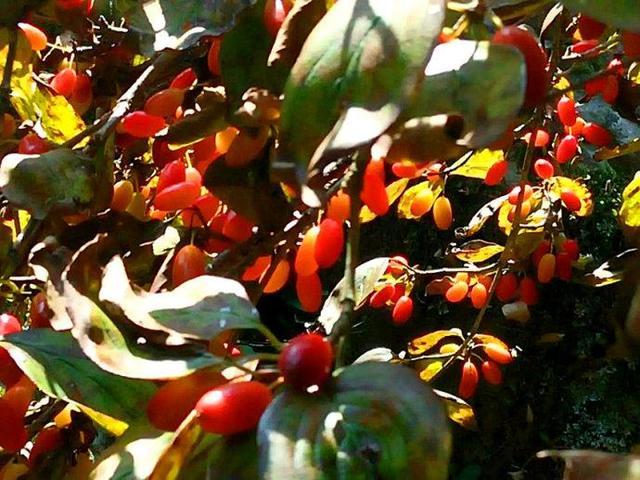
Cornus officinalis (plant of the genus Cornus in the family Cornaceae)
Cornus officinalis (scientific name: Cornus officinalis Sieb. et Zucc.) is a deciduous tree or shrub; bark grayish-brown; branchlets slender and cylindrical, hairless.
Leaves opposite, papery, green and hairless above, light green beneath; petiole slender and cylindrical, with a shallow groove above, rounded beneath.
Umbels borne on the sides of branches, involucral bracts ovate, tinged purple; peduncle stout, slightly covered with grayish short pubescence;
Flowers small, bisexual, opening before the leaves; calyx broadly triangular, hairless; petals ligulate-lanceolate, yellow, reflexed outward;
Stamens alternate with petals, filaments subulate, anthers elliptic; disk hairless; pedicels slender.
Drupe long elliptic, red to purplish-red; stone bony, narrowly elliptic, with several irregular ribbed striations. Flowering period March-April; fruiting period September-October.
Produced in China's Shanxi, Shaanxi, Gansu, Shandong, Jiangsu, Zhejiang, Anhui, Jiangxi, Henan, Hunan and other provinces. Also distributed in Korea and Japan. Grows at altitudes of 400-1500 m, rarely up to 2100 m, at forest edges or in forests. Introduced and cultivated in Sichuan. The fruit of this species (including Cornus chinensis) is called "yurou", commonly known as zaopi, used medicinally; its taste is sour and astringent, its nature slightly warm; it is an astringent tonic, with the effect of tonifying the liver and kidneys and stopping sweating.
Morphological characteristics
Deciduous tree or shrub, 4-10 m tall; bark grayish-brown; branchlets slender and cylindrical, hairless or rarely covered with appressed short pubescence; winter buds terminal and axillary, ovate to lanceolate, covered with yellowish-brown short pubescence. Leaves opposite, papery, ovate-lanceolate or ovate-elliptic, 5.5-10 cm long, 2.5-4.5 cm wide, apex acuminate, base broadly cuneate or nearly rounded, margin entire, green and hairless above, light green beneath, rarely covered with white appressed short pubescence, with dense light brown tufts of hair in the vein axils, midrib prominent above, raised beneath, nearly hairless, lateral veins 6-7 pairs, arcuate and curved inward; petiole slender and cylindrical, 0.6-1.2 cm long, with a shallow groove above, rounded beneath, slightly covered with appressed sparse pubescence.
Umbels borne on the sides of branches, with 4 involucral bracts, ovate, thickly papery to leathery, about 8 mm long, tinged purple, slightly covered with short pubescence on both sides, falling off after flowering; peduncle stout, about 2 mm long, slightly covered with grayish short pubescence; flowers small, bisexual, opening before the leaves; calyx lobes 4, broadly triangular, equal to or slightly longer than the disk, about 0.6 mm long, hairless; petals 4, ligulate-lanceolate, 3.3 mm long, yellow, reflexed outward; stamens 4, alternate with petals, 1.8 mm long, filaments subulate, anthers elliptic, 2-locular; disk cushion-shaped, hairless; ovary inferior, receptacle obovate, about 1 mm long, densely covered with appressed sparse pubescence, style cylindrical, 1.5 mm long, stigma truncate; pedicels slender, 0.5-1 cm long, densely covered with sparse pubescence.
Drupe long elliptic, 1.2-1.7 cm long, 5-7 mm in diameter, red to purplish-red; stone bony, narrowly elliptic, about 12 mm long, with several irregular ribbed striations. Flowering period March-April; fruiting period September-October.
Growth habits
Cornus officinalis is a sun-loving species of the warm temperate zone; its optimum growth temperature is 20-30°C, and growth is poor above 35°C. It is highly cold-resistant and can withstand brief low temperatures of -18°C, growing well; Cornus officinalis is relatively shade-tolerant but also enjoys ample light. It generally grows well in the middle and lower sections of hillsides, on shady slopes, sunny slopes, in valleys and on both banks of rivers, and is generally distributed in areas at altitudes of 400-1800 m, with 600-1300 m being more suitable. Cornus officinalis is best planted in well-drained, fertile sandy loam rich in organic matter. Clay soil should be mixed with an appropriate amount of river sand to increase drainage and aeration.
Origin and habitat
Produced in China's Shanxi, Shaanxi, Gansu, Shandong, Jiangsu, Zhejiang, Anhui, Jiangxi, Henan, Hunan and other provinces. Also distributed in Korea and Japan. Grows at altitudes of 400-1500 m, up to 2100 m, at forest edges or in forests. Introduced and cultivated in Sichuan, China.
Propagation methods
Seeds
Selection of nursery site: The nursery site should be chosen in a place with fertile, deep soil, relatively flat terrain, loose soil texture, sheltered from the wind and facing the sun, and with irrigation available, to ensure watering can be done at any time. Before sowing, the nursery site must be deeply plowed and finely harrowed, leveled and refined, ensuring it is loose, fine, level, free of tree roots, stones and tiles; the plowing depth should be more than 20 cm, and importantly, well-decomposed farmyard manure should be applied in combination with deep plowing.
Seed preparation: Seed collection: Select excellent mother trees that grow vigorously, are in the full fruiting stage, and have no alternate bearing. In September-October, pick fully mature, large and plump fruits that are free of pests, diseases and damage and are deep red in color. Remove the flesh from the picked fruits.
Seed treatment: The quality of seed treatment directly affects the germination rate and is very crucial. First put the seeds in a 5% alkaline solution and rub with hands for 5 mi, then scald with boiling water, stirring while pouring the boiling water, until the seeds are submerged by the boiling water. Wait until the water is slightly cool, then rub with hands for another 5 mi, soak in cold water for 24 hours, then remove the seeds, spread them on a cement floor and sun-dry for 8 hours; repeat this at least 3 days, until 90% of the seed coats have cracks. Then mix wet sand with the seeds at a ratio of 4:1 and store in sand. Spray water frequently to maintain moisture, and check frequently to prevent the seeds from molding. In the second spring, open the pit and take out the seeds for sowing. This treatment method is suitable for spring sowing. If autumn sowing is chosen, simply soak the seeds in warm water of no less than 70°C for 3 days and then sow (note: after the water has cooled completely, replace it with hot water promptly); after sowing, cover with plastic film to promote germination.
Sowing: Spring sowing for seedling cultivation is carried out around the Spring Equinox; dig out the seeds stored in sand from the previous autumn and sow them. Before sowing, open shallow furrows about 5 cm deep on the seedbed at a row spacing of 30 cm, spread the seeds evenly into the furrows, cover with 3-4 cm of soil, keep the soil moist, and seedlings can emerge in 40-50 days. Seed quantity used: 90-150 kg per sq m.
Layering
After the autumn fruit harvest or before the ground thaws and buds sprout, bend two- or three-year-old branches near the ground down to the ground, and near the ground bury the branches, cut to 1/3 of the xylem, into soil already amended with decomposed manure, covering with 15 cm of sandy loam, with the tips of the branches exposed above the ground. Water frequently; in the second winter or third spring of layering, cut the rooted layer off from the part connected to the mother plant, and transplant the rooted seedlings elsewhere for permanent planting.
Cuttings
In mid-to-late May, cut branches from excellent mother plants, cut the lignified branches into cuttings 15-20 cm long, keep 2-4 leaves on the upper part of the branches, insert them into a seedbed made of mixed humus soil and fine sand, with a row spacing of 20 cm × 8 cm and a depth of 12-16 cm, cover with 12-16 cm of soil, and firm it. Water thoroughly, cover with agricultural plastic film, maintain a temperature of 26-30°C and relative humidity of 60%-80%, and set up a shade shed above with 25% light transmittance; in mid-June adjust the light transmittance to 10% to avoid strong light. Remove the shade shed before overwintering and water thoroughly. The next year, loosen the soil and pull weeds appropriately, strengthen water and fertilizer management, and lift the seedlings for permanent planting in late autumn and early winter or early the following spring.
Grafting
Cornus officinalis is difficult to propagate from seedlings; seedlings raised from seed need more than 10 years after permanent planting to bear fruit, whereas grafted seedlings can flower and bear fruit in 2-3 years. Using grafted seedlings allows Cornus officinalis to fruit early and yield benefits early.
Selection of rootstock: The rootstock should preferably be seedlings grown from the plant's own improved varieties.
Scion: Select scions from high-yielding, vigorously growing, pest- and disease-free quality mother trees. When collecting scions, collect well-developed, plump-budded one-year-old branches from the outer canopy.
Grafting time: In early spring the rootstock begins to sprout. When the scion buds have just begun to swell (around mid-to-late March), use bark grafting; from mid-July to mid-August, when the rootstock bark is easy to peel and the scion buds are plump, carry out bud grafting.
Grafting methods: Bark grafting: First select a smooth, level part of the bark 5-10 cm above the ground and cut off the upper part of the rootstock, smooth the cut surface, make a cut from top to bottom on the windward side with a grafting knife, about 3 cm long, reaching the xylem, then use the knife to pry open a crack in the bark at the cut: then cut the scion into 15 cm lengths. On the lower side of the back of the main bud, cut a slanted surface 3-5 cm long, passing through the pith, and lightly scrape 2 cuts on both sides of the cut surface to expose the cambium; hold the prepared scion in the mouth to keep it moist for later use. Next, place the slanted surface of the scion facing inward, with the tip facing the cut slit, press the rootstock cut tightly with the hand and slowly insert the scion, then lightly tap the cut with the grafting knife to make it firm, with the cut surface slightly exposed at the cut being preferable; finally tie the cut well with plastic film. After grafting, promptly remove the tender shoots sprouting on the rootstock. When the scion seedling grows to 50 cm tall, use a small knife to slit open the binding plastic film.
Bud grafting: First select mature, robust scions and take buds 2 cm long and 1.5 cm wide from them. Cut off the top shoot of the rootstock, and at a smooth part 5-10 cm above the ground use a knife to carve out bark the same size as the bud piece. Insert the bud piece to be grafted into the bark-removed part of the rootstock, then tie tightly with plastic film, but expose the grafted bud. After 7-10 days, when the cut has healed, untie the binding and cut off the main trunk 5 cm above the bud. After grafting, promptly wipe off the sprouts on the rootstock to promote seedling growth.
Cultivation techniques
Post-cutting management
Immediately after cutting, irrigate so that the cuttings and soil are in close contact, allowing the cuttings to absorb sufficient water, then cover with agricultural plastic film, maintain the temperature at 26-30°C and relative humidity at 60%-80%, set up a shade shed above with 25% light transmittance, and avoid strong light in mid-June. Remove the shade shed before overwintering and water thoroughly. The next year, loosen the soil and pull weeds appropriately, strengthen water and fertilizer management, and lift the seedlings for permanent planting in late autumn and early winter or early the following spring.
Seedling stage management
When the seedlings grow 2 true leaves, thin them to a spacing of 7 cm, remove weeds, cultivate in early June, water once before winter, and earth up around the seedling roots so they can overwinter safely.
Because the seed coat of Cornus officinalis is hard and not easy to germinate, whether spring sowing or autumn sowing is used, the seeds should be covered with plastic film promptly after sowing to keep warm and moist. Under normal conditions, seedlings can all emerge within 1 year. After the seedlings are complete, strengthen management, loosen the soil and weed in a timely manner, water according to soil moisture, and apply fertilizer to promote seedling growth; when the seedlings reach 80-100 cm tall, they can be lifted from the nursery for permanent planting.
Field management
After permanent planting, cultivate and weed 4-5 times each year; in May and June apply additional superphosphate to promote flower bud differentiation and increase the fruit-setting rate; in winter apply additional winter fertilizer, which can also balance the difference between alternate bearing years. Earth up once in summer to prevent lodging. When young trees are about 40-60 cm tall, in February remove the top shoot and select and retain 3-4 main branches, then on the main branches select and retain 3-4 secondary main branches, forming a natural open-center shape. For young trees, shaping is primary and pruning secondary. Also, because the long, medium and short fruit branches of Cornus officinalis mainly bear fruit from terminal flower buds, all types of fruit branches should not be shortened. Adult trees are pruned in spring and autumn to regulate the contradiction between growth and fruiting, renew the fruiting branch groups, retain growing branches, and carry out shortening to promote branching.
Main values
Medicinal
The fruit flesh contains 16 kinds of amino acids, and in addition contains a large amount of elements essential to the human body. It also contains relatively strong physiologically active components such as saponin proto-sugars, polysaccharides, malic acid, tartaric acid, phenolics, resin, tannins and vitamins A and C. Its taste is sour and astringent, and it has the effects of nourishing, strengthening the stomach, promoting urination, tonifying the liver and kidneys, and benefiting qi and blood. It mainly treats high blood pressure, soreness and weakness of the waist and knees, dizziness and tinnitus, impotence and spermatorrhea, excessive menstruation and other conditions.
The mature dried fruit of Cornus officinalis, after the stone is removed, becomes the precious medicinal material shanyurou. The fruit is used as medicine, as an astringent blood tonic and tonic; it can strengthen the stomach, tonify the liver and kidneys, and treat anemia, lumbago, nervous and cardiac weakness and other conditions. Its nature and flavor are sour and astringent, entering the liver and kidney meridians. Sour and astringent in nature, it astringes; it has the effects of nourishing the liver and tonifying the kidneys and securing the kidneys and astringing essence, and is suitable for the symptoms of soreness and weakness of the waist and knees, spermatorrhea and slippery emission, and dizziness and tinnitus caused by insufficiency of the liver and kidneys.
Cornus officinalis flesh is rich in nutrients and functional components. Li Shizhen's Compendium of Materia Medica in the Ming Dynasty gathered the experience of physicians of past dynasties in using Cornus officinalis and listed it as a medicine for tonifying blood and securing essence, tonifying and benefiting the liver and kidneys, regulating qi, tonifying deficiency, improving eyesight and strengthening the body.
Economic
In the development of green health foods using Cornus officinalis as a raw material, it can be processed into beverages, jam, candied fruit, canned goods and various other foods.
Ornamental
Cornus officinalis blooms first and then sprouts leaves; in autumn it bears abundant red fruits, crimson as if about to drip, gorgeous and pleasing to the eye. It is an excellent choice for viewing fruits in autumn and winter, and is very popular when used in landscaping; it can be planted singly or in groups in courtyards and flower beds, and the landscape effect is very beautiful. As a potted plant for fruit viewing it can last as long as 3 months, and it sells very well in flower markets.
Plant culture
The name Cornus officinalis first appeared in the Shennong Bencao Jing. Among the people, there is also a legend about the origin of the name Cornus officinalis. It is said that during the Warring States period, the King of Zhao had cervical spondylosis, with neck pain that was hard to bear. An imperial physician surnamed Zhu used a kind of dried fruit boiled into a decoction for the King of Zhao to take orally, which quickly relieved the king's pain. Later the King of Zhao asked Imperial Physician Zhu what miraculous medicine he had used, and Imperial Physician Zhu answered that it was shanyu fruit, and that if taken persistently it would not only cure cervical pain but also calm the mind, strengthen the brain, clear heat and improve eyesight. The King of Zhao was overjoyed upon hearing this and ordered large-scale planting of shanyu. To commend Imperial Physician Zhu's merit, shanyu was renamed shanzhuyu, and later people wrote shanzhuyu as the present shanzhuyu, and it gradually passed down this way.
Cornus officinalis
Dynasty: Tang Dynasty
Author: Wang Wei
Original text: Red fruits open beneath the mountain, their clear fragrance rises all the more in the cold. Fortunately with the clustered osmanthus flowers, before the window they face the autumn moon.