Several Common Methods and Technical Key Points for Centipede Farming
I. Ambient-temperature farming
Ambient-temperature farming means relying entirely on natural temperature changes to raise centipedes. As the temperature changes through the four seasons, centipedes correspondingly go through several stages: the revival period, the growth and reproduction period, the fattening period and the hibernation period. Ambient-temperature farming has the following features: (1) the technique is simple and management is convenient; (2) it requires little investment, with no need to build a warming house or install heating equipment. Therefore, ambient-temperature farming is a fairly good farming method.
From the Start of Winter to around Minor Snow, the temperature gradually drops below 10°C, and the centipedes begin to enter hibernation. At this time, straw curtains should be laid over the breeding pond to prevent cold wind from striking it. Throughout the winter, ventilate the breeding pond once every half month, and at the same time sprinkle water around the stacked body inside the pond to keep it moist, providing the centipedes with a good place to overwinter. All these operations should be carried out at noon on a mild, sunny and calm day, and a duration of about 2 hours is appropriate.
After the Start of Spring, the temperature rises again and the centipedes slowly revive. When the temperature rises to 15°C, a small number of centipedes begin to come out and move about. When the temperature rises to 20°C, most centipedes begin to come out to move about and forage. At this time the centipedes are in the recovery period, and both their activity and digestive capacity are not vigorous. During this period, feed them a small amount, proceed step by step, and gradually increase the feeding amount. Never feed them a large amount, so as to avoid death from abdominal bloating. At the same time, pay attention to keeping them warm during unexpected cold spells. As the temperature continues to rise, the amount of feed can be appropriately increased. From Pure Brightness to Grain Full, the temperature rises to around 25°C, and the vast majority of centipedes come out to forage, with strong digestive capacity and a sharp increase in food intake. At this time, sufficient feed should be supplied to meet their needs for growth and development. Meanwhile, because the temperature rises, water in the pond evaporates faster, so a sufficient amount of water must be sprayed into the pond every day, and the amount of water sprayed gradually increases as the temperature rises. The centipedes enter their best growth period, with a large amount of activity, a sudden increase in food intake and vigorous growth and development. The laying of eggs and hatching of the centipedes both take place during this period.
In autumn the temperature drops, and the young centipedes hatched that year have already grown to 5-7 cm. Because young centipedes grow and develop especially fast, they store relatively little fat in their bodies. To ensure they overwinter well, a sufficient amount of meat, eggs and tofu foods rich in protein and fat must be supplied, so that they store enough fat and energy and lay the foundation for safely overwintering.
II. Heated farming
Heated centipede farming is also called winter-free farming, that is, using artificial temperature control to break the centipede's hibernation habit so that it remains in a good state of growth and development all year round. The most critical facility for heated farming is a warming house of a certain area that can be heated, has controlled temperature and has good insulation conditions. These warming houses can be newly built, or converted from existing ordinary residential houses or plastic greenhouses. Whichever type of warming house is used, it must meet the following four principles: first, economical and practical; second, provided with heating and insulation conditions; third, able to maintain good ventilation; fourth, scientifically and reasonably structured and easy to manage.
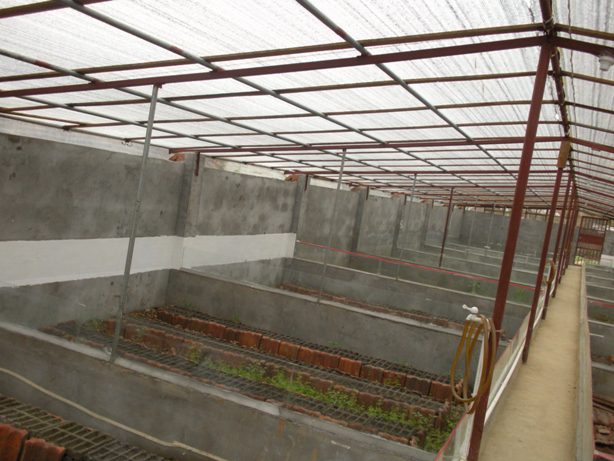
Centipede farm
In daily management, heated farming is basically the same as ambient-temperature farming, except for the following three points: first, pay attention to controlling the temperature and keep it between 20°C and 36°C; second, water evaporates faster, so a sufficient amount of water must be replenished in time; third, because the warming house is warm and ventilation is relatively poor, the feed left over by the centipedes must be cleaned up in time, so as to prevent it from rotting and deteriorating and producing an unpleasant smell.
III. Cross-farming method
So-called cross-farming means combining heated farming with ambient-temperature farming to achieve the goal of expanding the production scale to the maximum within a limited site. In the warm spring season, when the outdoor temperature rises above 20°C, the young centipedes in the warming house (about 5 cm) can be moved into ambient-temperature ponds for rearing, freeing up as much space in the warming house as possible. After four months of growth, the young centipedes moved into the ambient-temperature ponds can reach more than 12 cm, and at that point you can sell them. After this batch of centipedes is sold, if your warming-house rearing ponds are insufficient, you can continue to take out another batch of centipedes to rear in the ambient-temperature ponds. Repeating this can achieve the goal of expanding the production scale and obtaining the greatest economic benefit. The cross-farming method is especially suitable for farmers with their own small courtyard.