Detailed Explanation of Key Cultivation Techniques and Management Methods for Purple Sweet Potato
Sweet potato, also known as sweet potato, red sweet potato, white sweet potato, red yam, etc., is an annual plant of the Convolvulaceae family, cultivated in most parts of China except the Qinghai-Tibet alpine region. Over the past 20 years, more and more research results abroad have shown that sweet potato is rich in nutritional value. Sweet potato is rich in 18 amino acids, its dietary fiber content is 10 times that of rice and flour, and its vitamin E content is 9.5 times that of wheat. It is a physiologically alkaline food that maintains the acid-base balance needed for human health. Selenium-enriched purple sweet potato is a new sweet potato variety introduced and planted in Pinghu City from the Provincial Academy of Agricultural Sciences. After successful trial planting in 2007, it was tested by the Ministry of Agriculture Agricultural Product Quality Safety Supervision and Inspection Testing Center (Zhejiang). The organic selenium content per kilogram of fresh sweet potato reached more than 0.01 mg, and the anthocyanin content per kilogram of fresh sweet potato reached 200 mg. Regular consumption can improve immunity, lower blood pressure, and protect the liver.
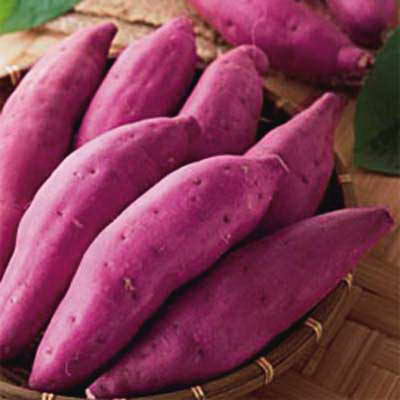
Purple Sweet Potato
I. Biological Characteristics
Purple sweet potato prefers a warm climate environment. The suitable growth temperature for stems and leaves is 18-25°C, and growth stops when the temperature is below 15°C. The optimum soil temperature for tuberous root growth is 22-24°C, and expansion stops when the soil temperature is below 20°C. Purple sweet potato is a short-day crop and requires sufficient light and high intensity. During the growth period of purple sweet potato, the suitable soil moisture is 60%-80% of the maximum field water-holding capacity.
II. Cultivation Technical Measures
1. Variety Selection
Purple sweet potato originated in Japan, with the variety name Chuanshanzi, successfully bred by Japanese researchers in the late 1990s. China began introducing it in 2002. Today, many varieties of purple sweet potato have been bred in China. Some are used for natural pigments and are not suitable for fresh eating, with high starch content, low moisture, and a relatively dry taste, making them more suitable for pigment extraction, whole flour processing, and snack food processing. One type of selenium-enriched purple sweet potato has the scientific name "Yu Zi 263". It is a new selenium-enriched purple sweet potato variety with purple skin, delicate purple flesh, sufficient moisture, and a sweet but not dry taste. It has a sweet and glutinous flavor and is an extremely ideal coarse grain option for people. It is more suitable for fresh eating, and most importantly, it is rich in selenium, a trace element beneficial to human health.
2. Land Selection and Fertilization
Selenium-enriched purple sweet potato is suitable for planting in paddy fields with relatively high terrain and convenient drainage and irrigation. Deep plowing and ridge planting are used, with small ridges and single rows, ridge width 40 cm, and ridge height 25 cm. Fertilization should follow the principles of increasing base fertilizer, heavily applying potassium fertilizer, and supplementing phosphorus fertilizer. The base fertilizer is mainly bio-organic fertilizer, applied at 300 kg per mu, combined with an appropriate amount of compound fertilizer. 15-15-15 compound fertilizer is applied at 10 kg per mu in bands. Topdressing should be mainly decomposed human manure and urine.
3. Timely Early Planting:
Selenium-enriched purple sweet potato is generally planted once a year. When the field temperature is stable above 15°C, the earlier the cuttings are inserted, the better. Generally, spring sweet potato is best planted by cuttings in mid-May. Planting can be done as late as before the end of July, but this affects the yield of selenium-enriched purple sweet potato.
III. Improve Cutting Quality and Reasonable Close Planting.
Select disease-free vine tip seedlings, separate large and small seedlings, bury three leaves when planting, and insert the seedlings obliquely into the bed surface. The sweet potato seedling is 20 cm long, inserted obliquely into the soil for 3 nodes, with 2 nodes exposed above the soil surface. After cutting, apply decomposed human manure and urine as topdressing to ensure survival. After the cuttings survive, water frequently to keep the soil moist. Determine a reasonable cutting density according to different soil fertility and characteristics. The plant spacing is generally 25 cm, and the row spacing is 75 cm. About 3,500 purple sweet potato seedlings are planted per mu. Flat bed planting.
4. Strengthen Field Management.
(1) Prevent white grubs before planting. Iron Frog (3% phoxim granules) can be used for control, at 6 jin per mu, applied in furrows in the middle of each ridge, preferably in the evening.
(2) Immediately after planting, use 150-fold acetochlor per mu for chemical weeding, at 100 g per mu, adding 3 knapsack tanks of water for weeding. Check and replant seedlings 3-5 days after planting to ensure full stand.
(3) During the early growth stage, carry out timely intertillage and earthing up. Generally, intertillage 2-3 times, and combine intertillage and earthing up with ridge repair. Selenium-enriched purple sweet potato is most afraid of waterlogging, so it must be drained in time. When drought is severe, timely drought relief should be carried out if conditions permit. After the rows close, pull out large weeds.