How to Increase Pomegranate Yield? High-Yield Pomegranate Cultivation Techniques
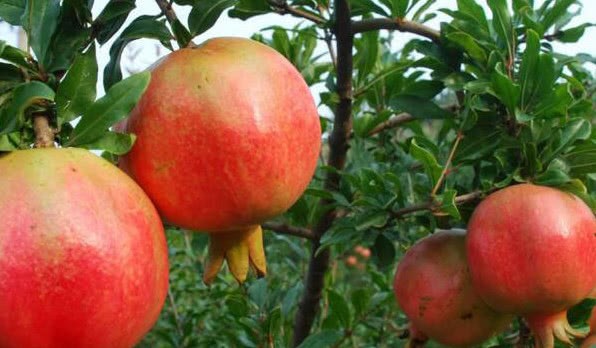
How to increase pomegranate yield is surely one of the primary concerns of every pomegranate grower. Pomegranate has a sweet, sour-astringent, warm nature and flavor, and possesses effects such as killing parasites, astringing, checking diarrhea, and stopping dysentery. It is one of the common fruits in our daily lives. Next, the editor will briefly explain the high-yield pomegranate cultivation techniques, hoping to be of some help to everyone.
1 Orchard Site Selection
Pomegranate is relatively fond of light, but too strong sunlight can cause sunburned fruit. Therefore, when selecting an orchard site, the following three points need to be considered: choose a location with sufficient sunlight for orchard establishment, with an average annual temperature of 16-20°C, annual accumulated temperature of 4,400-6,300°C, annual rainfall of 700-1,000 mm, and annual sunshine hours of 2,000-2,400 h; the selected plot should have certain irrigation conditions; choose flat land, gentle slope land, or mountain land with no pollution sources, convenient transportation, and deep, fertile soil, and plant in light clay soil or loam with good drainage, irrigation, and air permeability, with a pH value of 6-8.
2. Variety Selection
Select varieties that are excellent for early fruiting, high yield, and good quality, such as Tianlvzi, Tianguangyan, Houpi Tianshazi, Suanlvzi, etc.
3. Planting
Seedlings raised in nutrient bags can be planted in all four seasons, while seedlings not raised in nutrient bags are better planted in autumn and winter. Before planting, dig the planting pits according to the selected spacing between plants and rows. Each pit should be applied with 1 kg of ordinary calcium superphosphate and 25-50 kg of decomposed farmyard manure. First mix the decomposed farmyard manure with the ordinary calcium superphosphate, then mix thoroughly with the topsoil and fill into the pit, then backfill with subsoil. When planting, place the seedling in the center of the pit, fill the soil while gently lifting the seedling, so that the root system is tightly combined with the soil, and water thoroughly to settle the roots. Cover the tree disc with plastic film or rice straw. The planting spacing between plants and rows for Tianlvzi and Tianguangyan is 3 m x 4 m; for Houpi Tianshazi and Suanlvzi it is 4 m x 5 m.
4. Soil, Fertilizer, and Water Management
4.1 Soil Management
Intertillage and weeding: generally the intertillage depth is 5-10 cm. For orchards intercropped with green manure or vegetables, only the tree disc needs intertillage and weeding; intercropping and relay cropping: young orchards can be intercropped with vegetables or green manure, and mature orchards can be relay-cropped with vegetables after fruit harvest; tree disc mulching: choose any one of fallen leaves, weeds, straw, green manure, or plastic film to cover the tree disc, preventing soil moisture evaporation, which is beneficial to root growth and reduces the number of waterings.
4.2 Fertilizer and Water Management
For young trees, in October-December, dig a ring-shaped trench 40-50 cm from the trunk and apply 10-12 kg of decomposed farmyard manure per tree; in the spring of the second year, apply 50-100 g of compound fertilizer per tree in holes 40-50 cm from the trunk. For fruiting trees, apply base fertilizer in October-December with 50-100 kg of decomposed farmyard manure per tree and 2 kg of ordinary calcium superphosphate per tree. Apply topdressing 3-4 times each year. The first time is before the fruit tree has just sprouted but before flower buds appear (February-March), apply 1 kg of compound fertilizer per tree or 2-3 kg of ammonium bicarbonate mixed with ordinary calcium superphosphate per tree; the second time is during the young fruit stage (April-May), apply 0.5-1.0 kg of diammonium phosphate per tree, 0.5 kg of potassium sulfate per tree, or 1.0-1.5 kg of compound fertilizer per tree; the third time is in mid-June, apply 1.0-1.5 kg of compound fertilizer per tree; the fourth time is at the end of July, early-maturing varieties may skip this application, while late-maturing varieties apply 1 kg of compound fertilizer per tree. When the pomegranate tree sprouts, water thoroughly with sprouting water. Before the rainy season arrives, water in small amounts but frequently, generally once every 10-15 d; during the flowering period, flood irrigation is not suitable. If there is a long-term drought, water timely as well, but the amount of water should not be too much.
5. Training and Pruning
Common high-yield tree shapes for pomegranate: single-trunk open-center layered shape, three-main-trunk open-center shape, single-trunk three-main-branch shape. Next, the editor will specifically introduce the single-trunk open-center layered shape.
5.1 Young Trees
In the winter of the first year after planting, cut back at 80 cm on the upright trunk to establish the trunk, and during spring sprouting let the bud at the cut grow upright, and cut off excess sprouting branches, with the trunk height at about 50 cm. In the winter of the second year after planting, on the upright-growing central branch, select a point 80 cm from the first main branch and cut back. In the third year after planting, following the method of the second year, select and retain 2 branches as the third layer of main branches.
5.2 Full-Bearing Trees
Pruning of pomegranate trees during the full-bearing period mainly uses methods such as propping, pulling, hanging, cutting, twisting, kneading, and girdling, so that left and right do not affect each other, top and bottom do not overlap, every branch receives light, and every fruit faces the sun. First, winter pruning: cut off diseased and insect-damaged branches, thin and weak branches, water sprouts, and other useless branches; second, growing-season pruning: when vigorous spring shoots in the middle and lower parts of the main branches where there is space for growth reach 20-30 cm, pinch off the growing tips. Throughout the growing season, promptly remove useless sprouts, and cut off useless new shoots and shoots that would scratch the fruit, but appropriately retain new shoots that provide shade and protection for the fruit, to avoid producing "sun fruits."
6. Flower and Fruit Management
Suitable flower and fruit management techniques are the guarantee of consecutive years of high, stable yield and good quality in pomegranate trees. Flower and fruit management mainly has five points: first, strengthen fertilizer and water management, enhance tree vigor, and increase the proportion of normal flowers; second, for vigorously growing pomegranate trees, methods such as root cutting, pinching, branch twisting, branch bending, and branch pulling should be used to regulate the contradiction between branch growth and fruiting; third, manually remove empty flowers, cut back the flowering branches of degenerated flowers to vigorous positions, and cut off useless new branches inside the canopy, to increase the fruit-setting rate; fourth, during the flowering period, spray 0.2%-0.3% borax or amino acid foliar fertilizer at 500-600 times dilution, and during the young fruit stage spray foliar fertilizers such as 0.2%-0.3% monopotassium phosphate; fifth, following the principle of from top to bottom and from inside to outside, thin out diseased and insect-damaged fruits, deformed fruits, twin fruits, and excess small fruits.
7. Pest and Disease Control
Main pests and diseases of pomegranate: dry rot, brown spot, fusarium wilt, Bactrocera dorsalis, cotton bollworm, aphids, pomegranate mealybug, leopard moth, stink bug, thrips, etc.
Disease control measures: use Bordeaux mixture or lime sulfur mixture for winter orchard cleaning; gather and burn diseased fruits and diseased leaves on the ground; practice rational close planting, strengthen fertilizer and water management, and enhance tree vigor; for dry rot, use 75% chlorothalonil at 600-800 times dilution or 80% Daconil at 600-800 times dilution for control; for brown spot, use 10% Score at 1,500 times dilution or 50% dimethachlon at 600-800 times dilution for control.
Pest control measures: combined with orchard cleaning, eliminate overwintering sites of pests; hang yellow sticky boards to trap and kill pests with taxis such as Bactrocera dorsalis; choose insecticides such as chlorpyrifos, imidacloprid, profenofos, fenvalerate, and fenpropathrin for chemical control.
8. Harvest
Pomegranates can be harvested when the fruit skin is light yellow or white, the fruit surface is reddish and glossy, and the arils are pink or red. Handle gently while picking. After picking, grade the fruits according to different varieties, fruit size, smoothness of the fruit skin, etc.